
You have an extra $500 a month, or a bonus, or a tax refund. Part of you says to send it to the mortgage and be done with that debt years sooner. Another part says the money would grow faster in the market, and that paying down a loan you can comfortably afford is leaving money on the table. Both instincts can be right, which is why this question is so hard to settle with a slogan.
The good news is that the decision is less mysterious than it looks. It comes down to comparing one certain number (the interest rate on your loan) with one uncertain number (what your investments might earn after fees and taxes, with the possibility of a loss), and then asking whether you have the cushion, the time horizon and the temperament to live with the uncertain one.
This guide explains how extra payments really work, what to check in your loan documents, how the math plays out in a clearly hypothetical example, where taxes and liquidity enter the picture, and which steps usually come before either choice. It does not tell you what to do: it gives you the criteria to decide for yourself.
The trade-off in one sentence
Every extra dollar you send to your mortgage principal stops accruing interest at your loan's rate for the rest of the loan. In that sense, an extra payment earns a "return" equal to your interest rate: if your loan is at 6%, paying down the balance avoids 6% interest on that dollar. That saving is certain and does not depend on the stock market, on inflation or on anyone's forecast. You get it as long as you keep the loan paid down and the rate is fixed.
Investing the same dollar offers a return that may be higher or lower than your mortgage rate in any given period, and that can be negative. The SEC's Investor.gov explains that all investments involve some degree of risk, and that in general, as risks rise, investors look for higher returns to compensate. It also notes, for example, that large company stocks as a group have lost money on average about one out of every three years. A higher average return over decades does not tell you what happens in the ten years you actually need the money.
So the real question is not "which is better?" but "what is the price of certainty for me?" If your mortgage rate is high, the certain saving is attractive. If it is low, you are asking a modest, safe return to compete with investments that have historically offered more but with no promise.
How extra mortgage payments actually work
With a typical fixed-rate loan, your principal-and-interest payment stays the same for the life of the loan, but the split changes. The Consumer Financial Protection Bureau (CFPB) explains that early on, most of each payment goes to interest and the remainder to principal. As the balance falls, you owe less interest each month, so more of each payment goes to principal. This process is called amortization. The part of your payment that goes to principal reduces what you owe and builds your equity; the part that goes to interest does not.
An extra principal payment goes entirely against the balance. Because next month's interest is calculated on a smaller balance, a bit more of your regular payment then goes to principal too, and the effect snowballs. The CFPB says that even $100 more per month may reduce the loan term by several years, and advises you to check whether your loan allows extra payments and, if so, to make sure they are applied to principal rather than interest.
You generally have two ways to benefit:
- Shorten the term. Keep paying the same higher amount until the loan is gone sooner. Total interest falls, and you own the home free and clear earlier.
- Build equity faster without a new schedule. Make extra payments when you can. Your required monthly payment does not change, so the benefit is a lower balance and a shorter remaining term, but you keep the flexibility to stop.
Two practical points matter. First, an extra payment is not automatically applied to principal: tell your servicer how to apply it. Many servicers offer a "principal only" option online or on the payment coupon, and your statement should show the balance dropping by more than the scheduled amount. Second, extra principal does not replace the regular payment: you still owe the scheduled amount each month unless the servicer says otherwise in writing. Money sent to an escrow account for taxes and insurance does not reduce your loan balance either.
Two paths side by side
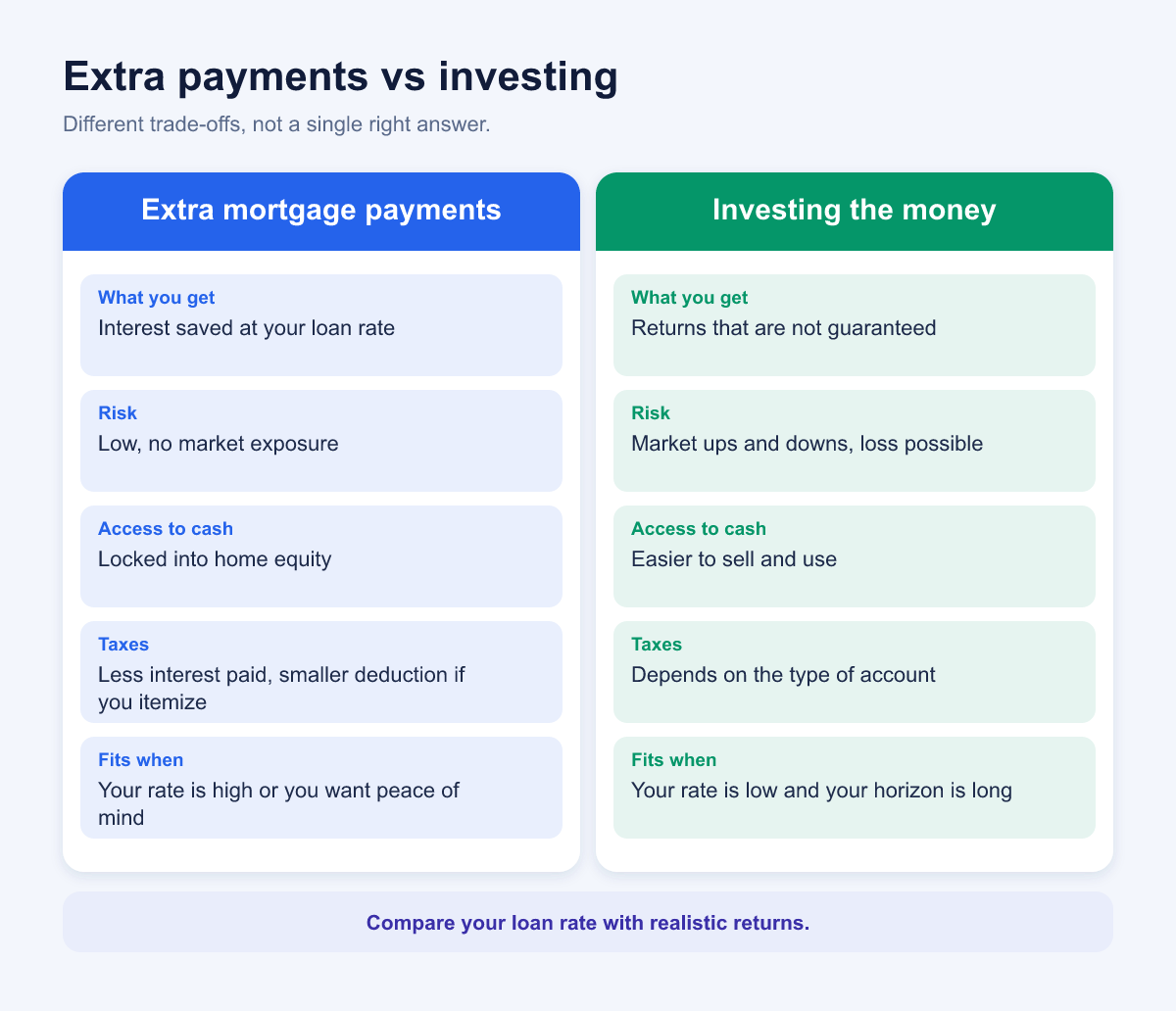
Before running numbers, it helps to see the two options along the same five dimensions: what you get, the risk, your access to the cash, taxes and when each fits.
What you get
With extra payments, you get interest saved at your loan rate, and a loan that ends sooner or a balance that is smaller. With investing, you get returns that are not guaranteed: the money may grow, stay flat or shrink. Your hoped-for return is a forecast, while your loan's rate is a contract.
Risk
Extra payments carry low risk, with no market exposure: the main risk is opportunity cost (you may earn less than the market would have paid). Investing means market ups and downs and the possibility of a loss, including a loss right when you need the money. Investor.gov also points out that a long horizon can justify taking more risk, while money you will need within about five years or less should not sit in risky investments because you may have to sell at a loss.
Access to cash
Extra payments are locked into home equity. You cannot take that money back out of the house with a phone call: you would need to sell the home, borrow against it (for example with a home equity line or a cash-out refinance, each with costs and qualification rules) or hope a lender agrees. Invested money in an ordinary account is easier to sell and use, although prices may be down on the day you sell, and some accounts (such as retirement accounts) have their own withdrawal rules.
Taxes
Extra payments mean less interest paid, so a smaller mortgage interest deduction if you itemize (more on this below). Investing is taxed depending on the type of account: returns in an ordinary taxable account, in a tax-deferred retirement account and in a Roth-type account are treated differently, and the difference can change the comparison materially.
Fits when
Extra payments tend to fit when your rate is high or you want peace of mind. Investing tends to fit when your rate is low and your horizon is long. Those two sentences are tendencies, not rules, which is why the next sections give you tools to test your own situation.
A hypothetical example with real arithmetic
Hypothetical example. The numbers below are invented round figures to show the mechanics. They are not forecasts, and they ignore taxes, fund fees, property taxes, insurance and inflation. Real investment returns are never smooth.
Assumptions: a $250,000 balance, a fixed 6% rate, 25 years (300 months) remaining. The regular principal-and-interest payment is about $1,610.75 a month. You have an extra $500 each month to deploy. The payment comes from the standard formula, M = L × i / (1 − (1 + i)−n), where L is the balance, i is the monthly rate (6% / 12 = 0.5%) and n is the number of months.
Path 1: send the extra $500 to principal
| Hypothetical result | Regular payments only | Regular payment + $500 extra |
|---|---|---|
| Monthly payment (principal and interest) | about $1,611 | about $2,111 |
| Months until the loan is paid off | 300 (25 years) | 180 (15 years) |
| Total interest paid | about $233,226 | about $129,612 |
| Interest saved | - | about $103,614 |
| Months saved | - | 120 (10 years) |
In this example, $500 a month for 15 years (a total of $90,000 of extra payments) removes about $103,600 of interest and ten years of payments. That outcome is certain as long as the rate is fixed and you keep up the payments.
Path 2: invest the extra $500 instead
Here you keep the regular schedule (the loan runs the full 300 months) and invest $500 at the end of each month. The ending value is the future value of an annuity: FV = P × ((1 + i)n − 1) / i, where P is the monthly deposit, i is the assumed annual return divided by 12 and n is the number of months. Over 300 months you would contribute $150,000. With a constant assumed return before taxes and fees:
- At an assumed 6%: about $346,497.
- At an assumed 8%: about $475,513.
Comparing fairly after 25 years
These two totals are not directly comparable, because in Path 1 you also stop paying the mortgage after year 15 and could invest the freed-up cash for the last 10 years. To compare like with like, the table below assumes you keep spending the same total each month ($2,110.75) in both paths. Path 1 puts it into the loan for 180 months, then invests the entire $2,110.75 for the remaining 120 months at the assumed return. Path 2 puts $1,610.75 into the loan for 300 months and invests $500 a month throughout.
| Assumed constant annual return (before taxes and fees) | Path 1: extra payments, then invest (value at month 300) | Path 2: invest $500 a month (value at month 300) |
|---|---|---|
| 0% (money not growing) | about $253,290 | $150,000 |
| 4% | about $310,808 | about $257,065 |
| 6% (same as the loan rate) | about $345,909 | about $346,497 |
| 8% | about $386,154 | about $475,513 |
Read the table as a map, not a prediction. When the assumed return equals the loan rate (6%), the two paths end up within rounding of each other: that is the break-even point, before taxes and fees. Below it, paying down the loan comes out ahead. Above it, investing does, but only if the return actually shows up every year, which is the part nobody can promise. A real 25-year stretch can include several bad years, and a bad year early in the period or close to the end matters differently than the long-run average suggests.
Another way to see the same thing: after 15 years the loan balance in the "regular payments" path would be about $145,086, while $500 a month invested at an assumed 6% would be about $145,409. Investing at the loan rate merely keeps pace with the debt. To come out ahead, the investments must beat the loan rate after costs, and the risk must be one you can tolerate.
Break-even and taxes
Your rate against a realistic net return
The comparison above suggests a simple test. Compare your mortgage rate with a realistic net return on the investments you would actually hold, meaning the return after fees, after taxes and adjusted for risk. Three adjustments matter:
- Fees. Fund expenses and advisory fees reduce what you keep. Our guide to index funds, ETFs and mutual funds explains how these costs show up.
- Taxes. In an ordinary taxable account, dividends and gains can be taxed. In a tax-advantaged account the treatment differs. The "return" from paying down a mortgage is interest you avoid paying, not income you receive.
- Risk. A certain 6% is not the same thing as an expected 6%. Because the market return is uncertain, many people want a clear margin over the loan rate before they take the risk. How much margin is a personal judgment; no official source sets it for you.
Hypothetical example. Suppose you assume investments average 8% a year before costs, fees take 0.5 percentage points and taxes take another 1.0 point. Net, that is 6.5% against a certain 6% from your loan. The 0.5-point edge is small and uncertain; a few weak years would erase it. Change any assumption (say, a 7% gross return) and the investing edge disappears. When the gap is this narrow, other factors (liquidity, peace of mind, your other goals) usually decide it.
Now think about the other side: if your loan carries a high rate, the "certain return" is difficult for a diversified portfolio to beat reliably after costs. If your rate is low, the certain return is modest and your money may have better uses.
Taxes: the mortgage interest deduction in general
IRS Publication 936 explains that home mortgage interest is deducted on Schedule A (Form 1040), that you must itemize deductions to claim it, and that the loan must be secured debt on a qualified home (a main home or a second home). Lenders generally report the interest to you on Form 1098. The rules also include debt limits and special situations; Publication 936 explains them.
Three practical consequences for this decision:
- It only helps if you itemize. If you take the standard deduction, your mortgage interest produces no separate federal tax benefit, so the "after-tax" cost of the loan is simply its rate.
- The benefit is never larger than the interest. Even for an itemizer, the deduction reduces taxes by a fraction of each dollar of interest, so paying less interest is still a net saving. Extra payments do shrink the deduction over time, but a lost deduction cannot outweigh the interest you no longer owe.
- Your situation changes it. Whether you itemize can change from year to year and with the tax rules in force, so ask a tax professional or check the IRS pages before treating the deduction as a reason either way.
On the investing side, the tax result depends on the account. Gains and income in a taxable account are generally taxable, while retirement accounts follow their own rules. For example, a pre-tax contribution to a workplace plan can reduce this year's taxable pay, which changes the arithmetic. Our comparison of 401(k) vs. Roth 401(k) shows how those accounts differ.
Before you send extra money: five checks
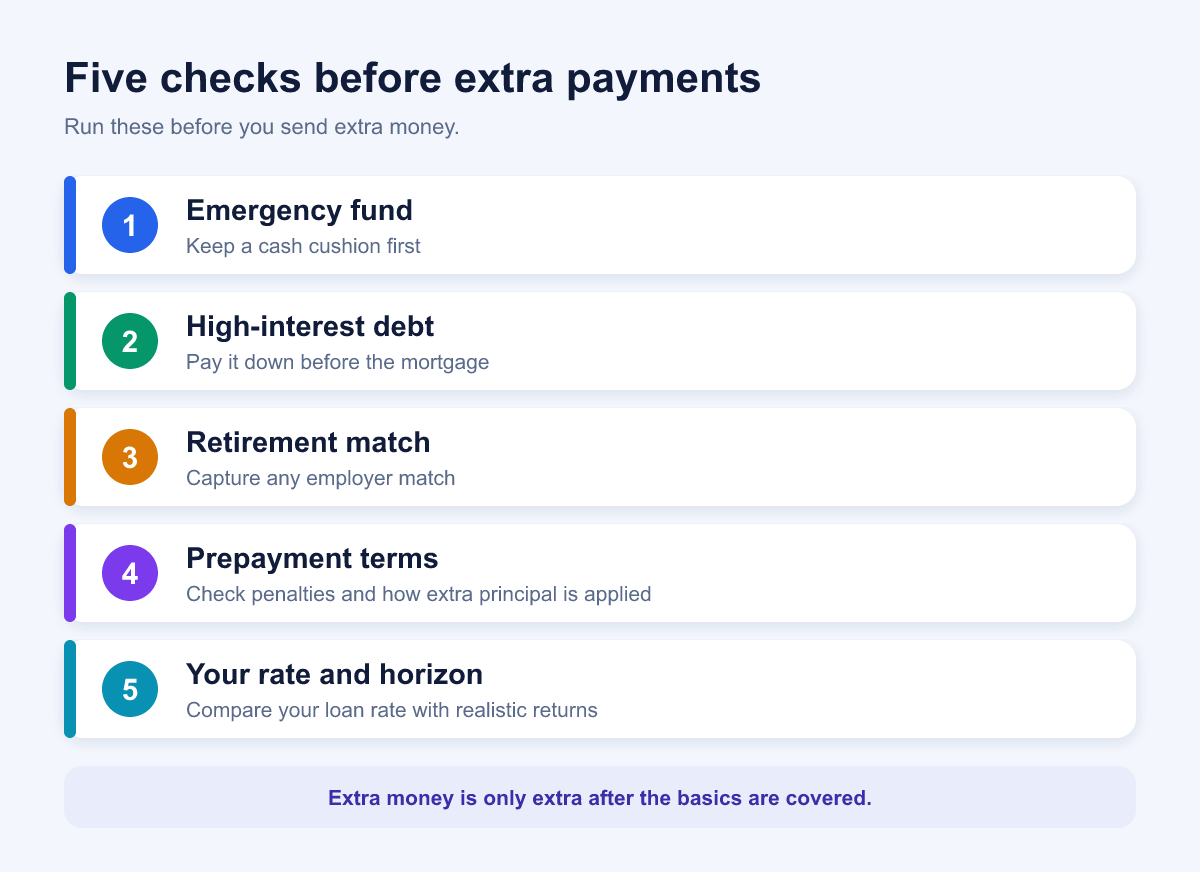
Whichever way you lean, five checks usually come first. Work through them in order: each one can change the answer before you get to the math.
1. Emergency fund: keep a cash cushion first
Money paid into a mortgage is hard to get back out, and a job loss or an unexpected repair is when you need cash most. Being house-rich and cash-poor is a real risk: a lender will not accept home equity at the grocery store. Build a cushion before you accelerate any loan; our guide to emergency funds covers how much to consider and where to keep it.
2. High-interest debt: pay it down before the mortgage
If you carry credit card or other high-rate debt, its interest rate is often higher than a mortgage rate. Compare the two rates: paying off a debt is a certain "return" at that debt's rate, so a higher-rate balance usually deserves attention before either extra mortgage payments or uncertain investing. The snowball and avalanche methods help you structure the payoff.
3. Retirement match: capture any employer match
If your employer matches contributions to a retirement plan, the match is an immediate addition to your pay that neither extra mortgage payments nor ordinary investing can replicate. Check what you must contribute to receive the full match and whether you are doing so. This is also where retirement accounts' tax treatment comes in.
4. Prepayment terms: check penalties and how extra principal is applied
The CFPB explains that a prepayment penalty is a fee some lenders charge if you pay off all or part of your mortgage early, and that not all mortgages have one. Typically, a penalty applies only if you pay off the entire balance (for example when you sell or refinance) within a specific number of years, usually three or five. In some cases it could apply if you pay off a large amount at once. Penalties do not normally apply if you pay extra principal in small chunks, but the CFPB advises double-checking with the lender.
Where do you look? Whether a loan carries a prepayment penalty must have been disclosed in your loan documents. The Loan Estimate you received and the closing documents flag it (the CFPB's Loan Estimate explainer describes a prepayment penalty as a risky feature), and sometimes it is only disclosed in an "Addendum to the Note," so look at the Note and anything with "Addendum" in the title. The CFPB adds that many states limit the amount or duration of these penalties, and that the periodic statement your servicer sends must show the penalty for paying off the loan early, if there is one. Then call or write your servicer and ask in plain terms: "Does my loan have a prepayment penalty, and how do I make sure extra payments go to principal?" Keep the answer in writing.
5. Your rate and horizon: compare your loan rate with realistic returns
Finally, do the comparison from the previous sections with your own numbers: your actual loan rate against a realistic net return, over a horizon that matches when you will need the money. A 4%-or-lower loan and a 30-year horizon is a very different setup from a 7% loan and a retirement in eight years.
Middle paths, recasting and refinancing
The decision is rarely all or nothing. Many people split the difference, and the options below let you adjust as your situation changes.
| Approach | How it works | What to watch |
|---|---|---|
| Split the extra cash | Send part to principal and invest the rest (for example half and half). | The split should reflect your rate, risk tolerance and goals, not a rule of thumb. |
| Round up the payment | Pay a slightly larger amount each month, with the difference marked "principal only." | Confirm the difference is applied to principal, not held or applied to future payments. |
| One extra payment a year | Use a bonus or refund for a single principal payment. | Flexible and easy to pause; a lump sum can matter if you have a prepayment penalty. |
| Biweekly schedule | Half-payments every two weeks add up to 26 half-payments, the equivalent of 13 monthly payments a year. | Some programs may charge fees, so read the terms and compare with simply adding about one-twelfth of your payment to each month as principal yourself. Confirm exactly when and how your servicer posts payments before signing up for anything. |
Two alternatives deserve a mention. A recast generally means the lender re-amortizes the loan after you make a large principal payment: the rate and term stay the same, but the monthly payment is recalculated on the lower balance. Whether it is available, and the fee, depends on the lender and the loan type, so ask your servicer. A refinance replaces the loan with a new one, which may change the rate or term but comes with closing costs. Our guide on the refinance break-even point shows how to weigh those costs, and the 15-year vs. 30-year mortgage guide explains how a shorter term changes the monthly payment and total interest.
When each path tends to fit, and three hypothetical households
There is no verdict that fits everyone, but there are criteria. Extra payments tend to look stronger when:
- your loan rate is high relative to what you realistically expect to earn after fees and taxes;
- you value a guaranteed result and the sleep that comes with owing less;
- you are close to a goal date (retirement, a child's college, a planned move) and do not want to rely on markets;
- you have no better use for the money (no high-interest debt, a funded cushion, a captured match).
Investing tends to look stronger when:
- your loan rate is low and your horizon is long;
- you can leave the money invested through downturns without selling;
- you have access to tax-advantaged accounts or an employer match not yet fully used;
- you want more liquid money rather than money locked into the house.
Investor.gov's guidance on risk tolerance is a useful frame: the right choice depends on when you will need the money, your goals and whether you would be able to sleep at night holding a risky investment. Here are three hypothetical households to show how the criteria interact. They are illustrations, not recommendations.
Household A: high rate, short horizon, wants certainty
Dana and Luis have a fixed 7% mortgage, a fully funded emergency fund, no other debt and a planned retirement in eight years. They worry about market swings so close to retiring. Because their rate is high, the certain saving is attractive, and their short horizon limits how much risk they want. For them, directing extra cash to principal fits their criteria, after confirming their loan has no prepayment penalty.
Household B: low rate, long horizon, unused match
Priya has a fixed 3.5% mortgage, 30 years until retirement and a workplace plan with a match she is not fully using. The match comes first. After that, her low loan rate makes a certain 3.5% saving modest compared with long-horizon investing, if she can tolerate volatility. Investing the extra cash tends to fit her criteria, with periodic checks of her risk tolerance and her emergency fund.
Household C: thin cushion and a credit card balance
Marcus has a 6% mortgage, about one month of expenses saved and a credit card balance with a much higher rate. For him, the mortgage-versus-investing question comes later. The first dollars go to a bigger cash cushion and to the card, and only then to a comparison like the one above.
Common mistakes to avoid
- Draining the emergency fund. Paying down the mortgage with money you may need next month turns a safe move into a risky one.
- Ignoring prepayment penalties. Read your Note and any addendum, and ask your servicer, before sending a large amount.
- Assuming market returns are guaranteed. A long-run average is not a promise for your 10 or 25 years. Plan with a range of outcomes, including a bad one.
- Ignoring taxes and fees. A "gross" return overstates what you keep; the deduction on your mortgage interest depends on whether you itemize.
- Not confirming extra goes to principal. Unlabeled extra money may be treated as an early payment of the next installment, which saves far less interest. Check your next statement.
- Locking up all your wealth in the house. Home equity is not cash. Getting it back out costs time and money and depends on lending conditions.
- Treating the question as permanent. You can change course: raise, lower or stop extra payments, or start investing, as your income, rate and goals change.
In summary
- An extra principal payment "earns" your loan's interest rate with certainty; investing offers uncertain returns that may be higher or lower and may be negative.
- In the hypothetical example, $500 extra per month on a $250,000, 6%, 25-year loan saves about $103,614 of interest and 120 months; investing the same $500 only beats that if the return is above the loan rate after fees and taxes.
- Check the five items first: emergency fund, high-interest debt, employer match, prepayment terms, then your rate versus realistic returns.
- Ask your servicer how extra payments are applied, and confirm in writing that they go to principal.
- The mortgage interest deduction only helps if you itemize; extra payments never lose you more in tax than they save in interest.
- Consider middle paths: split the money, round up, make one extra payment a year, or recast or refinance if it makes sense.
- Revisit the decision when your rate, income, risk tolerance or goals change.
This guide is general information, not financial, tax or legal advice. Your loan terms, taxes and goals are specific to you: consider speaking with a qualified professional, such as a HUD-approved housing counselor, a tax professional or a fiduciary financial planner, before deciding.
Frequently asked questions
Is paying extra on my mortgage a guaranteed return?
It is a certain saving of interest at your loan's rate, as long as the loan's rate is fixed and the extra payment is applied to principal. It is not a return in the sense of cash you can withdraw: the benefit is interest you never pay, and the money is locked into home equity.
Will I be charged a penalty for paying extra?
Not necessarily. The CFPB says not all mortgages have a prepayment penalty, that penalties typically apply when you pay off the whole loan within a few years (usually three or five), and that they do not normally apply to small extra principal payments. Whether yours does must have been disclosed in your loan documents. Check the Loan Estimate, the closing documents and the Note, and ask your servicer to confirm.
How do I make sure extra money goes to principal?
Use your servicer's "principal only" option (online, on the coupon or by written instruction), then check your next statement: the balance should drop by more than the scheduled principal amount. If it does not, contact the servicer promptly. The CFPB advises making sure extra payments are applied to principal rather than interest.
Does paying down my mortgage affect the mortgage interest deduction?
Yes: you pay less interest, so there is less interest to deduct. But the deduction is available only if you itemize (IRS Publication 936), and it only offsets a portion of each dollar of interest. See the IRS pages or a tax professional for your situation.
Should I invest through a retirement account instead of paying off the mortgage?
It depends on your employer match, the tax treatment of the account, your timeline and your risk tolerance. Capturing an employer match is usually a priority before extra mortgage payments, and retirement accounts can change the after-tax comparison. Our guide on 401(k) vs. Roth 401(k) explains the main differences.
What if I want both flexibility and a lower balance?
Consider a split: send part of the extra cash to principal and invest or save the rest. You could also make occasional lump-sum payments rather than committing to a higher required payment, and ask your servicer whether a recast is offered if you make a large payment.
Sources
- CFPB: Your mortgage servicer must comply with federal rules
- CFPB: How does paying down a mortgage work?
- CFPB: What is a prepayment penalty?
- CFPB: Can I be charged a penalty for paying off my mortgage early?
- CFPB: Loan Estimate Explainer
- Investor.gov (SEC): What is Risk?
- Investor.gov (SEC): Gauge Your Risk Tolerance
- IRS: Publication 936, Home Mortgage Interest Deduction