If you are new to investing, the vocabulary can feel like a trap. Someone tells you to buy an index fund. Someone else swears by ETFs. Your workplace plan offers a menu of mutual funds. It sounds like three different products competing for your money, and you are supposed to pick the right one.
Here is the key clarification that makes the rest easier: these terms do not sit on the same level. "Mutual fund" and "ETF" describe the structure of a fund, meaning how it is organized and how you buy and sell its shares. "Index fund" describes the strategy, meaning that the fund aims to follow a market index. An index fund can be a mutual fund, and it can be an ETF. So the comparison is less "index fund or ETF?" and more "which structure, following which strategy, at what cost?"
This guide explains each term using definitions from the U.S. Securities and Exchange Commission (SEC) and FINRA, compares how mutual funds and ETFs trade, price and charge fees, shows how a small difference in annual cost compounds over 20 years in a hypothetical example, and ends with a five-question method for comparing funds. It names no funds, companies or tickers, and it does not tell you what to buy: it is information to help you read a fund page with more confidence.
The three terms, defined
Mutual fund
The SEC describes a mutual fund as a registered open-end investment company that pools money from many investors and invests it in stocks, bonds, short-term money-market instruments, other securities or assets, or a mix. Each share represents your part ownership of the fund's portfolio and of its gains and losses. You buy shares from the fund itself, or through an investment professional such as a broker or adviser, and you sell (redeem) them back to the fund. Purchases and sales are priced at the fund's net asset value (NAV), which is typically calculated once at the end of each business day.
Exchange-traded fund (ETF)
An ETF is also a pooled fund, and its holdings are likewise usually managed by an SEC-registered investment adviser. The difference is how you trade it. Retail investors buy and sell ETF shares on a national stock exchange, at market prices that change throughout the trading day, so you generally need a brokerage account. This guide covers only ETFs registered under the Investment Company Act of 1940, which is the type the SEC describes. Other exchange-traded products, such as exchange-traded notes or commodity trusts, work differently and carry different risks.
Index fund
The SEC defines an index fund as a type of mutual fund or ETF that seeks to track the returns of a market index. A market index measures the performance of a "basket" of securities meant to represent a part of a stock market or an economy. You cannot invest in an index directly, so an index fund gives you an indirect way to hold something close to it. Some index funds hold every security in the index; others hold a representative sample.
That is the whole clarification in one line: an index fund is a strategy that can come in either wrapper. You can find an index mutual fund and an index ETF tracking the same index, and you can also find actively managed mutual funds and actively managed ETFs. The SEC notes that you can't always tell what a fund is from its name, so check the investment strategy section of the prospectus.
Active vs passive management
An actively managed fund relies on a manager's skill to pick investments, and may buy and sell without following an index. It has the potential to beat its benchmark, but the SEC points out that its results depend heavily on the manager. A passively managed fund tries to deliver approximately the return of an index, before fees. Passive funds tend to trade less, which can mean lower transaction costs, lower realized capital gains and lower fees, but the SEC also cautions that not every index fund is cheaper than every actively managed fund. Always check the actual cost of the specific fund.
Mutual funds and ETFs side by side
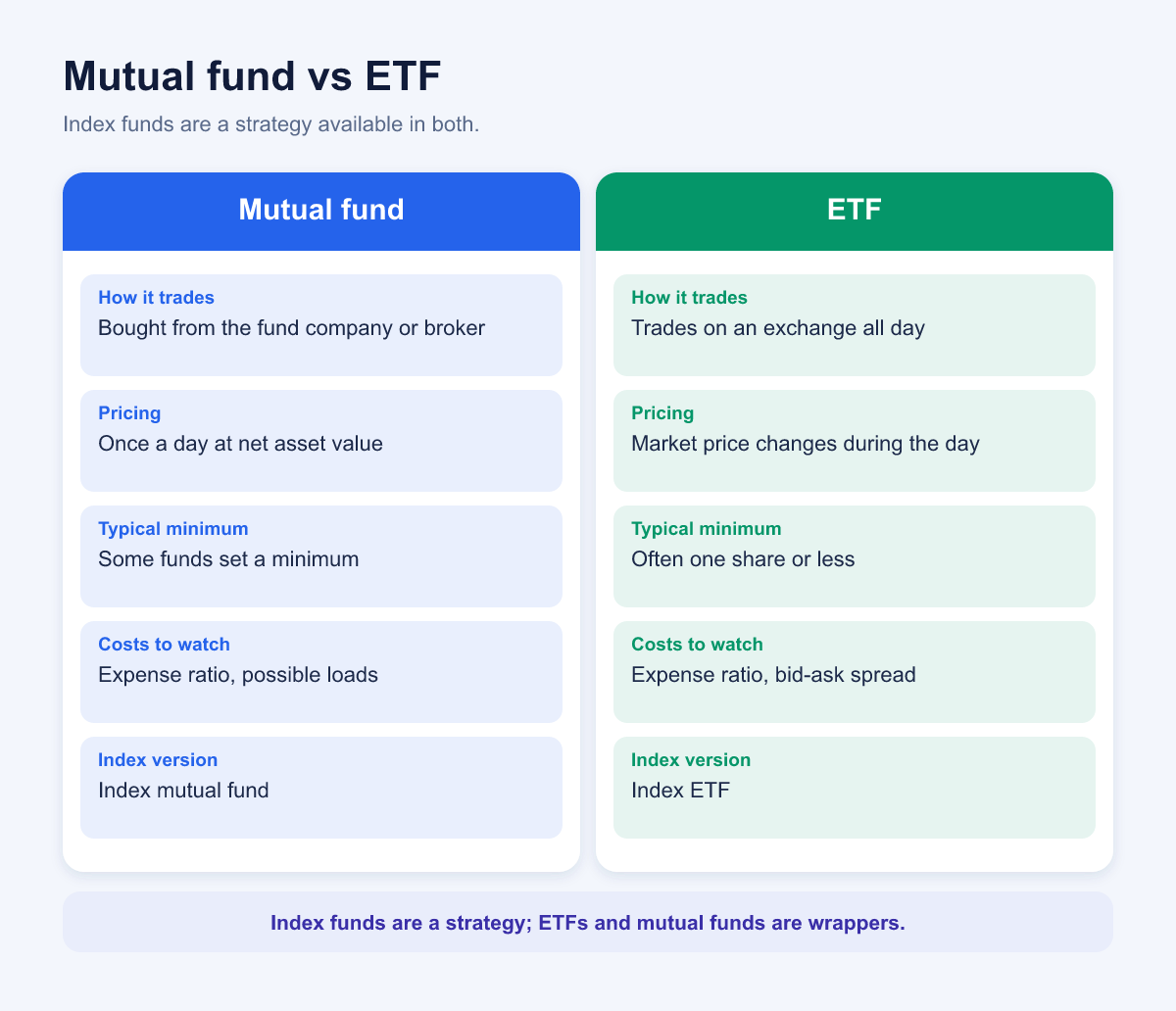
The figure below summarizes the five differences that matter most to a beginner. Index funds appear in the last row because they exist in both columns.
| Feature | Mutual fund | ETF |
|---|---|---|
| How it trades | Bought from the fund company or a broker | Trades on an exchange all day |
| Pricing | Once a day at net asset value | Market price changes during the day |
| Typical minimum | Some funds set a minimum | Often one share or less |
| Costs to watch | Expense ratio, possible loads | Expense ratio, bid-ask spread |
| Index version | Index mutual fund | Index ETF |
1. How it trades
With a mutual fund you place an order with the fund company or a broker, and the fund issues or redeems shares. With an ETF, the fund does not sell shares to ordinary investors directly: you buy from and sell to other market participants on an exchange, through a brokerage account. FINRA explains that large financial institutions called authorized participants create and redeem ETF shares with the fund in big blocks, and then investors trade those shares in the market.
2. Pricing
You can submit a mutual fund order at any time on a business day, but you will not know the exact price until the end of that day, when NAV is calculated. ETF shares trade at a price that moves while the market is open, so you can see a price before you trade. An ETF's market price can sit above or below its NAV (a premium or a discount), and while it usually stays close, the SEC notes it may vary significantly.
3. Typical minimum
Many mutual funds set a relatively low minimum for the first purchase and for later ones, but some require a larger starting amount, so check the prospectus. ETF shares can often be bought for relatively low dollar amounts, and many brokerages also allow fractional shares, although that is a brokerage feature that varies from one firm to another.
4. Costs to watch
Both structures charge an annual expense ratio, covered in the next section. Mutual funds may add sales loads or other shareholder fees. ETFs generally do not charge fees to investors when they buy or sell shares, but you may pay a broker commission and you face the bid-ask spread.
5. Index version
Whichever column you pick, you can choose an index strategy or an active one. An index mutual fund and an index ETF that track the same index hold similar things; what differs is the wrapper around them, meaning the trading mechanics, the fee structure and the tax behavior discussed below.
What funds really cost
The SEC states plainly that fees and expenses reduce your returns and that a fund with higher costs must perform better than a lower-cost fund to deliver the same result to you. Costs come in a few forms.
The expense ratio
Every mutual fund and ETF must show a standardized fee table in its prospectus. The total of the annual operating expenses, expressed as a percentage of the fund's average net assets, is the expense ratio. It includes management fees paid to the investment adviser, distribution (12b-1) fees where they apply, and other expenses such as legal, accounting and custodial costs. You do not receive a bill: the cost comes out of the fund's assets, so it quietly lowers the value of your shares.
Sales loads, 12b-1 fees and other shareholder fees
Some mutual funds charge a sales load, a fee that compensates the broker who sells the fund. A front-end load is deducted when you buy: the SEC's example is a 5 percent load on a $10,000 purchase, where $500 goes to the broker and $9,500 is invested. A back-end (deferred) load is charged when you sell. Funds may also charge redemption fees, exchange fees or account fees. 12b-1 fees pay for marketing and selling a fund and are named after the SEC rule that authorizes them; the SEC notes they typically apply to mutual funds, not ETFs. Funds that charge no sales load are often called no-load funds.
Trading costs for ETFs
Because an ETF trades like a stock, you may pay a brokerage commission each time you buy or sell, depending on your brokerage. You also face the bid-ask spread, which FINRA describes as the difference between the highest price a buyer will pay and the lowest price at which a seller will sell. FINRA adds that the spread can be almost zero for some products and much wider for others. For someone who buys on a regular schedule and rarely sells, spreads and commissions can matter more than they do for a one-time purchase, so it is worth knowing what your brokerage charges.
Costs the expense ratio does not show
The SEC warns that a fund's expense ratio does not include everything. Brokerage commissions, fees paid to a financial intermediary, and the trading costs a fund pays when it buys and sells its own holdings are not part of the ratio. A fund that advertises "zero fees" can still cost you money through these other channels, so read the whole fee picture.
| Cost | Who it can apply to | How you pay it |
|---|---|---|
| Expense ratio | Mutual funds and ETFs | Deducted from fund assets every year |
| Front-end or back-end sales load | Some mutual funds | Taken from your purchase or your sale proceeds |
| 12b-1 fee | Typically mutual funds | Part of the expense ratio |
| Redemption, exchange or account fee | Some mutual funds | Charged to you directly |
| Brokerage commission | ETFs, and some mutual funds bought through a broker | Per trade, depending on your brokerage |
| Bid-ask spread | ETFs | Built into the price you pay or receive |
FINRA offers a free Fund Analyzer that lets you model how the costs of different mutual funds and ETFs add up over time.
A hypothetical 20-year cost example
Small percentages sound harmless. This example shows why the SEC says even small differences in fees can mean large differences in returns over time.
Hypothetical example, for illustration only. Assumptions: you invest $10,000 once and add nothing more; the investments earn a constant 6 percent per year before costs; the only cost is the expense ratio, subtracted from that return each year; nothing is withdrawn, and taxes and trading costs are ignored. Real returns are never constant and can be negative, so treat the numbers as arithmetic, not a forecast.
Formula: ending value = $10,000 × (1 + 0.06 − expense ratio)20. For a 0.05 percent expense ratio, for example, the yearly growth rate is 5.95 percent, so $10,000 × 1.059520 ≈ $31,770.
| Assumed expense ratio | Net yearly return | Value after 20 years | Cost of fees vs. no fees |
|---|---|---|---|
| 0.00% (reference only) | 6.00% | $32,071 | $0 |
| 0.05% | 5.95% | $31,770 | $301 |
| 0.50% | 5.50% | $29,178 | $2,893 |
| 1.00% | 5.00% | $26,533 | $5,538 |
Under these assumptions, the gap between the 0.05 percent and 1.00 percent cases is about $5,237 on a $10,000 starting amount, which is more than half of the original investment. The point is not that any particular fund will earn 6 percent, or that the cheapest option is automatically right for you. The point is that cost is one of the few things you can see in advance, while future returns are unknown.
Taxes: taxable accounts vs retirement accounts
In a taxable brokerage account
Funds pay out money in two main ways: dividend payments (income from the fund's holdings, minus expenses) and capital gains distributions (gains realized when the fund sells holdings at a profit and passes them on at year end). According to the IRS, mutual funds and ETFs both pass dividend income through to shareholders, capital gain distributions are always reported as long-term capital gains, and they are reported to you on Form 1099-DIV. In a taxable account, you generally owe tax on these distributions for the year they are paid, even if you reinvest them.
The SEC and FINRA explain why ETFs often distribute less. Many ETFs buy and sell portfolio securities through in-kind exchanges (swapping securities rather than selling them for cash), which typically leads to fewer capital gains distributions and so potentially lower taxes than a similar mutual fund. Notice the careful wording: "typically" and "might." It is not a guarantee, it depends on the specific fund, and you still owe tax on any gain when you sell your own shares. Index funds in either structure also tend to trade less than active funds, which can limit realized gains, as the SEC notes.
In a tax-advantaged account
Inside a 401(k) or an IRA, the SEC states there is no tax difference between an ETF and a mutual fund. Distributions do not create a yearly tax bill in the same way, and the rules that matter are those of the account itself: contribution limits, when you can withdraw, and whether the account is traditional or Roth. If you are weighing account types, our guides on Roth vs traditional IRAs and on 401(k) vs Roth 401(k) plans cover that side. In many workplace plans the fund menu is fixed, so your choice may be between a few mutual funds, and the tax angle disappears while cost still matters.
Reading a fund's prospectus and fact sheet
Funds make their key facts available for free: on the fund's website, by contacting the fund or a broker, or through the SEC's EDGAR database. You do not need to read every page. A short checklist gets you most of the value:
- Investment objective and strategy. Does it say it tracks an index? Which one? Is it described as passive or active? The SEC suggests asking how the makeup of the index is determined.
- The fee table. Find shareholder fees (loads, redemption and account fees) and annual operating expenses, ending in the total that equals the expense ratio. The table also includes a hypothetical example of what you would pay over different time periods.
- Risks. An index fund takes on the general risks of the securities in its index. The SEC also names tracking error (the fund may not follow its index perfectly, especially if it holds only a sample) and underperformance versus the index because of fees and trading costs.
- Holdings. Look at what the fund owns and how concentrated it is. Some funds are far less diversified than their names suggest.
- Turnover. A higher turnover rate means more buying and selling inside the fund, which FINRA links to higher transaction costs.
- Share classes (mutual funds). The same fund can come in several share classes with different fee structures, so confirm which class you are looking at.
- Shareholder reports. Funds deliver reports twice a year with expenses and holdings.
How to choose: a five-question method
You do not need to guess which product is "best." A better approach is to answer a few questions in order, and let the answers narrow the field. These are criteria, not recommendations.
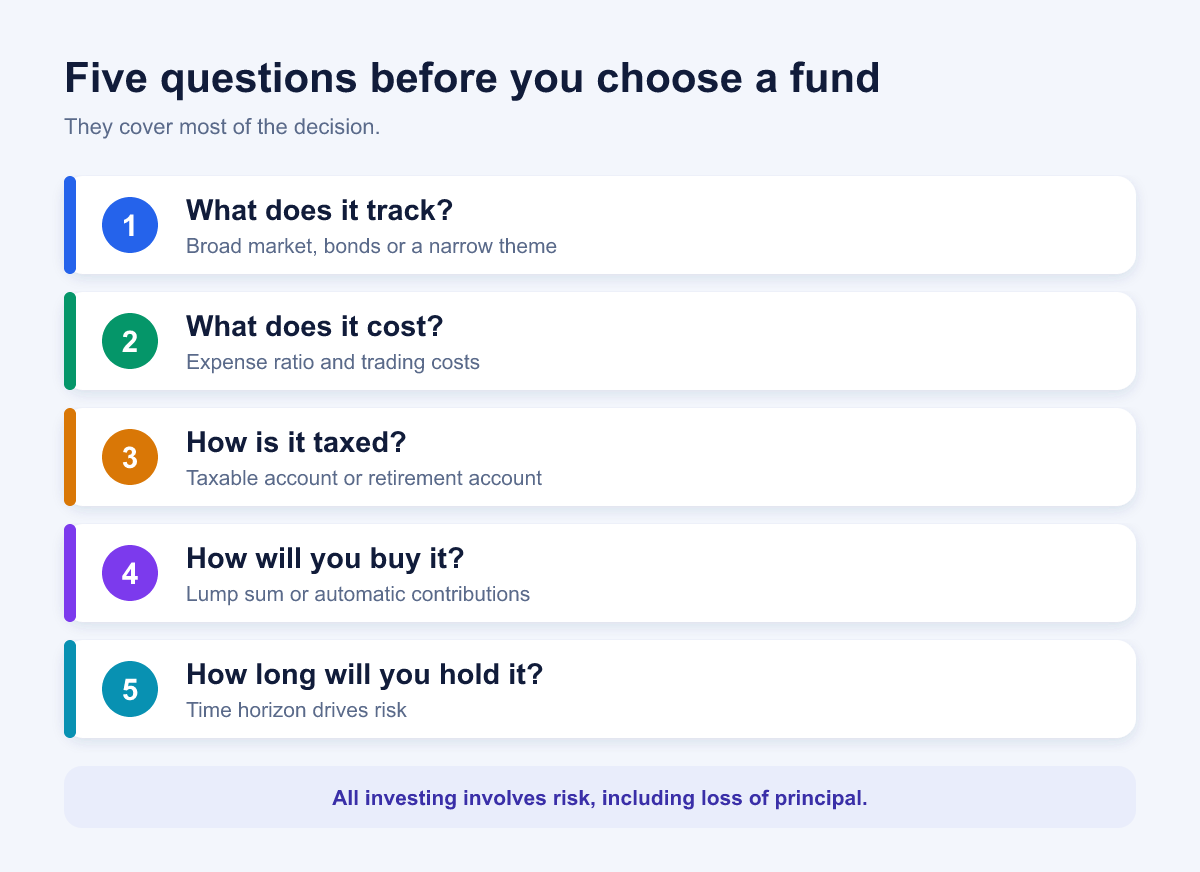
1. What does it track?
Start with the exposure, not the wrapper. Does the fund follow a broad market index, a bond index or a narrow theme such as one industry? A broad index spreads your money across many companies; a narrow one can rise and fall far more sharply. Also read how the index is built, because indexes can weight their holdings in different ways, for example by market capitalization or by share price.
2. What does it cost?
Compare expense ratios for funds that track the same kind of index, then add the costs that sit outside the ratio: loads for mutual funds, commissions and bid-ask spreads for ETFs. Two funds tracking nearly the same index are close substitutes, so a cost gap is easy to see.
3. How is it taxed?
In a retirement account the structure makes no tax difference. In a taxable account, ask how often the fund has distributed capital gains and whether an ETF or a mutual fund version suits the way you plan to hold it. A tax professional can answer questions about your own situation.
4. How will you buy it?
Ask whether you will invest a lump sum or small amounts on a schedule, and what your platform supports. Some mutual funds set minimums but allow automatic investments; ETFs need a brokerage account, and costs per trade depend on that brokerage. If you plan to invest every month, the cost per purchase matters.
5. How long will you hold it?
Time horizon drives how much market risk you can sit through. Money you may need within a few years has a different job than money you will not touch for decades. Before choosing funds, many people first look at whether they have a cash cushion (see our emergency fund guide) and whether high-interest debt is better handled first (see debt snowball vs debt avalanche).
Three hypothetical beginners
These profiles are invented to show how the questions work. They are not recommendations.
- Maya, early in her career. She contributes each paycheck to a workplace plan with a short menu of mutual funds. Her questions: Which options track an index? What is each fund's expense ratio? Because she is inside a retirement plan, the ETF-versus-mutual-fund tax question does not apply to her.
- Daniel, with a lump sum in a taxable account. He received a bonus and wants to invest part of it. Before the fund choice, he checks his cash cushion. Then his questions are: Does he want to invest it all at once or in steps? Which structure might distribute fewer taxable gains? What does his brokerage charge per trade?
- Priya, building an IRA over many years. She plans small monthly deposits. Her questions: Does her brokerage allow fractional shares or automatic investments? Does the fund have a minimum? How will fees and spreads add up over many small purchases?
Dollar-cost averaging, fractional shares and automatic investing
Dollar-cost averaging means investing equal amounts at regular intervals, regardless of market conditions. FINRA explains that this pattern means you buy more shares when the price is low and fewer when it is high, which sometimes results in a lower average price per share, and that it can take some emotion out of investing. FINRA also notes the limits: money waiting on the sidelines may earn less than if it had been invested right away, so spreading purchases out can reduce risk while lowering expected returns. FINRA also points out that regular paycheck contributions to a 401(k) are already a form of dollar-cost averaging.
Hypothetical example. You invest $100 a month for four months. The price per share is $10, $8, $10 and $12. You buy 10, 12.5, 10 and 8.33 shares, which is about 40.83 shares for $400, or about $9.80 per share on average, while the simple average of the four prices is $10.00. The method does not guarantee a profit or protect against a falling market: the result depends entirely on the prices that happen to occur.
Fractional shares and automatic investing are brokerage and fund-company features rather than features of the fund type. Some brokerages let you buy part of an ETF share for a dollar amount, and many brokerages and fund companies let you schedule recurring purchases. Rules, minimums and costs vary, so check your provider's terms and fee schedule before relying on them.
Risk and common mistakes
All investing involves risk. The SEC states that mutual funds and ETFs are not guaranteed or insured by the FDIC or any other government agency, and that you may lose some or all of the money you invest. An index fund does not remove market risk: it takes on the general risks of the securities in its index, so a fund that tracks a falling market falls with it. Diversification can lower the risk that one company's failure hurts you, but it cannot remove the risk of the market as a whole. Common mistakes follow from that.
- Confusing "index" with "ETF." They are different layers. An index fund can be a mutual fund, and an ETF can be actively managed.
- Chasing past performance. The SEC says a fund's past performance does not predict future returns. It can tell you how volatile a fund has been, which is useful, but not what comes next.
- Ignoring fees. A small percentage repeated every year is the cost that compounds in the example above. Include loads, commissions and spreads, not just the expense ratio.
- Overlapping funds. Holding several funds that track similar indexes can mean owning the same companies many times, while adding costs without adding diversification. Look at holdings, not only names.
- Ignoring the structure's trading rules. With ETFs, check the spread and avoid assuming the price equals NAV; with mutual funds, remember the price is set at day's end.
- Panic selling. Selling after a drop locks in the loss and can mean missing a later recovery. A written plan and a time horizon you chose in advance make this easier to resist.
- Investing money you may need soon. Money you expect to need within a few years is often kept in savings products rather than in market funds, because fund prices can be lower on the day you need to sell.
In summary
- Mutual fund and ETF are structures; index fund is a strategy that can use either structure.
- Mutual funds are priced once a day at NAV; ETFs trade on an exchange at changing prices during the day.
- The expense ratio is charged every year inside the fund; also check loads, 12b-1 fees, commissions and bid-ask spreads.
- In a taxable account, funds can distribute taxable dividends and capital gains; ETFs typically distribute fewer capital gains. In a 401(k) or IRA, the SEC says there is no tax difference between the two.
- Index funds reduce some costs but still carry market risk, tracking error and the possibility of loss.
- Read the prospectus fee table, the index it follows, the holdings and the turnover before you buy.
- Use the five questions: what it tracks, what it costs, how it is taxed, how you will buy it and how long you will hold it.
- Dollar-cost averaging spreads out purchases; it does not guarantee a gain or prevent a loss.
- Check your cash cushion and high-interest debt before you invest money you may need soon.
This guide is general information, not financial, tax or legal advice. Fees, rules and products change, and your situation is unique. For decisions about your own money, read the fund's official documents and consider speaking with a qualified professional.
Frequently asked questions
Is an index fund the same as an ETF?
No. An index fund is a fund that aims to track an index. An ETF is a fund that trades on an exchange. The SEC defines an index fund as a type of mutual fund or ETF, so the same index can be tracked by an index mutual fund or an index ETF.
Are ETFs cheaper than mutual funds?
Not automatically. Costs depend on the individual fund. ETFs generally do not charge sales loads, and 12b-1 fees typically apply to mutual funds, but ETF investors may pay commissions and the bid-ask spread, and plenty of mutual funds have low expense ratios and no loads. Compare the total cost of the specific funds you are considering, including your brokerage's fees.
Do I need a brokerage account to buy an ETF?
The SEC explains that you generally need a brokerage account to buy, sell and hold ETF shares, since retail investors trade ETFs on an exchange. Mutual fund shares can be held directly with the fund company or through a broker or adviser.
Why do some funds have a minimum investment?
Some mutual funds set a minimum for the initial purchase or for later purchases, and some charge account fees if your balance falls below a threshold. ETF shares can often be purchased for relatively low dollar amounts. Minimums are listed in the prospectus or on the fund company's website, and they vary from fund to fund.
Can I lose money in an index fund?
Yes. Index funds are not insured or guaranteed. An index fund takes on the risks of the securities in its index, so if the index falls, the fund generally falls too. It may also trail its index slightly because of fees, trading costs and tracking error.
Does it matter whether I hold a fund in an IRA or a regular account?
It can matter a lot. In a taxable account, dividends and capital gains distributions can create a yearly tax bill, and the ETF versus mutual fund structure may affect how large that is. In a 401(k) or IRA, the SEC states there is no tax difference between the two structures, though the account's own rules apply.
Sources
- Investor.gov (SEC): Index Funds
- Investor.gov (SEC): Mutual Funds
- Investor.gov (SEC): Exchange-Traded Funds (ETFs)
- SEC Investor Bulletin: Characteristics of Mutual Funds and Exchange-Traded Funds (ETFs)
- SEC Investor Bulletin: Mutual Fund and ETF Fees and Expenses
- FINRA: Exchange-Traded Funds and Products
- FINRA: The Benefits and Limitations of Dollar-Cost Averaging
- IRS: Topic no. 404, Dividends and other corporate distributions