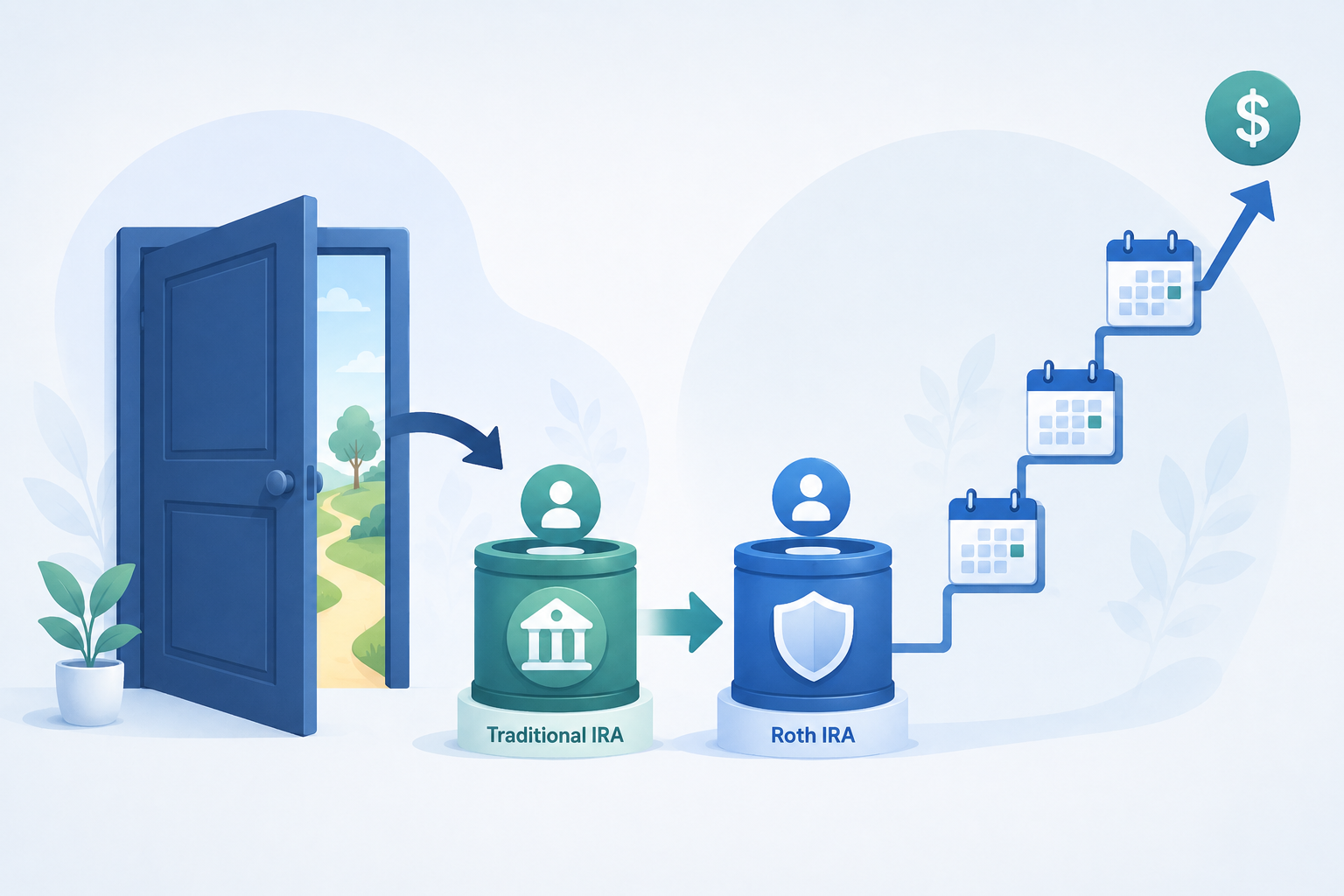
One of the most consequential financial decisions you will make in your working years is also one that millions of Americans delay, guess at, or get wrong: choosing between a Roth IRA and a Traditional IRA. Both are powerful tax-advantaged retirement accounts. Both allow your money to grow free of annual capital gains taxes. But they differ fundamentally in when you pay taxes — and that timing difference can be worth tens of thousands of dollars over a lifetime of saving.
This guide explains how each account works, who benefits most from each, what the current contribution and income rules look like in 2026, and how to make a confident decision based on your personal situation.
What Is a Traditional IRA?
A Traditional IRA (Individual Retirement Account) is a tax-deferred retirement savings account. Contributions may be tax-deductible in the year you make them, depending on your income and whether you have access to a workplace retirement plan like a 401(k). Your money grows without being subject to annual taxes on dividends, interest, or capital gains. You pay income taxes when you withdraw the money in retirement.
Traditional IRA Key Rules
- Contributions: up to $7,000 in 2026 ($8,000 if you are 50 or older, thanks to the catch-up contribution provision). These limits apply to the total across all IRAs you own — not per account.
- Tax deductibility: if neither you nor your spouse is covered by a workplace retirement plan, contributions are fully deductible regardless of income. If you or your spouse is covered by a workplace plan, deductibility phases out at higher income levels (see details below).
- Required Minimum Distributions (RMDs): the IRS requires you to begin withdrawing a minimum amount each year starting at age 73 (per the SECURE 2.0 Act, effective 2023). Failing to take RMDs results in a 25% excise tax on the amount that should have been withdrawn (reduced from the prior 50% penalty).
- Early withdrawal penalty: withdrawals before age 59.5 are subject to a 10% penalty plus ordinary income taxes, with certain exceptions (first home purchase up to $10,000, qualified education expenses, disability, certain medical expenses, and a few others).
- No income limit for contributions: anyone with earned income can contribute to a Traditional IRA regardless of how much they earn, though the deductibility of those contributions may be limited.
Traditional IRA Deductibility Phase-Out Ranges (2026)
If you are covered by a workplace retirement plan:
- Single or head of household: phase-out between $79,000 and $89,000 of modified adjusted gross income (MAGI)
- Married filing jointly (contributor covered): phase-out between $126,000 and $146,000
- Married filing jointly (spouse covered, not the contributor): phase-out between $236,000 and $246,000
Above the upper threshold, Traditional IRA contributions are no longer deductible. You can still contribute — these are called nondeductible contributions — but they track separately using Form 8606 and create a "basis" in your IRA that is not taxed again on withdrawal.
What Is a Roth IRA?
A Roth IRA is a tax-free retirement savings account. You contribute money that has already been taxed (after-tax dollars), your money grows completely tax-free, and qualified withdrawals in retirement are entirely tax-free. There are no required minimum distributions during your lifetime, making the Roth IRA uniquely flexible for estate planning and late-career tax management.
Roth IRA Key Rules
- Contributions: same limits as Traditional IRA — $7,000 in 2026 ($8,000 if 50 or older). Again, this limit is shared across all your IRAs.
- No tax deduction: contributions are made with after-tax money and are never deductible.
- Tax-free qualified distributions: withdrawals of both contributions and earnings are completely tax-free if you are at least 59.5 years old and the account has been open for at least five years.
- Contributions can be withdrawn anytime: this is one of the Roth IRA's most underappreciated features. You can withdraw your original contributions (not earnings) at any time, at any age, without penalty or tax. This makes the Roth IRA an accessible emergency backup as well as a retirement vehicle.
- No RMDs during your lifetime: unlike Traditional IRAs and 401(k)s, Roth IRAs do not require you to take distributions at any age. Your money can continue to grow tax-free for as long as you live, or pass to heirs who then have up to 10 years to withdraw the funds (also tax-free under current rules).
- Income limits for direct contributions: Roth IRA contributions phase out at higher income levels, unlike Traditional IRAs.
Roth IRA Income Phase-Out Ranges (2026)
- Single, head of household, or married filing separately (if you lived apart all year): phase-out between $150,000 and $165,000 of MAGI
- Married filing jointly: phase-out between $236,000 and $246,000
- Married filing separately (if you lived with your spouse): phase-out begins at $0 and ends at $10,000 — effectively barring most married couples filing separately from contributing
Above the upper threshold, you cannot make direct Roth IRA contributions. (But high earners have a workaround — see the Backdoor Roth section below.)
Side by Side Comparison
| Feature | Traditional IRA | Roth IRA |
|---|---|---|
| Tax on contributions | Pre-tax (deductible, if eligible) | After-tax (never deductible) |
| Tax on growth | Tax-deferred | Tax-free |
| Tax on qualified withdrawals | Ordinary income tax | Zero |
| 2026 contribution limit | $7,000 / $8,000 (50+) | $7,000 / $8,000 (50+) |
| Income limit for contributions | None (deductibility limited) | Phase-out at $150k–$165k (single) |
| Required Minimum Distributions | Yes, starting at age 73 | No (during lifetime) |
| Early withdrawal of contributions | Taxed and penalized | Always penalty-free |
| Best for | High tax bracket now, lower in retirement | Lower bracket now, higher later |
When a Traditional IRA Is the Better Choice
You Are Currently in a High Tax Bracket
The Traditional IRA's core advantage is the upfront tax deduction. If you are in the 32%, 35%, or 37% federal tax bracket today, a $7,000 deductible contribution reduces your federal tax bill by $2,240 to $2,590 in the year you make it. If you expect to be in a lower tax bracket in retirement — say 22% or 24% — the math favors deferring taxes now and paying them later at the lower rate.
You Expect Lower Income in Retirement
If you anticipate a significant income reduction in retirement — no more business income, no salary, and relatively modest Social Security benefits — a Traditional IRA can deliver exactly what it promises: tax-deferred savings that you draw down at a lower effective rate than you would pay today.
You Need to Lower Your Taxable Income Now
For some taxpayers, a Traditional IRA deduction can push income below a critical threshold — qualifying for a lower tax bracket, avoiding the Medicare IRMAA surcharge, or preserving eligibility for other deductions and credits. Consult a tax professional to model whether the deduction has outsized benefits in your specific situation.
You Are Close to Retirement
For someone 55 to 65, the time horizon for tax-free growth in a Roth is shorter, making the immediate deduction value of a Traditional IRA relatively more attractive. However, this calculus depends heavily on whether you plan to use the funds early in retirement (when Roth flexibility matters less) or want to preserve tax-free assets for late-stage retirement or legacy planning.
When a Roth IRA Is the Better Choice
You Are Early in Your Career
If you are in your 20s or early 30s and currently in a low tax bracket (22% or below), the Roth IRA is usually the superior choice. You pay taxes at today's low rate, and your money then grows for 30 to 40 years completely tax-free. The compound effect of decades of tax-free growth is extraordinary. A 25-year-old who contributes $7,000 per year to a Roth IRA and earns an average annual return of 7% will have approximately $1.7 million by age 65 — all of it tax-free.
You Expect Tax Rates to Rise
This is not a political prediction — it is a legitimate planning consideration. The current reduced federal income tax rates established by the Tax Cuts and Jobs Act of 2017 are scheduled to sunset after 2025, reverting to higher pre-2017 rates unless Congress acts. Many financial planners recommend using Roth accounts aggressively while rates are relatively low, as future tax rates are an unknown that tilts toward Roth in many scenarios.
You Want Flexibility and No RMD Pressure
The absence of required minimum distributions in a Roth IRA makes it ideal for tax planning in retirement. You can leave the Roth untouched while drawing from Traditional accounts first, allowing the tax-free balance to continue growing. Or you can make large Roth withdrawals in years when you have other deductions to offset income. This flexibility is particularly valuable in retirement, when managing taxable income can affect Medicare premiums, Social Security taxation, and capital gains rates.
You Want to Pass Wealth to Heirs
A Roth IRA is one of the best legacy assets you can leave to heirs. Unlike Traditional IRAs, which require heirs to pay income tax on every dollar they withdraw, inherited Roth IRA distributions are tax-free (subject to the 10-year distribution rule established by the SECURE Act). For estate planning purposes, a Roth IRA can provide a significant tax-free inheritance.
You Have an Emergency Fund but Want Extra Flexibility
Because Roth contributions (not earnings) can be withdrawn at any time without penalty, the Roth IRA can serve double duty as a retirement account and an accessible backup fund. While using Roth funds for non-retirement purposes is not ideal — every dollar withdrawn early is a dollar that misses decades of compound growth — the psychological security of knowing the money is accessible if truly needed can make it easier to commit to consistent contributions.
The Backdoor Roth IRA: A Strategy for High Earners
If your income exceeds the Roth IRA contribution limits ($165,000 for singles, $246,000 for married couples in 2026), you cannot make direct Roth contributions. But you can use the Backdoor Roth IRA strategy:
- Make a nondeductible contribution to a Traditional IRA (anyone can do this, regardless of income)
- Convert the Traditional IRA balance to a Roth IRA
Because you contributed after-tax money and are converting immediately (before any earnings accumulate), there is typically little or no taxable income generated by the conversion. The result: Roth IRA contributions for high earners who would otherwise be ineligible.
There is an important complication called the pro-rata rule. If you have other pre-tax money in any Traditional IRA (including SEP IRAs and SIMPLE IRAs), the IRS treats all your IRA dollars as a pool when calculating the taxable portion of a conversion. If you have a large existing Traditional IRA balance, the Backdoor Roth becomes much less efficient. Consult a tax advisor to evaluate whether this applies to your situation and whether rolling your pre-tax IRA into a 401(k) (if your plan allows it) can clear the way for a clean Backdoor Roth conversion.
Can You Have Both a Traditional IRA and a Roth IRA?
Yes. You can maintain both types of IRA simultaneously. However, the total combined contributions to all your IRAs cannot exceed the annual limit — $7,000 in 2026 ($8,000 if 50 or older). You could contribute $4,000 to a Roth and $3,000 to a Traditional in the same year, for example. Having both types can provide tax diversification: you are effectively hedging against future tax rate changes by holding both taxable-in-retirement and tax-free-in-retirement assets.
IRA vs 401(k): Getting the Order Right
Most financial advisors recommend the following contribution priority order:
- Contribute enough to your 401(k) to get the full employer match. This is free money and an immediate 50% to 100% return, making it the highest priority regardless of IRA type.
- Max out your IRA (Roth or Traditional, depending on your situation). The IRA typically offers more investment flexibility than a 401(k), with access to virtually any publicly traded security rather than the limited fund menu most plans offer.
- Return to your 401(k) and contribute up to the IRS limit ($23,500 in 2026, or $31,000 for those 50 and older with catch-up contributions) if you have additional savings capacity.
A Framework for Making the Decision
If you are uncertain which account is right for you, ask yourself these questions:
- What is my current marginal tax rate? Below 22%: lean Roth. At 24% to 32%: consider both or Traditional. At 35% to 37%: Traditional often wins.
- Do I expect my tax rate to rise or fall in retirement? Rising: Roth. Falling: Traditional. Unknown (the most common answer): diversify across both.
- Do I value flexibility? If you might need access before retirement, Roth contributions provide a penalty-free option.
- Do I have heirs I want to leave tax-free assets? Roth IRAs are powerful legacy assets.
- Am I above the Roth income limits? Use the Backdoor Roth if you want Roth benefits.
The Bottom Line
The Roth IRA vs Traditional IRA debate is ultimately a question of tax timing and tax rate prediction. For younger workers in lower brackets, the Roth IRA's decades of tax-free growth are extremely hard to beat. For high earners in peak earning years who expect lower income in retirement, the Traditional IRA's immediate deduction is genuinely valuable. For many Americans in the middle, holding both types provides the best of both worlds — flexibility, tax diversification, and the option to manage taxable income strategically in retirement.
The most important thing is not getting the choice exactly right on the first try — it is simply starting. Every year you delay contributes to a smaller eventual retirement balance. Open whichever account makes sense today, contribute consistently, and revisit the choice annually as your income, tax bracket, and financial picture evolve. A fee-only financial advisor or CPA can model the long-term impact of each option based on your specific numbers, which is worth doing at any income level.