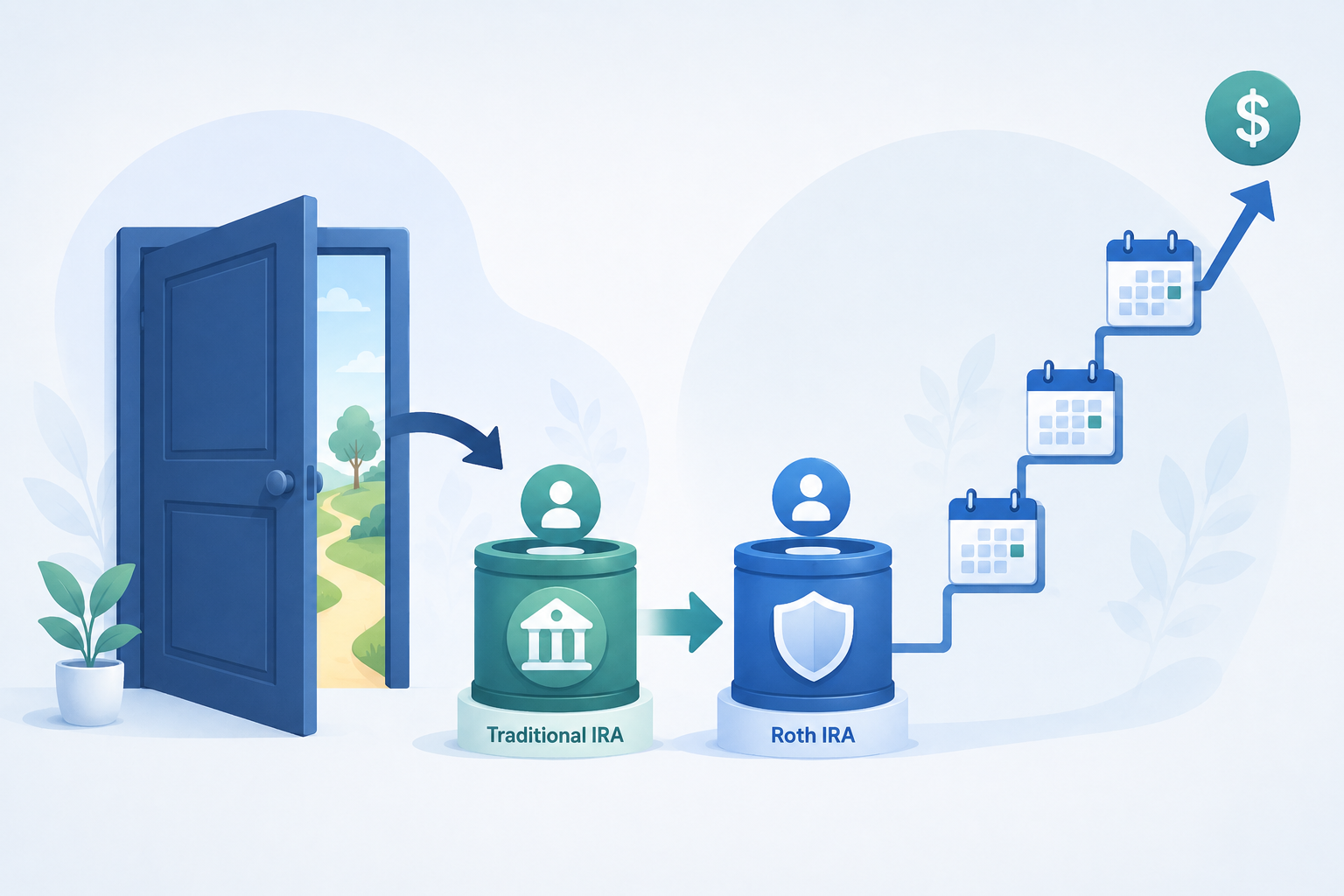
Choosing between a Traditional IRA and a Roth IRA is one of the most important retirement planning decisions you will make, since the two account types are taxed in fundamentally different ways and each suits different financial situations. A Traditional IRA offers an upfront tax deduction with taxable withdrawals in retirement, while a Roth IRA offers no upfront deduction but completely tax free withdrawals later in life. This guide explains exactly how each account works, the current 2026 contribution limits, and how to determine which option, or combination of both, best fits your income level and retirement timeline.
What Is a Traditional IRA and How Does It Work?
A Traditional IRA is a tax advantaged retirement account that allows you to contribute pretax or tax deductible dollars, reducing your taxable income in the year you contribute. The money then grows tax deferred until you withdraw it in retirement, at which point withdrawals are taxed as ordinary income.
Because the tax deduction happens now while the tax bill on withdrawals happens later, a Traditional IRA is often most beneficial for people who expect to be in a lower tax bracket during retirement than they are during their working years, since this allows them to defer paying tax until a time when their overall rate is likely to be lower.
What Is a Roth IRA and How Does It Work?
A Roth IRA works in the opposite way, since contributions are made with after tax dollars, meaning you receive no upfront tax deduction. In exchange for giving up that immediate benefit, your money grows completely tax free, and qualified withdrawals in retirement are entirely tax free as well, including all investment growth.
This structure makes a Roth IRA particularly attractive for people who expect to be in the same or a higher tax bracket in retirement than they are today, since paying tax now at a known rate can be more advantageous than paying an unknown, potentially higher rate later in life.
What Are the 2026 IRA Contribution Limits?
For 2026, the IRS allows a combined total contribution across all your Traditional and Roth IRAs of up to seven thousand five hundred dollars, or eight thousand six hundred dollars if you are age fifty or older, taking advantage of the additional catch up contribution allowed for older savers.
This limit applies to your total contributions across every IRA you hold, meaning if you contribute to both a Traditional IRA and a Roth IRA in the same year, the combined total across both accounts still cannot exceed this overall annual limit set by the IRS for 2026.
Are There Income Limits That Restrict Roth IRA Contributions?
Unlike a Traditional IRA, which generally has no income limit preventing you from contributing, though your ability to deduct the contribution may be limited, a Roth IRA has strict income limits that can reduce or completely eliminate your ability to contribute directly once your income exceeds certain thresholds set annually by the IRS.
Higher income earners who exceed the Roth IRA income limits sometimes use a strategy called a backdoor Roth conversion, contributing to a Traditional IRA first and then converting those funds to a Roth IRA, though this strategy involves specific tax considerations that are worth discussing with a tax professional before attempting it.
How Does the Tax Deduction Work for Traditional IRA Contributions?
Whether your Traditional IRA contribution is fully deductible depends on whether you or your spouse are covered by a retirement plan at work, such as a 401k, and your household income level, since the deduction phases out at higher income levels for people with access to a workplace retirement plan.
If neither you nor your spouse has access to a workplace retirement plan, your Traditional IRA contribution is generally fully deductible regardless of your income level, making this an especially valuable tax planning tool for self employed individuals or those without employer sponsored retirement benefits.
When Can You Withdraw Money From Each Type of IRA Without Penalty?
Both Traditional and Roth IRAs generally impose a ten percent early withdrawal penalty on earnings withdrawn before age fifty nine and a half, in addition to any regular income tax owed, though several exceptions exist for situations such as a first time home purchase, certain educational expenses, or significant medical costs.
A key advantage of the Roth IRA is that you can withdraw your original contributions, though not the earnings, at any time without tax or penalty, since you already paid tax on that money before contributing it, giving Roth IRA holders more flexibility in emergencies compared to Traditional IRA holders.
Do Traditional and Roth IRAs Have Required Minimum Distributions?
Traditional IRAs require you to begin taking required minimum distributions starting at a specific age set by current law, forcing you to withdraw and pay tax on a minimum amount each year whether or not you actually need the money for living expenses at that point in your life.
Roth IRAs, by contrast, have no required minimum distributions during the original account holder's lifetime, allowing the money to continue growing tax free for as long as you choose, which makes the Roth IRA a particularly effective tool for estate planning and passing wealth to heirs.
Which Account Type Is Better for Younger Savers Early in Their Career?
Younger workers early in their careers are often in a lower tax bracket than they will likely be later in life as their income grows, making a Roth IRA especially attractive since they can pay tax on contributions now at a relatively low rate and enjoy tax free growth for decades afterward.
Additionally, younger savers have a longer time horizon before retirement, meaning the tax free growth offered by a Roth IRA has more time to compound, potentially resulting in a significantly larger tax free balance by the time they actually need to access the money in retirement.
Which Account Type Is Better for Higher Income Earners Closer to Retirement?
Higher income earners closer to retirement who expect their tax bracket to drop once they stop working often benefit more from a Traditional IRA, since the immediate tax deduction can provide meaningful tax savings during their remaining higher earning years while they are still in a relatively high bracket.
For these savers, the ability to defer taxation until retirement, when they anticipate falling into a lower bracket due to reduced income, can result in paying a lower overall tax rate on that money compared to paying tax on Roth contributions at their current higher rate.
Can You Contribute to Both a Traditional and a Roth IRA in the Same Year?
Yes, you can contribute to both account types in the same year, as long as your combined contributions across both accounts do not exceed the overall annual IRA contribution limit, and you meet the income eligibility requirements for making Roth IRA contributions directly.
Splitting contributions between both account types can provide valuable tax diversification in retirement, giving you flexibility to draw from either taxable Traditional IRA funds or tax free Roth IRA funds depending on your income needs and tax situation in any given retirement year.
What Happens If You Withdraw Traditional IRA Funds Before Retirement?
Withdrawing funds from a Traditional IRA before age fifty nine and a half generally triggers both ordinary income tax on the withdrawn amount and an additional ten percent early withdrawal penalty, making early withdrawals a costly way to access retirement savings except in genuinely necessary circumstances.
Certain exceptions allow penalty free early withdrawals, such as using up to a specific lifetime limit for a first time home purchase or covering qualified higher education expenses, though regular income tax would still apply to these early withdrawals even when the penalty itself is waived.
How Do Roth Conversions Work for Existing Traditional IRA Balances?
A Roth conversion allows you to move funds from an existing Traditional IRA into a Roth IRA, paying ordinary income tax on the converted amount in the year of conversion in exchange for future tax free growth and withdrawals, potentially useful during a temporary low income year.
Many people strategically time Roth conversions during years when their income is unusually low, such as during a career transition or early retirement before required minimum distributions begin, since converting funds during a lower income year can result in paying tax at a meaningfully lower rate than converting during a peak earning year.
How Should You Decide Which IRA Type Fits Your Situation?
Deciding between a Traditional and Roth IRA ultimately comes down to comparing your current tax rate against your expected tax rate in retirement, along with considering factors like your income eligibility for Roth contributions, your need for tax flexibility, and your broader estate planning goals.
Many financial advisors recommend a blended approach for savers who are uncertain about their future tax situation, contributing to both account types over time to build tax diversification that provides flexibility no matter how tax laws or your personal financial circumstances change between now and retirement.
How Do IRAs Compare to Employer Sponsored Retirement Plans Like a 401k?
Unlike an employer sponsored 401k, an IRA is opened and managed entirely on your own through a brokerage or bank, giving you complete control over your investment choices rather than being limited to the specific fund lineup offered by an employer's retirement plan administrator.
IRAs also generally allow much lower annual contribution limits than a 401k, meaning many savers use an IRA as a supplemental retirement account alongside an employer sponsored plan, particularly once they have contributed enough to their 401k to capture any available employer matching contribution.
What Investment Options Are Typically Available Within an IRA?
Most IRA providers offer access to a wide range of investment options, including individual stocks, bonds, mutual funds, and exchange traded funds, giving you significantly more flexibility and choice than the limited menu of options typically found within an employer sponsored 401k plan.
This broader investment selection allows you to build a more customized portfolio tailored specifically to your risk tolerance and retirement timeline, though it also requires taking a more active role in selecting and periodically rebalancing your investments compared to a more simplified employer plan.
How Do Fees Differ Between Traditional and Roth IRA Providers?
Fees associated with an IRA depend primarily on the specific brokerage or financial institution you choose, rather than on whether the account is a Traditional or Roth IRA, since the tax treatment itself does not directly affect the account maintenance or investment fees charged by the provider.
Comparing account fees, investment expense ratios, and any account minimums across different IRA providers before opening an account can help you avoid unnecessary costs that would otherwise erode your investment returns over the many years your money remains invested before retirement.
What Happens to an IRA When the Account Holder Passes Away?
Both Traditional and Roth IRAs can be passed to a named beneficiary upon the original account holder's death, though the tax treatment for the beneficiary differs depending on the account type, with inherited Roth IRA withdrawals generally remaining tax free while inherited Traditional IRA withdrawals remain taxable.
Since rules governing inherited IRAs have changed significantly in recent years, including new required distribution timelines for many non spouse beneficiaries, it is important for both account holders and their designated beneficiaries to understand the current inherited IRA rules well before they become relevant.
Should Self Employed Individuals Consider a SEP IRA Instead?
Self employed individuals and small business owners sometimes find that a SEP IRA, which allows significantly higher contribution limits based on a percentage of business income, better serves their retirement savings goals compared to a standard Traditional or Roth IRA with its much lower annual contribution limit.
A SEP IRA can often be used alongside a personal Traditional or Roth IRA, allowing self employed savers to potentially maximize retirement contributions across multiple account types, though the specific contribution rules and limits for a SEP IRA differ meaningfully from a standard IRA and are worth researching separately.
Frequently Asked Questions About Traditional and Roth IRAs
Below are answers to some of the most common questions people have when comparing Traditional and Roth IRAs.
Can I roll over my 401k into either type of IRA?
Yes, you can generally roll over a Traditional 401k into a Traditional IRA without triggering immediate tax, or roll over a Roth 401k into a Roth IRA, though rolling Traditional 401k funds into a Roth IRA would trigger tax on the converted amount, similar to a standard Roth conversion.
Is there an age limit for contributing to an IRA?
No, there is no longer an age limit for contributing to either a Traditional or Roth IRA, as long as you have qualifying earned income for the year and meet the income requirements applicable to Roth IRA contributions specifically.
What happens to my IRA if I change jobs?
Your IRA is completely independent of your employer, so changing jobs has no effect on an existing IRA, though you may choose to roll over funds from a former employer's retirement plan into your IRA to consolidate your retirement accounts.
Can my spouse contribute to an IRA if they do not work?
Yes, a spousal IRA allows a nonworking spouse to contribute based on the working spouse's taxable compensation, as long as the couple files a joint tax return and their combined contributions do not exceed their combined taxable compensation for the year.
Do I have to choose only one type of IRA and stick with it forever?
No, you can adjust your contribution strategy from year to year based on your changing income and tax situation, contributing more heavily to a Traditional IRA in some years and shifting toward a Roth IRA in others as your circumstances evolve over time.
Can I still contribute to an IRA if I am already retired but have part time income?
Yes, as long as you have qualifying earned income from part time work or self employment during the year, you can continue contributing to an IRA regardless of your age, provided you also meet any applicable income limits for Roth IRA eligibility that year.
Does opening an IRA affect my eligibility for other tax credits or deductions?
Contributing to a Traditional IRA can lower your adjusted gross income, which may help you qualify for certain other tax credits and deductions tied to income thresholds, making it worth reviewing your full tax situation alongside a tax professional before finalizing your annual contribution strategy for the year ahead and beyond.
What happens to my IRA if I move to a different state before retirement?
Your IRA remains fully intact and unaffected if you move to a different state, since IRAs are federally regulated retirement accounts that are not tied to any particular state, though the state tax treatment of your eventual withdrawals may vary depending on where you live when you retire.
Choosing between a Traditional and Roth IRA, or using a combination of both, is a highly personal decision that depends on your current income, expected retirement tax bracket, and broader financial goals, and taking time to carefully evaluate these factors will help you build a retirement savings strategy that minimizes your lifetime tax burden while maximizing your long term financial security, whether retirement is decades away or just around the corner for you and your family.