
Whenever mortgage rates dip, the same message shows up in your inbox: "Refinance now and lower your payment." Sometimes that is true. Sometimes the lower payment is paid for with thousands of dollars in closing costs, a longer loan term, or both, and the homeowner moves out before the math ever works in their favor. A refinance is not a prize you win for noticing a lower rate. It is a new loan, with its own costs, and it has to earn its keep.
This guide gives you a simple way to decide. You will see what a refinance is, the most common reasons to do one (and to skip one), what closing costs usually include, and the break-even calculation that tells you how many months it takes to recoup those costs. You will also see how a "no-closing-cost" offer changes the math, how resetting your loan term can raise your total interest, and how to compare offers using the Loan Estimate. All dollar amounts in worked examples are hypothetical and use round numbers so you can follow every step.
What a refinance is
A mortgage refinance means taking out a new mortgage and using it to pay off your existing one. You end up with a new interest rate, a new loan term, and often a new lender, even though you still live in the same house. Because it is a brand-new loan, you go through an application, a credit check, a valuation of the home, and a closing, much like you did when you bought.
Rate-and-term refinance
In a rate-and-term refinance (also called a non-cash-out refinance), the new loan is roughly the size of what you still owe. The point is to change the interest rate, the length of the loan, the type of rate (for example, adjustable to fixed), or some combination. This is the type this guide focuses on.
Cash-out refinance
In a cash-out refinance, you borrow more than you owe and receive the difference as cash. The Consumer Financial Protection Bureau (CFPB) describes it as a loan in which the homeowner borrows an amount substantially greater than what they owe on the existing mortgage, which increases the mortgage balance. Because the new loan replaces the original mortgage and uses your home as collateral, it carries its own risks and costs. That is a different decision with different trade-offs; if that is what you are considering, read our comparison of a cash-out refinance vs a HELOC for home improvements.
Reasons to refinance, and reasons to wait
Common reasons to refinance
- A lower interest rate. If market rates have fallen since you took out your loan, or your credit and finances have improved, a new loan may carry a lower rate and a lower principal-and-interest payment.
- A shorter term. Moving from a 30-year to a 15-year loan usually raises the monthly payment but can cut the total interest dramatically. The CFPB notes that shorter terms generally save money overall, in part because the interest rate is usually lower. See our 15-year vs 30-year mortgage comparison for the full picture.
- Switching from an adjustable-rate to a fixed-rate loan. With an adjustable-rate mortgage (ARM), the rate can go up and down after the initial fixed period, and the CFPB warns the payment could go up a lot. A fixed rate trades a possibly higher starting rate for payments that stay the same.
- Dropping mortgage insurance. If you have an FHA loan, you pay FHA mortgage insurance premiums (MIP). Once your equity has grown, some homeowners refinance into a conventional loan to get out of FHA insurance. Our guide to FHA vs conventional loans explains how MIP and private mortgage insurance (PMI) differ. HUD notes that, for FHA mortgages with a case number assigned on or after June 3, 2013, the insurance can be terminated if the mortgage is paid in full before its maturity date, which is what happens when the loan is refinanced. Ask your servicer how your own loan works.
- Removing PMI on a conventional loan. If you pay PMI, you may not need a refinance at all. Federal rules give you the right to request cancellation once your balance is scheduled to reach 80 percent of the home's original value, and PMI generally ends automatically at 78 percent, if you are current on payments. Check this first, because cancelling PMI costs far less than a refinance.
Common reasons to wait or skip it
- You may move soon. If you sell before you recoup the closing costs, the refinance loses money.
- You would reset the clock. Starting a new 30-year loan when you are ten years into your old one can lower the payment but increase the total interest you pay.
- The closing costs are high compared with the savings. A small rate drop on a small balance may never pay for itself.
- Your finances or home value have changed. A lower credit score, less equity, or higher debts can mean you are offered a worse rate than you have today.
- Your current loan has a prepayment penalty. The CFPB explains that a prepayment penalty is a fee some lenders charge if you pay off the mortgage early, and it can apply if you pay off the whole balance, for example by refinancing, within a set number of years. Check your loan documents.
Closing costs and the break-even calculation
What refinance closing costs usually include
A refinance has upfront costs, just like a purchase. The CFPB groups the costs of taking out a mortgage into several categories, and most apply to a refinance too:
- Origination and lender charges: what the lender charges to make the loan. They may be labeled origination, application, underwriting, processing or administrative fees. The CFPB's advice is that the total is what matters, however the lender itemizes it.
- Points: an optional upfront charge paid to lower your interest rate. One point equals one percent of the loan amount.
- Third-party costs: services required to get the loan, such as the appraisal and title insurance. You can shop separately for some of them.
- Government fees: charges tied to recording the transaction, which generally do not vary based on which lender you use.
- Prepaid expenses and deposits: for example, interest from closing to the end of the month, and initial deposits into an escrow account for property taxes and homeowners insurance.
No single percentage applies to every loan, so do not rely on a rule of thumb you saw online. Your own Loan Estimate lists the total closing costs for your specific offer, and that is the number to use.
The break-even formula
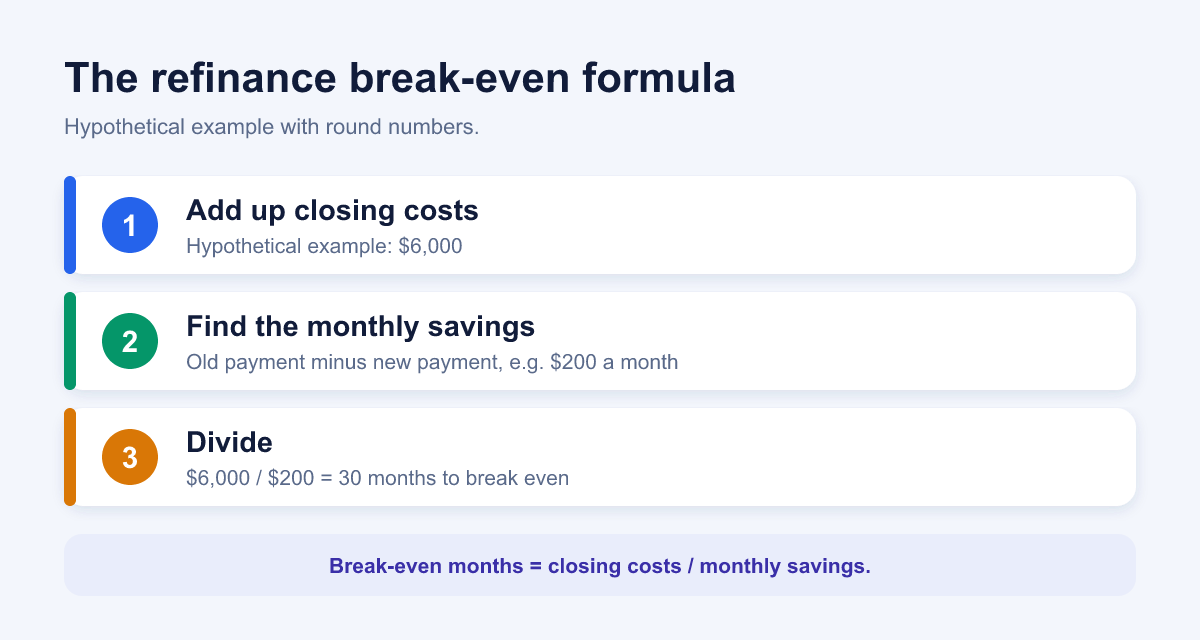
The break-even point is the number of months it takes for your monthly savings to add up to what you paid to refinance. The formula has only three steps:
- Add up the closing costs for the new loan.
- Find the monthly savings: your old payment minus your new payment (principal and interest only, so you compare like with like).
- Divide: closing costs divided by monthly savings equals months to break even.
Hypothetical example: the break-even point
Hypothetical example. These numbers are made up to show the method; they are not current rates or a prediction. Assume you owe $300,000 on a 30-year fixed-rate mortgage with 30 years remaining (to keep the arithmetic simple) at 7.0 percent, and a lender offers a new 30-year fixed-rate loan at 6.0 percent for the same amount.
- Old principal-and-interest payment: about $1,996 a month.
- New principal-and-interest payment: about $1,799 a month.
- Monthly savings: about $197, which we round to $200 for the example.
- Closing costs: $6,000, paid in cash at closing.
Break-even: $6,000 / $200 = 30 months, or two and a half years. If you keep the new loan and stay in the home for more than 30 months, the savings exceed the costs. If you sell or refinance again at month 24, you paid $6,000 to save about $4,800, so you came out behind.
How the break-even point changes
The same formula shows how sensitive the result is to both inputs. The table below uses the same hypothetical approach, rounding up to a whole month.
| Hypothetical closing costs | Savings of $100 a month | Savings of $200 a month | Savings of $300 a month |
|---|---|---|---|
| $4,000 | 40 months | 20 months | 14 months |
| $6,000 | 60 months | 30 months | 20 months |
| $8,000 | 80 months | 40 months | 27 months |
Two lessons stand out. Doubling the costs doubles the break-even time, and small monthly savings stretch it out fast. A $100 monthly saving against $8,000 in costs takes more than six and a half years, which is longer than many people stay in one home.
Limits of the simple formula
The break-even method is a first filter, not a full analysis. It looks only at payment savings and ignores how your loan term changes, what happens to your equity, and whether you invest the savings. It also assumes you keep the new loan for the whole period. Use it to rule deals in or out, then check the total-interest picture in the sections below.
No-closing-cost refinances and rolling costs into the loan
You may see offers advertised as "no closing costs." The CFPB explains that there are still costs to originate every mortgage, and a lender can make an offer look free in two ways: by charging you a higher interest rate and giving you a credit to cover the costs, or by adding the closing costs to your loan amount. A higher rate means you pay more over time, and a higher loan amount raises your payments and reduces your equity.
Lender credits and points are two sides of the same trade-off. Points lower your rate in exchange for paying more at closing; lender credits lower your closing costs in exchange for a higher rate. When you compare lenders, the CFPB recommends asking each one for the same amount of points or credits so the offers line up.
Hypothetical example: rolling the costs into the loan
Continue the example above, and assume the $6,000 is added to the balance, so you borrow $306,000 at 6.0 percent for 30 years.
- New payment: about $1,835 a month, compared with about $1,799 when you pay the $6,000 in cash. That is roughly $36 a month more.
- Savings against the old payment of about $1,996: roughly $161 a month, instead of about $197.
- Over 30 years, borrowing that extra $6,000 adds about $6,950 in interest at this assumed rate.
You keep $6,000 in your pocket on closing day, but you pay for that convenience for as long as you hold the loan. Also notice that there is no cash "break-even" in the same sense: the question becomes whether the lower payment and extra interest fit your plans.
Hypothetical example: taking a higher rate instead
Now assume a lender offers a credit that covers the full $6,000 if you accept a 6.25 percent rate instead of 6.0 percent. On a $300,000 loan over 30 years, the payment would be about $1,847 instead of about $1,799, or roughly $48.50 a month more. Dividing $6,000 by $48.50 gives about 124 months, a little over ten years. If you expect to keep the loan longer than that, paying the costs upfront and taking the lower rate costs less overall. If you expect to leave sooner, the credit may be the cheaper route. The break-even idea works for any upfront-cost-versus-rate trade-off.
Term reset and total interest
A lower payment is not the same as a lower cost. When you refinance into a new 30-year loan, the clock starts over. If you had 25 years left, you now have 30, which means five more years of interest payments. Interest is mostly front-loaded in a long loan, so early payments go largely to interest rather than principal.
Hypothetical example: four paths on the same balance
Hypothetical example. Assume a $300,000 balance at 7.0 percent with 25 years remaining, and $6,000 in closing costs paid in cash for any refinance. The refinance options use assumed rates, shown below, and are not real offers. "Total interest plus costs" adds the $6,000 to the interest so each row reflects everything you would pay beyond the $300,000.
| Option (hypothetical) | Monthly principal and interest | Monthly savings vs keeping | Total interest plus costs |
|---|---|---|---|
| Keep current loan: 7.0 percent, 25 years left | $2,120 | None | $336,101 |
| Refinance: 6.0 percent, new 30-year loan | $1,799 | $322 | $353,515 |
| Refinance: 6.0 percent, new 25-year loan | $1,933 | $187 | $285,871 |
| Refinance: 5.5 percent, new 15-year loan | $2,451 | -$331 (higher payment) | $147,225 |
Look at the second row. The new 30-year loan has the lowest payment and a quick break-even (about 19 months, since $6,000 / $322 is roughly 18.6), yet the total cost is about $17,400 higher than keeping the old loan because you are paying for five extra years. The third row shows a middle path: match the remaining term, keep a meaningful monthly saving (break-even of roughly 32 months), and cut total interest plus costs by about $50,000. The fourth row costs more each month but is far cheaper overall.
The fix, if you want the lower payment, is to ask for a new term that matches what you have left, or to keep paying your old payment amount on the new loan so the extra goes to principal. Check that the new loan has no prepayment penalty, then confirm how extra payments are applied.
Qualifying and shopping: credit, equity, income, Loan Estimates and rate locks
What lenders look at
A lender reviewing a refinance application typically looks at the same categories as for a purchase loan. The CFPB says your credit score and credit report determine whether you can get a mortgage and the rate you pay, and that other factors include your debts, savings, assets and current income. Your credit score is one component, but an important one. Here is how those factors usually play out:
- Credit: Higher scores can make you eligible for lower interest rates. Check your reports for errors before you apply, and avoid opening a lot of new credit in the weeks before.
- Equity: Lenders compare the new loan with the value of your home. The more equity you have, the more options you tend to have, and a small amount of equity can limit them or add costs. Ask each lender how they treat your loan-to-value ratio.
- Debt-to-income ratio (DTI): According to the CFPB, DTI is your total monthly debt payments divided by your gross monthly income, and different loan products and lenders have different limits. For instance, $2,000 in monthly debt payments on $6,000 of gross monthly income is a DTI of about 33 percent.
- Appraisal: The CFPB notes that when you refinance, your lender may need a new appraisal and may require you to pay for it, or may use another way to check the value. You are generally entitled to a copy of the appraisal.
The general timeline
Timelines vary by lender, season and how fast you return documents. In general, expect these stages: shopping and comparing, applying, receiving a Loan Estimate, deciding to move forward, document collection and underwriting, valuation of the home, and closing. Delays usually come from missing paperwork, an appraisal that takes longer than expected, or changes in your application, which is why the length of a rate lock matters.
Compare Loan Estimates from several lenders
The CFPB describes the Loan Estimate as a three-page form you receive after applying for a mortgage, and says all lenders must use the same standard form, which makes comparing loans easier. It shows the estimated interest rate, monthly payment and total closing costs, and flags special features such as a prepayment penalty. When you receive one, the lender has not yet approved or denied your application.
To compare fairly:
- Apply with several lenders within a short window and request each Loan Estimate for the same loan type, amount and term.
- Use the same assumptions on points and lender credits across lenders.
- Compare the total closing costs and the interest rate side by side, and calculate the break-even point for each.
- Look at the annual percentage rate (APR) as one more comparison tool, but do not use it as your only one. Our guide on APR vs interest rate explains the difference.
- Check the page 1 note on a prepayment penalty and on whether the rate is adjustable.
The CFPB also notes that some costs on the Loan Estimate can change before closing and others cannot, with specific limits on what the lender may increase. Ask each lender which fees can change.
Rate locks
A rate lock means your interest rate will not change between the offer and closing, as long as you close within the specified time frame and nothing changes in your application. The CFPB says locks are typically available for 30, 45 or 60 days, and sometimes longer, and that if your rate is not locked it can change at any time. There can be downsides: extending a lock can be expensive, and a lock may keep you from a lower rate if the market falls. Rate lock policies vary by lender, so ask what happens if your closing is delayed, and what it costs to extend. Your Loan Estimate shows whether the rate is locked and for how long, but not the cost of extending it.
Refinance or stay put: a checklist
Before you apply, run through five checks. If you cannot answer one with confidence, pause until you can.
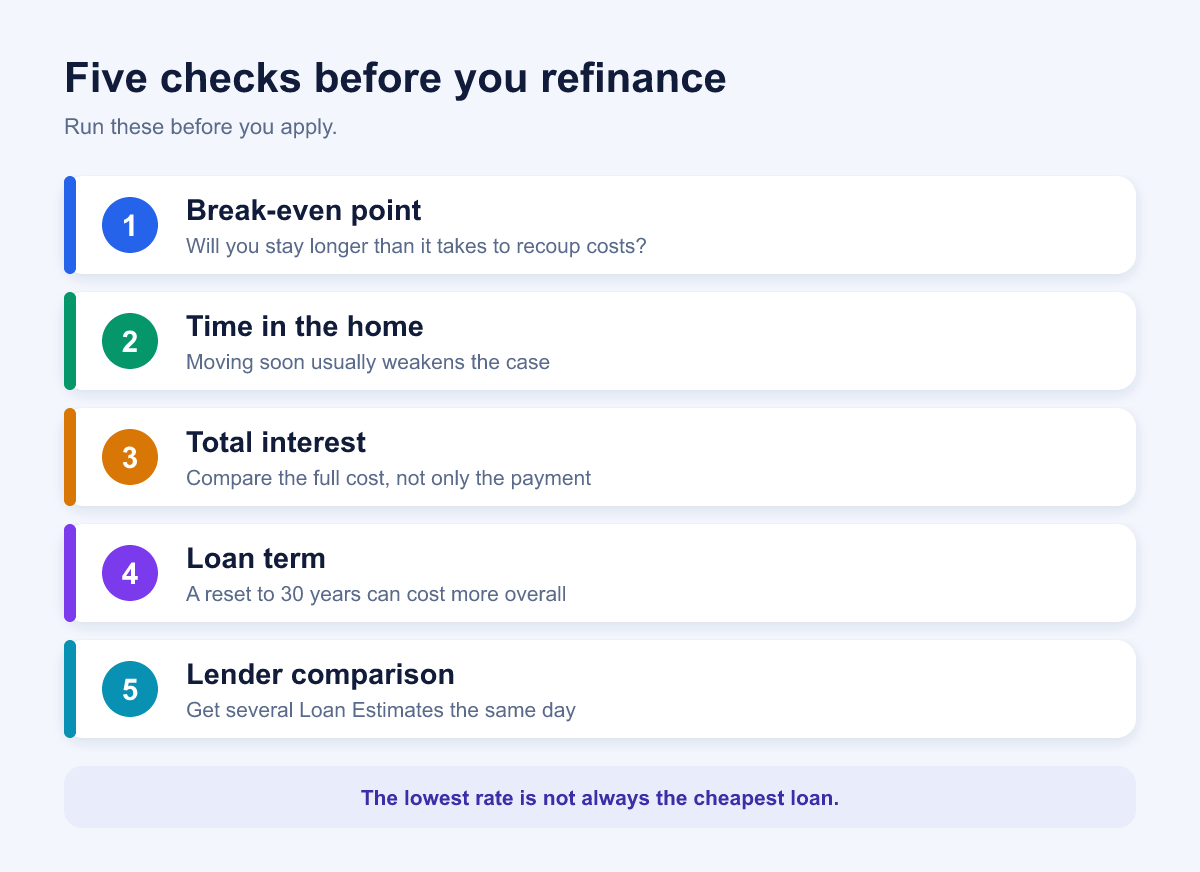
- Break-even point. Will you stay longer than it takes to recoup the costs? Use the closing costs and payment figures from an actual Loan Estimate, not an advertisement. If the break-even is 30 months and you are fairly sure you will stay five years, the numbers lean toward yes. If you are on the fence about staying, they lean toward no.
- Time in the home. Moving soon usually weakens the case. Think about job changes, family plans and whether you might sell within a few years. A refinance is a bet on staying.
- Total interest. Compare the full cost, not only the payment. Add the remaining interest on your current loan and compare it with total interest plus closing costs on each new option, as in the term table above.
- Loan term. A reset to 30 years can cost more overall. Consider a term that matches your remaining years or a shorter term if the higher payment fits comfortably in your budget. Our guide on 15-year vs 30-year mortgages shows the trade-off.
- Lender comparison. Get several Loan Estimates the same day or within a short window so market moves do not distort the comparison, and compare them line by line.
Three hypothetical homeowner profiles
These profiles are fictional and simplified. They illustrate how the same method can lead to different answers. They are not recommendations for any real person.
Profile 1: The long-term homeowner
This homeowner plans to stay at least ten more years and has about 28 years left on a 30-year loan. A lender offers a lower rate and the same term; the savings are $200 a month against $6,000 in closing costs, a 30-month break-even. The case looks reasonable on payment savings. The remaining questions are whether the new term resets too far and whether the total interest, including costs, is lower. If the lower payment comes with a reset, the homeowner could ask for a shorter term or keep paying the old payment amount.
Profile 2: The homeowner who may move in two years
The same offer ($6,000 costs, $200 monthly savings, 30-month break-even) looks different here. If the homeowner sells at month 24, the savings of $4,800 do not cover the $6,000. Unless the costs can be reduced a lot or rolled in with a clear understanding of the trade-offs, waiting or skipping is the likely result. A "no-closing-cost" offer might look more attractive, but the higher rate or bigger loan still has a price, so the homeowner would test it with the same formula.
Profile 3: The FHA borrower with growing equity
This homeowner pays $150 a month in FHA mortgage insurance (a made-up figure) and has built more equity since closing. A conventional refinance with the same principal-and-interest payment would remove that $150, so the monthly savings are $150. With $6,000 in closing costs, the break-even is 40 months. The homeowner would also check credit, equity and appraisal requirements for a conventional loan, confirm that no prepayment penalty applies, and compare the insurance savings with the extra interest of a reset term. If the loan is a conventional loan with PMI, they would first ask the servicer about PMI cancellation rights.
Common mistakes to avoid
- Comparing only the rate. Two offers with the same rate can have very different closing costs, points and credits. Compare the total cost and the Loan Estimate line by line, and learn the difference between APR and the interest rate.
- Ignoring the term reset. A lower payment on a 30-year restart can raise your total interest, as the table showed.
- Not shopping lenders. Each lender prices differently and uses the same standard Loan Estimate form, so comparing is easy once you ask. Getting only one quote leaves savings on the table.
- Refinancing over and over. Every new loan has new closing costs and restarts the term. Frequent refinancing can erase the savings unless each one clears its own break-even point.
- Forgetting costs that are not obvious. A prepayment penalty on your old loan, higher escrow deposits, and an extended rate lock can all raise the real price.
- Letting the rate lock expire. If closing slips, your rate can change. Ask about lock length and extension costs before you choose a lender.
- Taking cash out without a plan. A cash-out refinance increases your balance and may raise your payment. Make sure it is the right tool before choosing it, and compare it with the alternatives.
In summary
- A refinance is a new loan that replaces your old one, with its own closing costs, term and rate.
- Break-even months = closing costs / monthly savings. In the hypothetical example, $6,000 / $200 = 30 months.
- A lower payment does not always mean a lower total cost, especially if you reset to a longer term.
- "No-closing-cost" offers usually mean a higher rate or a higher loan balance; test them with the same math.
- If you pay PMI on a conventional loan, check your cancellation rights before paying for a refinance.
- Get several Loan Estimates, compare total costs, and ask about rate lock length and extension costs.
- Use the five checks: break-even point, time in the home, total interest, loan term and lender comparison.
This guide is general information, not legal, tax or financial advice. Rates, fees and rules change and depend on your lender, loan type and location. For personalized guidance, talk with a HUD-approved housing counselor, a licensed mortgage professional or a qualified financial or tax advisor.
Frequently asked questions
What is a good break-even point for a refinance?
There is no official threshold. What matters is whether you will keep the new loan, and stay in the home, longer than the break-even period. A shorter break-even is safer, and a long one is only reasonable if you are confident about staying put. Because your plans can change, many homeowners prefer a break-even well inside the time they expect to stay.
Does refinancing hurt my credit score?
Applying for a new loan involves a credit check, and the CFPB notes that your score can go down if you apply for or open many new accounts in a short time. Shopping for a mortgage with several lenders is expected, but ask each lender how inquiries will be handled. Any short-term effect depends on your credit history.
Can I roll closing costs into my new loan?
Some lenders allow it, and some offers are built that way. The CFPB notes that adding closing costs to the loan amount increases your payments and reduces your equity. You also pay interest on the added amount for as long as you hold the loan, so include it in your comparison.
Is a no-closing-cost refinance really free?
No. The CFPB explains that there are always costs to originate a mortgage. A "no-closing-cost" loan typically either carries a higher interest rate in exchange for a lender credit, or adds the costs to your loan balance. Whether it makes sense depends on how long you expect to keep the loan.
How long does a refinance take?
It varies with the lender, how quickly you provide documents, the appraisal, and how busy the market is. Ask each lender for an estimated timeline, and match your rate lock to it. The CFPB advises making sure a lock is long enough to cover the time until closing.
Should I refinance to get rid of PMI?
Not necessarily. If you have PMI on a conventional loan, you have rights to request cancellation when your balance is scheduled to reach 80 percent of the home's original value, and PMI generally ends automatically at 78 percent if you are current. Some investors, such as Fannie Mae and Freddie Mac, have guidelines that can be more favorable to borrowers. For an FHA loan, rules are different, so ask your servicer and compare the cost of a refinance with the insurance you would save.
Sources
- CFPB: Loan Estimate Explainer
- CFPB: What is a Loan Estimate?
- CFPB: What costs come with taking out a mortgage?
- CFPB: Is there such a thing as a no-cost or no-closing cost loan or refinancing?
- CFPB: What's a lock-in or a rate lock on a mortgage?
- CFPB: When can I remove private mortgage insurance (PMI) from my loan?
- CFPB: Understand the different kinds of loans available
- HUD: Single Family Mortgage Insurance Premiums