
You have found a home you like, you have saved some cash, and now a loan officer asks a question that sounds simple: FHA or conventional? The answer changes your down payment, your monthly payment, how long you pay for mortgage insurance, and even what you can do with the loan later. Yet most buyers compare the wrong number. They look at the interest rate or at the smallest down payment, and they overlook the insurance that comes with both loans.
This guide explains, in plain English, what an FHA loan and a conventional loan are, how MIP (FHA's mortgage insurance premium) and PMI (private mortgage insurance) work, and when each one can end. It also shows a method to compare the full monthly payment, with a hypothetical $300,000 home and round numbers. Rates, limits and premiums change, so where a figure is current we say so ("at the time of writing, October 2026") and point to the official page where you can check it yourself.
What each loan is
An FHA loan is a mortgage insured by the Federal Housing Administration, which is part of the U.S. Department of Housing and Urban Development (HUD). You still borrow from a private lender such as a bank or mortgage company. The difference is that FHA insures the loan, so the lender is protected if you stop paying. HUD describes this as the reason lenders can offer FHA borrowers low down payments and easier credit qualifying.
A conventional loan is a mortgage that is not backed by a government program such as FHA, USDA or VA. Many conventional loans are conforming loans: they fit the size limits and underwriting rules that allow Fannie Mae and Freddie Mac to buy them. The Federal Housing Finance Agency (FHFA) explains that those two companies may only purchase mortgages below a set amount called the conforming loan limit, and that larger loans are known as jumbo loans. A jumbo loan is conventional too, but it follows each lender's own rules.
One point is easy to miss. Mortgage insurance, whatever the kind, protects the lender, not you. The Consumer Financial Protection Bureau (CFPB) is explicit that if you fall behind, you can still lose your home to foreclosure. Insurance simply makes it possible for lenders to approve smaller down payments.
FHA vs conventional loan side by side
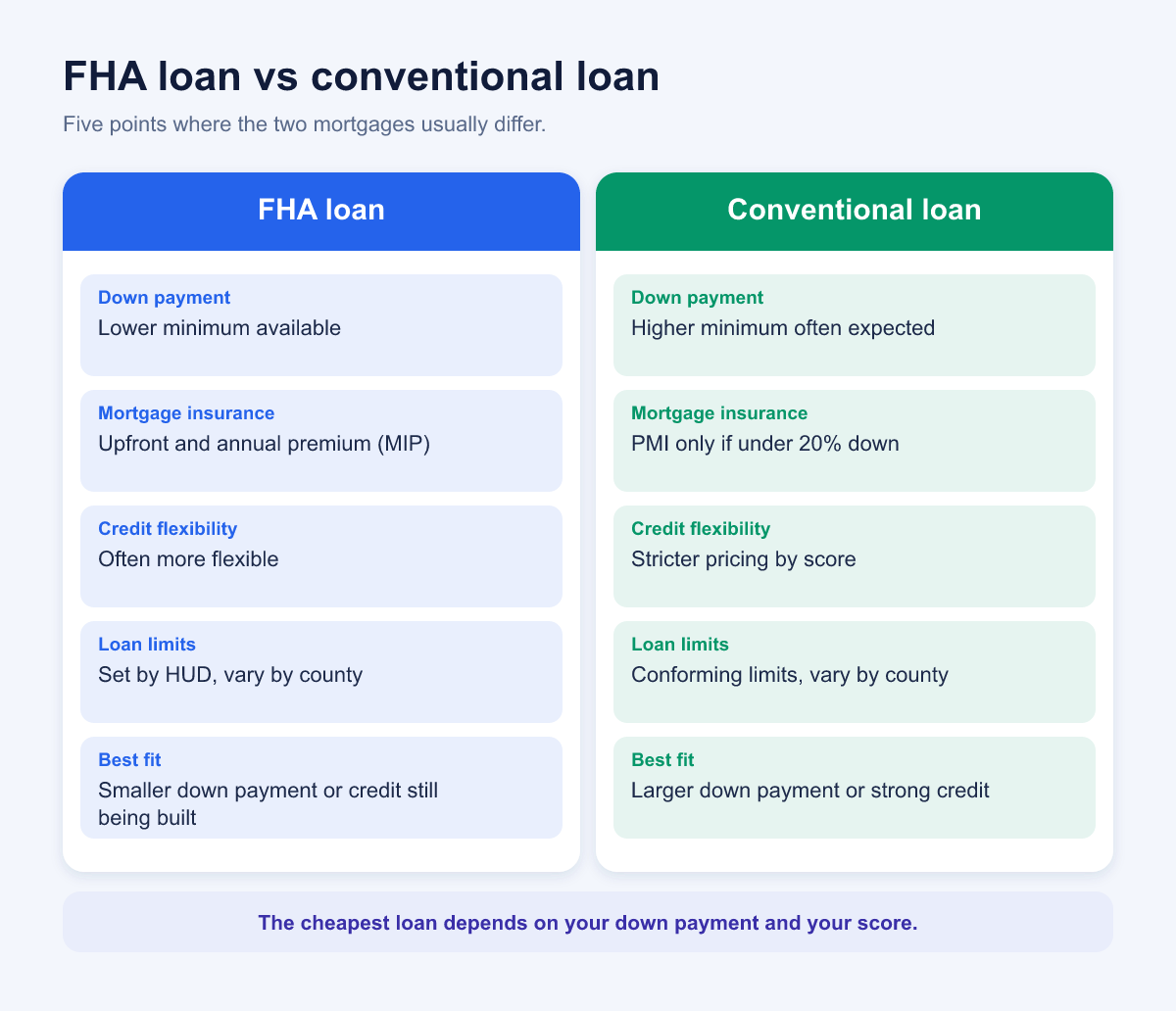
The comparison above has five rows. Here is what each one means in practice.
1. Down payment
HUD states that an FHA down payment can be as low as 3.5 percent of the purchase price, available on one-to-four-unit properties. That is the floor, not a promise: your lender can ask for more depending on your file. For conventional loans, the minimum is set by the lender and the loan program, and a larger down payment is often expected. The number that matters most is 20 percent, because that is the point where a conventional loan normally no longer needs PMI.
2. Mortgage insurance
FHA loans carry mortgage insurance in two parts: an upfront premium and an annual premium billed monthly. Conventional loans carry PMI only when the down payment is under 20 percent. The next two sections go through both in detail, because this row usually decides which loan costs less.
3. Credit flexibility
FHA is often more flexible on credit history. HUD's lender handbook sets different rules for borrowers with a credit score below 580 or no score at all, which signals that FHA does consider lower-score borrowers, with stricter debt limits. Conventional lenders price risk more finely: the CFPB notes that PMI rates vary by down payment and by credit score, and the interest rate usually moves with your score too. Flexible does not mean cheap: a lower score often costs more on any loan.
4. Loan limits
Both loan types have maximum amounts, and both vary by county and by year. HUD publishes FHA mortgage limits and offers a lookup tool by state, county or metropolitan area. FHFA publishes conforming loan limits county by county, and says the 2026 limits were set under the formula in the Housing and Economic Recovery Act of 2008. We do not quote dollar limits here because they depend on where the home is. Check both lists for your county before you shop.
5. Best fit
As a rule of thumb, FHA tends to suit a buyer with a smaller down payment or a credit history that is still being built. Conventional tends to suit a buyer with a larger down payment or a strong credit profile. That is a tendency, not a rule, which is why the total-cost method later in this guide matters.
Down payment and credit: what lenders actually review
Whichever loan you choose, the lender reviews the same broad things: your credit history and score, your income and employment, your debts, the cash you are putting in and where it comes from, and the home itself. The weight each factor carries differs by loan.
Credit score and history
On a conventional loan, your score affects your approval, your interest rate and your PMI price. On an FHA loan, the mortgage insurance premium is set by HUD, so, according to the CFPB, it costs the same no matter your credit score, with only a slight increase for down payments under 5 percent. Your score still affects the interest rate your lender offers. If your score is still low, our guide on how to build credit from scratch explains the habits that move it, and waiting a few months to improve it can change the offer you receive.
Debt-to-income ratio
Lenders compare your monthly debts to your income. HUD's handbook includes tables of qualifying ratios. The baseline shown is 31 percent of income for housing costs and 43 percent for total debt, and higher ratios are allowed when compensating factors such as documented cash reserves are present. Borrowers with a credit score below 580 or no score may not exceed 31/43. Lenders can apply different ratios depending on how a file is underwritten, so ask which ones apply to you. To see how a ratio translates to a price range, read how much house you can afford and the 28/36 rule.
Down payment and cash to close
The down payment is only part of the cash you need. Closing costs, prepaid taxes and insurance, and any upfront mortgage insurance add to it. FHA allows the upfront premium to be rolled into the loan, which lowers the cash you need at closing but raises the loan amount and the interest you pay, as the CFPB points out.
Mortgage insurance: FHA MIP vs conventional PMI
This is the heart of the comparison. Both products protect the lender, both are added to your payment, and both can be a large part of what a low down payment really costs. They work differently.
| Feature | FHA mortgage insurance (MIP) | Conventional PMI |
|---|---|---|
| Who insures the loan | FHA, part of HUD | A private insurance company, arranged by your lender |
| When it applies | Required on FHA loans, in general regardless of down payment | Usually required when the down payment is under 20 percent |
| Upfront cost | Yes. HUD's handbook lists 1.75 percent of the base loan amount at the time of writing; it can be rolled into the loan | Often none or small; some policies charge an upfront premium or both |
| Ongoing cost | Annual premium, billed monthly | Most commonly a monthly premium added to your payment |
| What sets the price | HUD's published schedule: loan term, loan amount, loan-to-value ratio (not your credit score) | Down payment and credit score, according to the CFPB |
| How long it lasts | Depends on the starting down payment and the case date (see below) | Until it is canceled or terminates under federal rules |
How FHA annual MIP is structured
HUD's Mortgagee Letter 2023-05, effective for cases endorsed on or after March 20, 2023, lowered the annual premium. For a standard-size loan with a term of more than 15 years, the letter lists 0.50 percent a year when the loan-to-value ratio (LTV) is 95 percent or less and 0.55 percent a year above 95 percent. Shorter terms and larger loans follow other rows of the schedule. The duration matters just as much as the rate: the letter lists 11 years when the starting LTV is 90 percent or less (a down payment of at least 10 percent), and the full mortgage term when the starting LTV is above 90 percent. HUD can revise the schedule, so confirm the current figures in Appendix 1.0 of the FHA Single Family Housing Policy Handbook 4000.1 or with an FHA lender before you rely on them.
How conventional PMI is priced
PMI is priced by the insurer, and the main drivers are your credit score and your loan-to-value ratio. The CFPB says that PMI is generally cheaper than FHA mortgage insurance for borrowers with good credit, and that most PMI is paid monthly with little or no payment at closing. The same page warns that some lenders offer low-down-payment conventional loans with no PMI in exchange for a higher interest rate. Whether that is a better deal depends on how long you keep the loan.
Getting rid of mortgage insurance
This is where the two loans diverge most over time.
Conventional: the Homeowners Protection Act
For many conventional mortgages on a single-family principal residence that closed on or after July 29, 1999, federal law gives you rights, as summarized by the CFPB:
- Request cancellation at 80 percent. You can ask your servicer in writing to cancel PMI once your principal balance is scheduled to reach 80 percent of the home's original value. You also need a good payment history, no junior liens such as a second mortgage, and evidence that the property has not declined in value.
- Automatic termination at 78 percent. If you are current on payments, your servicer must automatically end PMI when the balance is scheduled to reach 78 percent of the original value.
- Final termination at the midpoint. PMI must end the month after you reach the halfway point of the loan's amortization schedule, for example after 15 years on a 30-year loan.
"Original value" generally means the lower of the contract sales price and the appraised value at purchase. Extra principal payments can bring you to 80 percent sooner. Some investors, including Fannie Mae and Freddie Mac, have their own cancellation guidelines, but the CFPB notes they cannot be less favorable to the borrower than the federal rules.
FHA: different rules
The CFPB states that FHA and VA loans have different requirements, so the 80 and 78 percent rules above do not apply to them. HUD's own page on discontinuing premiums explains why: the insurance agreement is between FHA and your mortgage company, and most mortgage companies expect substantial equity before dropping it. It also notes that the early-cancellation procedures it describes are limited to older cases, those with a case number assigned before June 3, 2013, so a new borrower should plan around the schedule: 11 years or the full term, depending on the starting down payment.
Refinancing out of FHA
The usual way to end FHA mortgage insurance early on a newer loan is to refinance into a conventional loan once you have built equity, either through payments or through home appreciation. The math works only if the new loan's rate, closing costs and PMI (if any) beat what you pay now. Appraised value must support the new loan, and a refinance restarts the clock on some costs. Run the numbers on the full cost of the new loan, not on the monthly payment alone, and see our comparison of 15-year and 30-year mortgages if you are also thinking about changing the term.
Loan limits, property standards, occupancy and assumable loans
Loan limits
Each program caps the amount you can borrow. FHA limits are published by HUD and depend on the county and the property type, and the HUD mortgage limits lookup lets you search by state, county or metropolitan area. Conforming limits come from FHFA. In expensive markets, a loan can exceed one limit and still fit the other, so check both if you are buying near the edge.
Property standards and the appraisal
FHA loans come with HUD's minimum property requirements and minimum property standards, which are laid out in the handbook. The appraisal for an FHA loan assesses value and also whether the home meets those standards for safety, soundness and security. A home with serious defects may need repairs before closing. Conventional appraisals also look at condition, but the requirements come from the lender and the loan investor rather than from HUD. Either way, an independent home inspection is separate from the appraisal and worth considering. HUD has a short guide on buying a home that lists the inspection step.
Occupancy
FHA financing is generally meant for a home you will live in as your primary residence, with exceptions described in HUD's handbook. A conventional loan can also be used for other kinds of occupancy, such as a second home or an investment property, usually on different terms. If you plan to rent the property out from day one, FHA is generally not the right tool. Ask your lender for the exact occupancy rule that applies to you.
Assumable loans
HUD's handbook includes assumption policies for FHA loans, which means a qualified buyer can sometimes take over an existing FHA mortgage rather than getting a new one. The buyer is underwritten by the lender and must cover the gap between the seller's balance and the sale price. This can be attractive when an existing loan carries a low rate, but it is not automatic and not always available. Conventional loans typically include a due-on-sale clause that makes assumption uncommon.
A worked example: the total monthly cost
Comparing only interest rates misses the insurance and the loan amount. A better method is to build the full monthly payment for each offer and add the cash needed at closing. Use this formula:
Monthly payment = principal and interest + mortgage insurance + property taxes + homeowners insurance
The CFPB's Loan Estimate shows the pieces on page 1 in "Projected Payments": principal and interest, mortgage insurance and escrow amounts. Then repeat the exercise over the number of years you expect to keep the loan.
Hypothetical example. Assumptions, all invented for illustration: a $300,000 home; a 30-year fixed loan at 6.00 percent for both loans (not a forecast; real FHA and conventional rates can differ, so use your own Loan Estimates); property taxes and homeowners insurance of $425 a month for both (our guide on how property taxes are calculated explains why this part varies); FHA upfront premium of 1.75 percent financed into the loan; FHA annual premium of 0.55 percent at 3.5 percent down and 0.50 percent at 10 percent down, as in the schedule above; and PMI at placeholder rates of 0.35 to 1.00 percent a year, which are not quotes. Premiums are held constant for simplicity, although real premiums can change as the balance falls.
| Scenario | Down payment | Loan amount | Principal and interest | Mortgage insurance | Taxes and insurance | Total per month |
|---|---|---|---|---|---|---|
| FHA, 3.5% down | $10,500 | $294,566 (includes $5,066 financed upfront MIP) | $1,766 | $133 | $425 | $2,324 |
| Conventional, 5% down, PMI at 0.40% | $15,000 | $285,000 | $1,709 | $95 | $425 | $2,229 |
| Conventional, 5% down, PMI at 1.00% | $15,000 | $285,000 | $1,709 | $238 | $425 | $2,372 |
| FHA, 10% down | $30,000 | $274,725 (includes $4,725 financed upfront MIP) | $1,647 | $113 | $425 | $2,185 |
| Conventional, 10% down, PMI at 0.35% | $30,000 | $270,000 | $1,619 | $79 | $425 | $2,123 |
What the table shows
In this invented example, three things stand out. First, the conventional loan costs less per month when PMI is priced low, but the gap closes or reverses when PMI is priced high, which is how a weaker credit profile can change the answer. Second, the FHA loan amount is larger because the upfront premium is financed. Third, the duration of the insurance differs:
- On the conventional loan with 5 percent down and 0.40 percent PMI, the balance is scheduled to reach 80 percent of the original value after about 118 payments (just under 10 years), so PMI would total roughly $11,000 if the premium stayed constant.
- With 10 percent down and PMI at 0.35 percent, the 80 percent point comes after about 89 payments (just over 7 years), for a total near $7,000.
- On the FHA loan with 10 percent down, annual MIP runs 11 years, roughly $14,850 at a constant $112.50 a month, plus the financed upfront premium.
- On the FHA loan with 3.5 percent down, MIP is scheduled for the full 30-year term unless you refinance or sell first.
Now add a third scenario in your head: 20 percent down on a conventional loan means a $240,000 loan, principal and interest near $1,439, no PMI, and a total near $1,864 a month in this example. An FHA loan with 20 percent down still carries the upfront premium and the annual premium, which is why buyers with 20 percent or more often choose conventional.
The limits of this simplification are real. We ignore closing costs, rate differences between the loans, seller concessions, escrow cushions, tax effects and the change in premiums as the balance falls. Treat the table as a method, not a prediction. If you want to test a shorter term, our 15-year vs 30-year mortgage comparison shows how the payment and total interest change.
How to choose: four questions
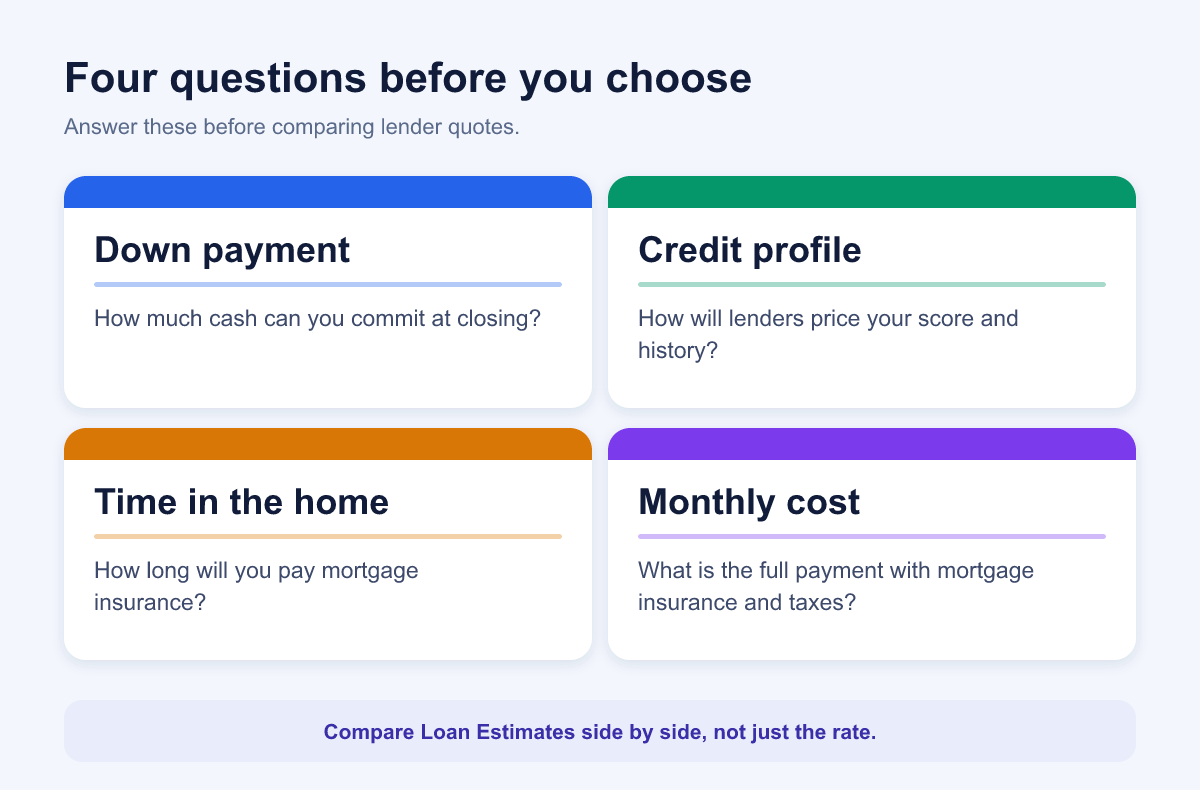
1. Down payment: how much cash can you commit at closing?
Add the down payment, closing costs, prepaid items and a cash cushion for moving and repairs. If the total pushes you toward the minimum, FHA's lower floor may keep the purchase within reach. If you can reach 20 percent without draining your savings, conventional avoids mortgage insurance entirely.
2. Credit profile: how will lenders price your score and history?
Ask for quotes on both loan types on the same day. For a lower score, FHA's insurance price does not rise with your score, while conventional PMI and the interest rate often do. For a strong score, conventional PMI tends to be cheaper, according to the CFPB. Do not guess: the quotes tell you.
3. Time in the home: how long will you pay mortgage insurance?
If you expect to stay five years or less, upfront costs and the loan balance matter more than the premium schedule. If you plan to stay 15 years or more, a premium that lasts the whole term costs far more than one that ends at 78 or 80 percent. Remember that refinancing is a way out, but not a free one.
4. Monthly cost: what is the full payment with insurance, taxes and insurance?
Compare the total, not the rate. Use the formula above on each Loan Estimate, and test the result against your budget. Our guide on the 28/36 rule offers a way to check whether the total is comfortable.
Three hypothetical buyers
These profiles are invented to show the reasoning, not to recommend a loan.
- Maya, early in her career. She has saved a modest down payment, has a short credit history and wants to buy a starter home. Her tradeoff is between FHA's lower floor and a conventional loan whose PMI may be priced high for her score. She asks for both Loan Estimates and checks how long each insurance would last.
- Daniel and Priya, with strong credit. They have about 10 percent saved and plan to stay for many years. Conventional PMI priced for good credit that can be canceled at 80 percent may beat an FHA premium that runs 11 years. They compare totals over their planned stay.
- Luis, rebuilding after a rough stretch. His score has recovered but is not high. FHA's flexible credit rules may be the realistic path. He plans to refinance into a conventional loan once his equity and score improve, and he asks the lender what refinancing would cost.
Common mistakes to avoid
- Comparing only the interest rate. A lower rate with higher mortgage insurance and a larger loan can cost more per month. Compare the full payment.
- Ignoring how long MIP lasts. A 3.5 percent down FHA loan can carry MIP for the full term. Ask for the duration in writing.
- Forgetting the financed upfront premium. Rolling it into the loan feels painless, but it raises your balance and your interest.
- Not asking for a Loan Estimate from several lenders. The CFPB recommends requesting multiple Loan Estimates from different lenders and comparing origination charges and the total. Prices for the same loan type can differ.
- Assuming mortgage insurance ends on its own. PMI follows federal cancellation rules, and you must meet conditions to request it early; FHA premiums follow HUD's schedule, and a new FHA loan usually has no 80 percent cancellation option.
- Skipping the property check. An FHA appraisal can flag repairs that delay closing. A separate inspection can reveal what the appraisal does not.
- Stretching the budget to the maximum approval. Approval is not affordability. Keep room for repairs, taxes that rise and an emergency fund.
In summary
- An FHA loan is insured by HUD's Federal Housing Administration; a conventional loan is not backed by a government program.
- HUD says FHA down payments can be as low as 3.5 percent; conventional minimums are set by the lender and program.
- FHA charges an upfront and an annual mortgage insurance premium; conventional PMI generally applies only under 20 percent down.
- PMI can be canceled at 80 percent and terminates automatically at 78 percent under federal rules; FHA MIP follows a HUD schedule tied to the starting down payment.
- Loan limits, for both FHA and conforming loans, vary by county and year: check HUD and FHFA.
- Compare the full monthly payment (principal and interest, insurance, taxes) and the duration of the insurance, not just the rate.
- Request Loan Estimates from several lenders and ask each one to show FHA and conventional options side by side.
- Think about refinancing as a possible exit from FHA mortgage insurance, but price the full cost first.
Frequently asked questions
Is an FHA loan only for first-time buyers?
No. HUD promotes FHA loans for first-time buyers, but FHA loans are not limited to them. Eligibility depends on the lender's and HUD's requirements for the borrower and the property, so ask a lender what applies to your situation.
Is the minimum FHA down payment always 3.5 percent?
HUD says the down payment can be as low as 3.5 percent of the purchase price. That is the lowest figure, and a lender can require more depending on your file. Ask for the requirement that applies to your credit and loan details.
Do I always pay PMI on a conventional loan with less than 20 percent down?
Usually, but not always. The CFPB notes that some lenders offer conventional loans with smaller down payments and no PMI in exchange for a higher interest rate. Compare the total cost over the time you plan to keep the loan.
Can I remove FHA mortgage insurance?
The 80 and 78 percent rules apply to PMI, not to FHA. For newer FHA loans, the premium follows HUD's schedule, which is 11 years or the full term depending on the starting down payment, according to Mortgagee Letter 2023-05. A common way out is refinancing into a conventional loan, which carries its own costs. Check the current schedule and your own case with your servicer.
Which loan has the lower monthly payment?
It depends on your down payment, your credit score, the interest rate you are offered and the insurance price. In our hypothetical example, the conventional loan cost less when PMI was priced low and more when PMI was priced high. Only your own Loan Estimates can answer for you.
Can I switch from FHA to a conventional loan later?
Yes, through a refinance, if you qualify for the new loan. You pay closing costs on the new mortgage, and the appraised value and your credit determine the terms. Compare the total cost of the new loan with the cost of keeping the current one.
This guide is general information, not financial, legal or tax advice, and it does not take your personal situation into account. Rates, premiums and limits change, so verify current figures with a lender and consider speaking with a HUD-approved housing counselor before you commit.
Sources
- HUD: Let FHA Loans Help You
- HUD: Single Family Mortgage Insurance Premiums (discontinuing monthly premium payments)
- HUD: Mortgagee Letter 2023-05, Reduction of FHA Annual Mortgage Insurance Premium Rates
- FHFA: Conforming Loan Limit
- CFPB: What is mortgage insurance and how does it work?
- CFPB: What is private mortgage insurance?
- CFPB: When can I remove private mortgage insurance (PMI) from my loan?
- CFPB: Loan Estimate Explainer