

Ask whether you need a trust or just a will and you will usually get one of two answers: a sales pitch for a trust, or a warning that trusts are overkill. The reality sits in between. A will and a revocable living trust solve different problems, and a basic estate plan is made of several pieces, only some of which you may need. What fits depends on what you own, where you own it, who depends on you and the laws of your state.
This guide explains what a will does and does not do, what probate is, how a revocable living trust works (including the step many people skip, called funding), how the two compare on privacy and incapacity, what a trust does not change for taxes, creditors and Medicaid, and where the real costs sit. It also covers the other documents in a basic plan, three hypothetical profiles, a step-by-step method and the most common mistakes. It is general information, not advice for your situation: estate law is state law, and a licensed attorney in your state is the right person to apply it to your facts.
What a will does, and what probate is
A will is a legal document that states your wishes and instructions for managing and distributing your estate after your death. It does a few specific jobs:
- Names an executor, the person who carries out your instructions, pays debts and taxes, and distributes what is left.
- Names guardians for minor children. Illinois Legal Aid Online, for example, notes that parents of minor children can name a legal guardian in their will.
- Directs who receives the assets that pass through the will, including special requests such as gifts of particular items.
Just as important is what a will does not do. It does not take effect until death, so it does nothing if you are alive but unable to manage your affairs. It does not control assets that pass by a beneficiary form or by joint ownership. And it does not avoid probate. Illinois Legal Aid states it plainly: a will alone does not bypass the probate process; it gives the court instructions to follow.
What probate is
Probate is the court process through which a will is proved valid and an estate is administered under court supervision. According to Cornell's Legal Information Institute, that includes collecting assets, paying debts and taxes, and distributing property to heirs or beneficiaries. The executor named in the will does the work; if there is no executor, or none willing to serve, the court appoints a personal representative.
Probate is run by state courts, so rules, fees and timelines differ widely from state to state and sometimes from county to county. Illinois Legal Aid says some cases take a few months and others take longer, especially with many assets, debts or disagreements, because the process generally cannot finish until the time for creditors to make claims has passed. This guide gives no cost or time figures because they depend on where you live and on the size and complexity of the estate.
Two points often get lost:
- Probate usually applies to assets in your name alone with no automatic way to pass to someone else. Illinois Legal Aid lists life insurance paid to a named beneficiary, retirement accounts with designated beneficiaries, jointly owned property with survivorship rights and property held in a trust as examples that generally do not go through probate.
- Small estates may have a shortcut. Many states have small-estate procedures that are shorter or skip court entirely, with thresholds that vary heavily by state. Illinois, for example, offers a small estate affidavit, which Illinois Legal Aid says is usually faster and costs less than probate.
Because a will is filed with the court, its contents are often visible to others once probate starts. How open the court file is depends on the state and the court, so treat privacy as a state-by-state question rather than a certainty. If you die with no valid will at all, state law (called intestacy) decides who inherits, which may not match what you would have chosen.
What a revocable living trust is and how it works
A trust is a legal arrangement in which one person holds assets for the benefit of another. A living trust, also called a revocable trust, is one where you keep the ability to change it or end it altogether. Cornell describes the appeal as flexibility: you can fund the trust over time, change what is in it, and arrange for the assets to be managed if you become unable to do so.
The roles
| Role | Who it is | What it does |
|---|---|---|
| Grantor (also called settlor) | You, the person who creates the trust | Sets the terms and can amend or revoke them |
| Trustee | Often you, while you are able | Holds and manages the trust assets under the trust's terms |
| Successor trustee | A person or institution you name | Takes over if the trustee dies or becomes incapacitated |
| Beneficiaries | The people or organizations you name | Receive trust assets under the terms you set |
In a typical arrangement you serve as your own trustee, so day to day you keep using and controlling your assets. The change shows up when something happens to you: the successor trustee steps in under the instructions you wrote.
Funding: where most trusts succeed or fail
Signing the trust document creates the trust, but it does not move anything into it. Funding means retitling assets so the trustee, not you personally, is the owner. For a home that usually means a new deed; for bank and brokerage accounts it means retitling with each institution; for some personal property it may mean a written assignment. Retirement accounts are generally handled through beneficiary designations rather than retitling, and the tax rules for naming a trust as a beneficiary are technical, so ask a professional first.
An asset left in your own name still goes through the process a will would have governed. A trust that holds only a few of your assets leaves the rest outside it, and that rest may still need probate.
The pour-over will
Most trust-based plans include a pour-over will, a will that sends any leftover assets into your living trust at death. Cornell notes that a well-drafted pour-over will can work alongside a trust to avoid probate, while a poorly drafted one may still pass the estate through probate. A pour-over will is also the usual home for guardian nominations for minor children, which a trust document does not replace.
Will vs revocable living trust, side by side
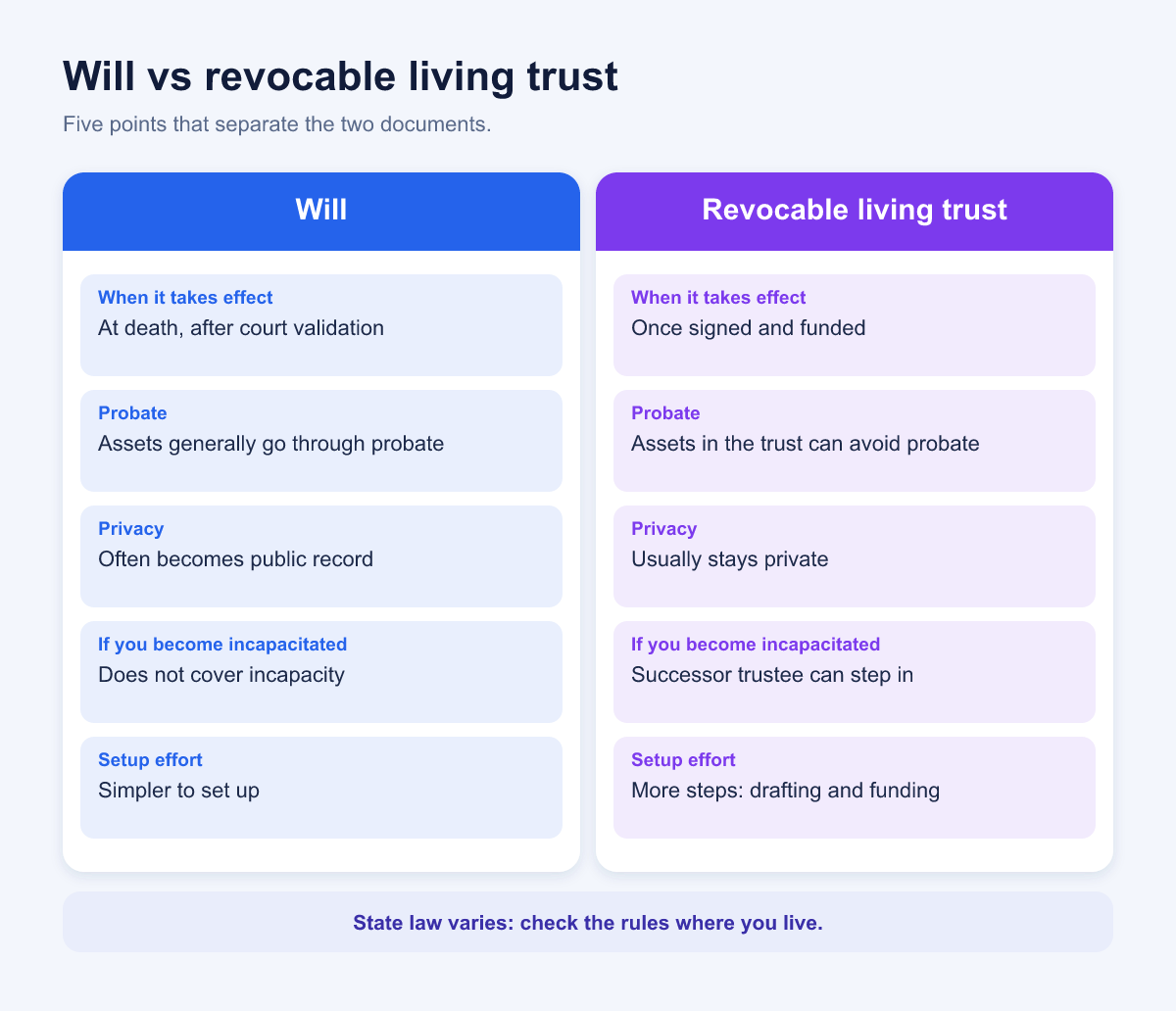
The figure sums up five differences. Here they are in the same order, with the nuance that state law adds.
| Question | Will | Revocable living trust |
|---|---|---|
| When it takes effect | At death, after the court validates it | Once signed and funded, so it can operate during your life |
| Probate | Assets in your name generally go through probate | Assets properly placed in the trust can avoid probate; assets left out may not |
| Privacy | Often becomes part of the court record | Usually stays private unless a court dispute brings it into the open |
| If you become incapacitated | Does not cover incapacity | A successor trustee can step in, for the assets in the trust |
| Setup effort | Simpler to set up | More steps: drafting and funding |
When it takes effect. A will is dormant while you live and, as Cornell explains, must be admitted by a court after death. A trust exists as soon as it is validly signed, but only the assets actually titled in the trust are governed by it.
Probate. The word "can" matters. A trust avoids probate for what it holds, and many states also offer simplified procedures for small estates, so the practical gap between the two depends on your state and your assets.
Privacy. Probate is a court process, and court files are often available to others, though access rules vary. A trust is generally a private document, but it can become visible if a dispute lands in court or if an institution asks to see parts of it.
Incapacity. A will says nothing about the period before death. A trust names someone to manage its assets, but it covers only what is in it, which is why a power of attorney usually sits beside it (see the next section).
Setup effort. The extra effort of a trust is real: drafting, retitling, and keeping the trust current as you buy, sell or open accounts. That effort is the main reason the cost question below matters.
Incapacity: successor trustee vs durable power of attorney
Incapacity planning is often a stronger reason to act than death planning, because it can happen at any age. Two tools cover it:
- A durable power of attorney lets someone you name (your agent) act for you on financial matters. "Durable" generally has to be stated in the document and means the power stays valid even if you become unable to make decisions; a non-durable power of attorney typically ends on incapacity. State laws vary.
- A successor trustee takes over management of the trust property when the trustee dies or becomes incapacitated, following the instructions you wrote into the trust.
The two are complementary. The successor trustee manages only what is titled in the trust. The power of attorney reaches assets outside it, such as a retirement account or a vehicle, and lets your agent handle matters like filing taxes or dealing with an agency. Without either, family members may have to ask a court to appoint a guardian or conservator for an incapacitated adult, a court-supervised arrangement whose name and rules vary by state. The cost and delay of that route are a common motivator for planning ahead.
Medical decisions are separate again. A health care directive names a health care agent and records your wishes, covered in the section on the rest of a basic plan. Whoever you choose for any of these roles, name a backup, and talk to the person first.
What a revocable trust does not change: taxes, creditors and Medicaid
A trust is sometimes described as a tax or asset-protection shield. A revocable one is neither, and the reasons are mechanical.
Income tax
Under section 676 of the Internal Revenue Code, the grantor is treated as the owner of any portion of a trust when the grantor, or a non-adverse party, holds the power to revest title in the grantor. That is exactly the power you keep in a revocable trust. In practice, a revocable trust is generally treated as yours for income tax while you are alive, so it is usually not a separate taxpayer. Reporting details depend on how the trust is set up, so ask a CPA.
Estate tax
The IRS describes the federal estate tax as a tax on the right to transfer property at death, computed on a "gross estate" that includes cash, securities, real estate, insurance, trusts, annuities and business interests. Moving assets into a revocable trust you control does not take them out of that picture, so a revocable trust does not by itself reduce federal estate tax.
The federal threshold is very high. At the time of writing (October 2026), the IRS says a federal estate tax return is required for a 2026 death if the gross estate, plus adjusted taxable gifts and the specific gift tax exemption, exceeds $15,000,000. The IRS also notes that a surviving spouse can elect to use a deceased spouse's unused exemption, on a timely filed return. Some states have their own estate or inheritance taxes with different rules, so check your state's revenue department. Figures change, so confirm on the IRS page listed in Sources.
Creditors
Because you can revoke or change the trust, you have not given up control of the assets. Cornell's entry on living trusts specifically cautions that a settlor may face higher tax and creditor liability than an irrevocable trust might allow. Do not treat a revocable living trust as protection from your own creditors. Asset protection is a different, more specialized subject (our guide to LLCs and land trusts for rental property looks at one slice of it).
Medicaid
Federal Medicaid law (42 U.S.C. 1396p) provides that, for a revocable trust, the trust's principal is considered a resource available to the individual, and payments from it count as income. A revocable trust is therefore not Medicaid planning on its own. If long-term care coverage is a concern, an elder-law attorney in your state can explain which strategies exist and which rules apply.
What it costs: the mechanics
This guide quotes no prices: they vary by state, by attorney and by how complex your situation is. What you can do is understand what drives them.
| Route | What you typically get | What drives the cost | Watch-outs |
|---|---|---|---|
| Attorney, flat fee | Documents drafted for your state, advice on funding and coordination | Complexity, number of documents, property in several states, how much funding help is included | Ask exactly what the fee covers: deeds, retitling help, amendments |
| Online document service | Fill-in-the-blank documents, often with state-specific forms | Subscription or per-document charges, optional attorney review | Forms may not fit unusual facts; you handle signing and funding yourself |
| Do it yourself | Forms or templates you complete alone | Mostly your time, plus notary and recording fees | Errors in witnessing, wording or retitling can defeat the document |
The hidden cost of a trust is not the drafting; it is funding and maintenance. A deed to retitle a home may carry recording fees, each financial institution has its own paperwork, and every new account or property you acquire later has to be titled correctly. If you skip those steps to save money, you may pay for a trust that governs very little. A trust also asks something of the people who run it: a successor trustee takes on recordkeeping and legal duties.
The other side of the ledger is what probate would cost in your state, which depends on local fees and attorney charges and on whether small-estate shortcuts apply. When you compare quotes, ask for a written scope, ask what is included for funding, and ask what happens if you move or your family changes. Keeping some cash accessible also matters for any plan; our emergency fund guide covers how much and where.
Who may benefit from a trust, and who may be fine without one
These are mechanisms, not recommendations. Whether any of them applies to you is a question for an attorney in your state.
| Situation | Why a trust may help | What may be enough instead |
|---|---|---|
| Real estate in more than one state | Property in a trust may avoid separate court proceedings in each state where you own land; ask an attorney how your states treat this | If only one modest property, a transfer-on-death deed where your state allows it |
| Privacy matters to you | A trust usually stays out of the court file | If privacy is not a priority, a will plus beneficiary forms |
| Blended family | Lets you set who benefits now and who inherits later, with a trustee following your instructions | Beneficiary forms and joint ownership can undo your intentions, so they need review either way |
| Incapacity concerns | A successor trustee can manage trust assets without court involvement | A durable power of attorney covers many cases |
| Minor or special-needs beneficiary | A trust can hold assets and release them over time under rules you set; special-needs planning has technical rules tied to benefits eligibility | For minors, some states offer custodial accounts; ask an attorney before leaving assets directly to a person with special needs |
| Modest, simple estate | Usually little added benefit | A will, beneficiary designations, payable-on-death and transfer-on-death accounts, and the incapacity documents |
Three hypothetical profiles
Hypothetical examples with simple assumptions; none of this is a recommendation.
Profile 1, a young parent with a modest estate. Assume two parents in their thirties, a small home with a mortgage, employer retirement accounts and group life insurance. The urgent pieces are a will naming guardians for the children, up-to-date beneficiary forms, a durable power of attorney and health care directives. A trust is possible but may add more setup than it saves. If the parents want life insurance beyond what work provides, the term vs whole life guide explains the main policy types, and the beneficiary designation on the policy then matters.
Profile 2, a homeowner with a rental in another state. Assume one person owns a home in one state and a rental house in another. Real estate owned in two states can mean court involvement in both, so this is the classic case where people ask an attorney about a trust or other ways to pass the rental property. A trust also does not replace the liability and insurance questions that a rental raises; see the guide on LLC vs land trust for rental property.
Profile 3, a blended family. Assume a couple where each has children from an earlier marriage. A simple will leaving everything to a spouse can mean the children from the earlier marriage receive nothing unless the spouse chooses to share, and joint accounts or beneficiary forms can override both people's intentions. A trust can let the first spouse to die decide who benefits during the survivor's life and who inherits afterward. The documents have to be drafted carefully, and every beneficiary form must match.
The rest of a basic estate plan
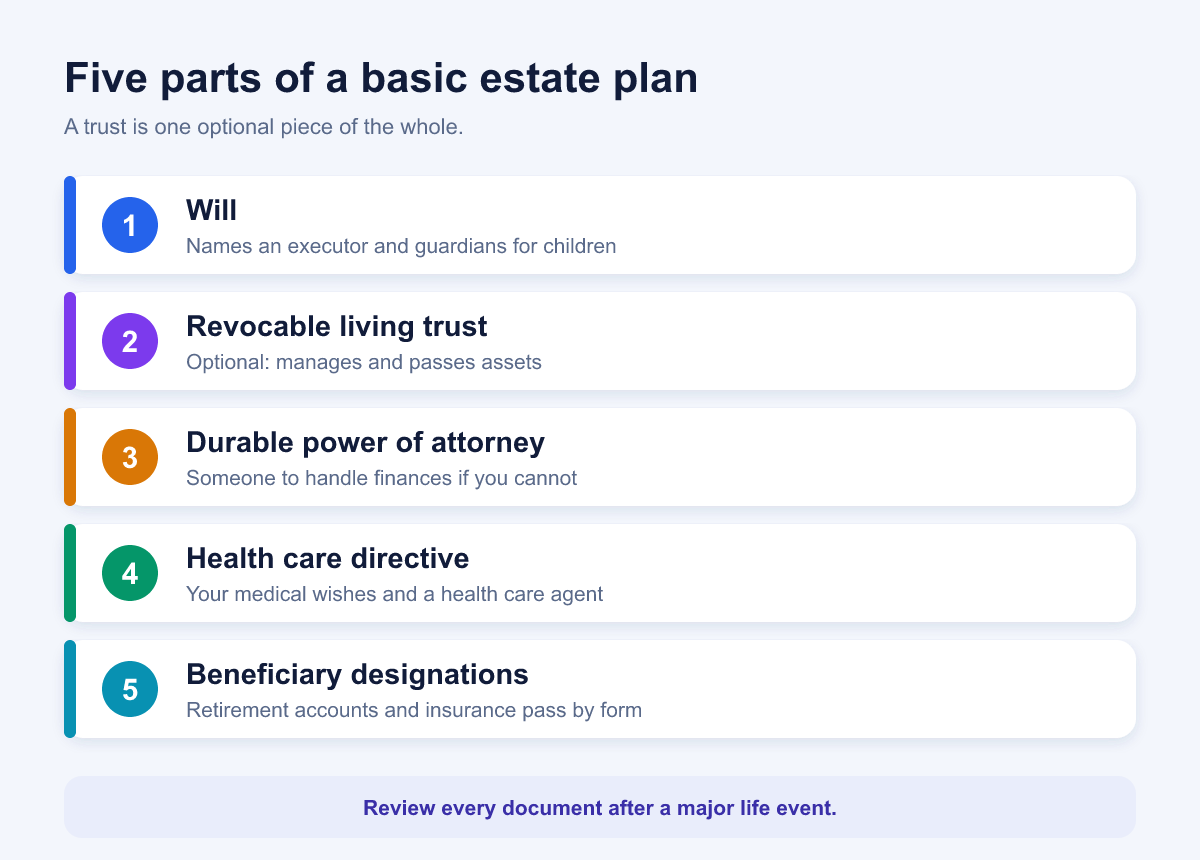
The figure lists the five pieces, and only one of them is a trust. In the same order:
- Will. Names an executor and guardians for minor children, and directs the assets that pass through it.
- Revocable living trust. Optional. Manages and passes the assets you title in it, as described above.
- Durable power of attorney. Gives someone you trust authority to handle your finances if you cannot. The durability generally has to be stated in the document.
- Health care directive. Records your medical wishes and names a health care agent. A living will is one type of advance directive: it lists your wishes about medical treatment for when you cannot give informed consent or refusal yourself. Names and rules vary by state.
- Beneficiary designations. Retirement accounts and insurance pass by form. This is the piece people forget, and it often matters most.
Beneficiary designations deserve special attention because they generally control what they cover. Illinois Legal Aid lists property that has a named beneficiary among the things a will cannot direct, and says that cars, bank accounts and life insurance policies often have beneficiaries. Assets that skip probate this way can still count toward the federal gross estate, which the IRS says includes insurance and trusts. If your will says one thing and a beneficiary form says another, the form usually wins for that asset. Many banks also offer payable-on-death designations on accounts, and some states allow transfer-on-death registration for securities or real estate; availability and rules vary by state.
Benefits like Social Security follow federal rules and are not distributed through your will. If you are planning for a spouse or dependents, our Social Security guide explains how claiming works.
A step-by-step method, and the mistakes to avoid
- Inventory your assets. List real estate, accounts, retirement plans, insurance policies, vehicles, business interests and digital accounts, noting how each is titled and whether it has a beneficiary.
- Choose your people. Pick an executor, guardians for children, a trustee and successor trustee if you use a trust, a financial agent and a health care agent. Name backups and ask each person first.
- Pick the tools. Start with the essentials: will, durable power of attorney, health care directive, beneficiary designations. Then decide with an attorney whether a trust adds enough to justify its setup.
- Execute properly. Signing, witnessing and notary rules vary by state. In Illinois, for example, Illinois Legal Aid says a will must be signed and witnessed by two people who are not benefiting from it. Follow your own state's rules exactly.
- Fund and coordinate. If you have a trust, retitle the assets you intend it to hold. Then check that beneficiary forms and account titles agree with the plan.
- Store and share. Keep originals safe, tell your executor and agents where they are, and make sure they can be found.
- Update after life events. Marriage, divorce, a birth, a death, a move to another state, a major purchase or sale, or a change in a beneficiary's circumstances all call for a review.
Common mistakes
- Not funding the trust. The trust document is signed, but the house and accounts are still in your name.
- Outdated beneficiary designations. An ex-spouse or a deceased person is still named on a form that overrides your will.
- No backup agent or successor. If the only person you named cannot serve, a court may have to step in.
- DIY errors. Wrong witnesses, unclear wording or forms that do not match your state can undermine a document when it is needed.
- Naming a minor child directly. A minor generally cannot manage assets, which can lead to a court-supervised arrangement.
- Expecting a revocable trust to do what it does not. It does not by itself reduce estate tax, shield assets from your creditors or handle Medicaid planning.
- Forgetting to review after moving. Another state's rules may treat your documents differently.
In summary
- A will names an executor and guardians and directs assets in your name, but it does not avoid probate.
- A revocable living trust can avoid probate for the assets you place in it, keeps you in control while you are alive, and adds an incapacity plan through a successor trustee.
- A trust works only for what is funded; a pour-over will catches the rest.
- It does not by itself reduce estate tax, protect you from creditors or handle Medicaid planning.
- The real cost is funding and maintenance, not just drafting.
- A durable power of attorney, a health care directive and current beneficiary designations are core pieces whether or not you have a trust.
- Rules on witnessing, probate and taxes vary by state: use a local attorney for the final decision.
Checklist: inventory assets, name people and backups, choose tools, sign correctly, fund the trust if you have one, check beneficiary forms, store and share locations, and review after every major life event.
This guide is general information, not legal, tax or financial advice. Laws differ by state and change over time; consult a licensed attorney or tax professional about your own situation.
Frequently asked questions
Does a will avoid probate?
No. Illinois Legal Aid says a will does not automatically avoid probate; it provides the instructions the probate court follows. Assets that pass by beneficiary designation, joint ownership with survivorship or a trust generally do not go through probate, and small-estate procedures may shorten the process in some states.
If I have a trust, do I still need a will?
Usually yes. A pour-over will sends anything not titled in the trust into it, and guardians for minor children are normally named in a will. Cornell notes that a poorly drafted pour-over arrangement may still pass the estate through probate, so the documents need to work together.
Can I change or cancel a revocable trust?
Yes. A living trust is one where you keep the ability to alter or end it, according to Cornell. Follow the amendment and revocation steps written in your trust document, and keep funding and beneficiary forms in line with any change.
Does a revocable trust protect my home from creditors or nursing-home costs?
Generally no. Because you can revoke it, you have kept control, and Cornell cautions about creditor liability. Under federal Medicaid law, the principal of a revocable trust is treated as a resource available to you. Ask an elder-law attorney in your state about options that do work.
Will my estate owe federal estate tax?
Most estates do not have to file. At the time of writing (October 2026), the IRS gives $15,000,000 as the filing threshold for deaths in 2026, counting adjusted taxable gifts and the specific gift tax exemption. State estate or inheritance taxes may differ, so check your state, and confirm current figures with the IRS.
Is a do-it-yourself will or trust a good idea?
It can work for simple situations, but mistakes are common and often surface only when it is too late to fix them. Signing and witnessing rules vary by state, and a trust fails if it is not funded. If your situation has a rental property, a blended family, a minor or special-needs beneficiary, or property in several states, professional review is worth considering.
Sources
- IRS: Estate tax
- Cornell Law School (LII): 26 U.S. Code, section 676, Power to revoke
- Cornell Law School (LII): 42 U.S. Code, section 1396p, Liens, adjustments and recoveries, and transfers of assets (Medicaid)
- Illinois Legal Aid Online: Probate
- Illinois Legal Aid Online: Wills and estate planning
- Cornell Law School (LII) Wex: Living trust
- Cornell Law School (LII) Wex: Pour-over will
- Cornell Law School (LII) Wex: Probate