
Few financial products are described in as many different ways as the annuity. To one person it is a paycheck you cannot outlive. To another it is an expensive contract with a long lock-up. Both descriptions can be accurate, because "annuity" covers very different contracts: some behave like a savings product with a declared interest rate, others like an investment account that can lose value, and others sit somewhere in between with caps and limits that are easy to misread.
This guide explains how annuities work, how the three common types (fixed, variable and indexed) differ, where the costs hide, how earnings are taxed in general terms, and what backs the insurer's promises. It does not name companies, quote rates or rank products. Its goal is to help you read a contract and ask better questions, whoever is selling it. Every rule and figure below comes from an official page we opened while writing (November 2026); the worked examples are hypothetical and use round numbers.
What an annuity is and how it works
An annuity is a contract between you and an insurance company. According to the SEC's investor education site, you buy it with a single lump-sum payment or a series of payments, and in return the insurer agrees to make periodic income payments to you, either right away or at a future date. You may also be able to withdraw the contract's value as a lump sum, although doing so can trigger surrender charges, taxes and tax penalties.
Two phases: accumulation and payout
Most annuities have two phases. During the accumulation phase, your payments go in and the money grows (or, depending on the type, fluctuates). During the payout phase, the insurer pays income, for a set number of years or for life, depending on the option you choose. Choosing to convert the contract into guaranteed income is called annuitizing, and FINRA notes that this decision is generally irrevocable: you give up control of the money in exchange for a steady income stream and shift the risk of outliving your savings to the insurer.
Immediate vs deferred
- Immediate annuity: you pay one lump sum and typically start receiving income within one year.
- Deferred annuity: you pay one lump sum or several payments over time, let the money grow for a while, and start income later.
The rest of this guide mostly concerns deferred annuities, because that is where the three types, the fees and the surrender periods matter most.
What it is not
An annuity is not a bank deposit. FINRA states that annuities are not guaranteed by the FDIC, the SIPC or any other federal agency; any protection beyond the insurer's own promise comes from state guarantees, covered further down. The SEC also says annuities are only appropriate for people with a long-term time horizon.
Fixed, variable and indexed annuities compared
Regulators and industry groups sort annuities into three broad families. The SEC's investor education site lists the main types of deferred annuities in order of increasing risk: fixed, fixed indexed, registered index-linked (RILA) and variable. This guide uses the three labels most sellers and regulators use for consumers (fixed, variable and indexed), and treats fixed indexed annuities and RILAs as two kinds of indexed contract.
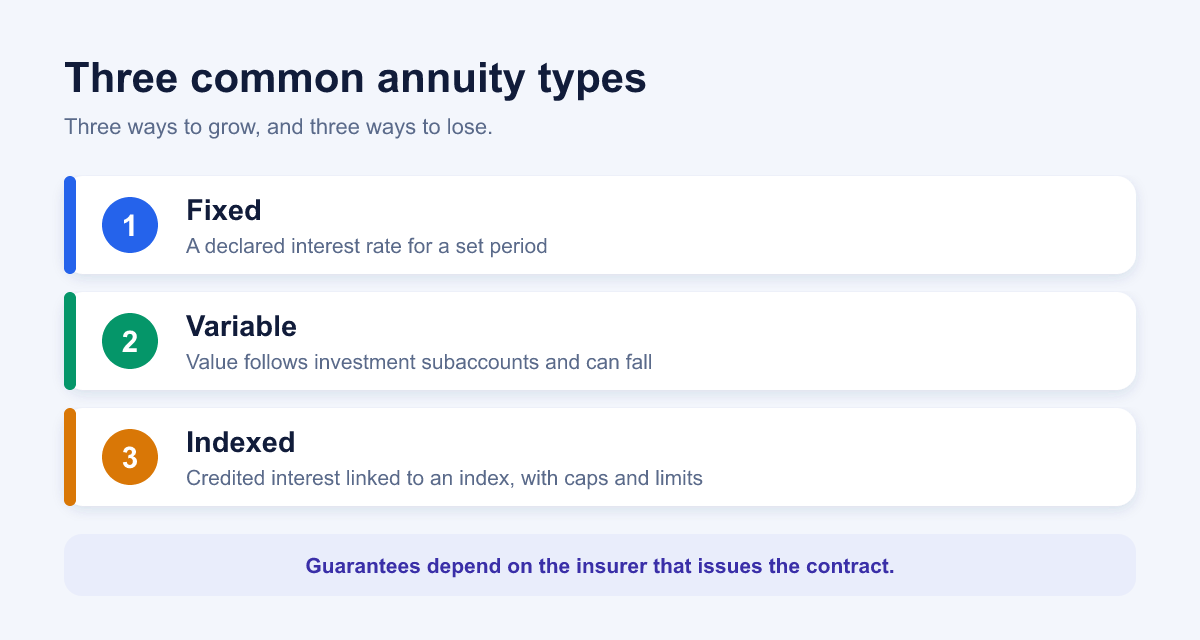
1. Fixed annuity: a declared interest rate for a set period
With a fixed annuity, the insurer sets the interest rate. The SEC says a fixed annuity guarantees at least a minimum interest rate during the accumulation phase; it may earn more, but only the minimum is guaranteed. FINRA adds that the rate is often fixed for a number of years and then changes periodically based on current rates. The usual trade-offs: little or no risk of losing money from markets (apart from surrender charges if you leave early), but lower growth potential, and payments that typically do not adjust for inflation.
2. Variable annuity: value follows investment subaccounts and can fall
A variable annuity works like an investment account wrapped in an insurance contract. You choose from a menu of subaccounts (often similar to mutual funds), and the contract's value rises or falls with them. The SEC states plainly that you can lose money in a variable annuity, including part of your original investment. FINRA points out that a variable annuity's annual expenses are likely to be much higher than those of a typical mutual fund, in exchange for features such as tax-deferred growth, a death benefit and payout options that can provide income for life. Variable annuities are securities: they are registered with the SEC, come with a prospectus, and are also regulated by FINRA and by state insurance regulators.
3. Indexed annuity: credited interest linked to an index, with caps and limits
An indexed annuity credits interest based in part on the performance of a market index, such as the S&P 500. It is not a direct investment in the index: the insurer applies formulas that usually limit how much of the index's gain you receive. Two sub-types matter:
- Fixed indexed annuities are insurance products. According to the SEC, the interest credited is never less than zero even if the market falls, but you do not know the rate in advance.
- Registered index-linked annuities (RILAs) are also securities. Unlike a fixed indexed annuity, you can lose money in a RILA; the insurer generally sets parameters that limit both gains and losses.
| Feature | Fixed | Variable | Indexed (fixed indexed / RILA) |
|---|---|---|---|
| How it grows | Declared rate set by the insurer | Performance of the subaccounts you choose | Interest linked to an index, after caps, participation rates or spreads |
| Can you lose money? | Generally no, other than surrender charges | Yes, potentially without limit | Fixed indexed: generally no, other than surrender charges. RILA: yes, within limits |
| Ongoing costs | Reflected in the interest rate | Explicit fees at the contract level and in the underlying funds | Reflected in the limits on gains, explicit fees, or both |
| Regulated as | Insurance product | Insurance product and security | Fixed indexed: insurance. RILA: insurance and security |
The table is a summary of the SEC's comparison chart. Always check the actual contract, because product designs vary and some contracts combine features.
How indexed crediting works (with a hypothetical example)
Indexed annuities are the hardest of the three to compare, and the SEC and FINRA both describe them as complex. Understanding a few terms from the SEC's investor bulletin on indexed annuities (dated July 31, 2020) goes a long way:
- Participation rate: the share of the index gain that is credited to you.
- Rate cap: the maximum positive return the contract can credit for the period.
- Spread (also called margin or asset fee): a set percentage subtracted from any gain.
- Floor and buffer (or shield): in contracts where losses are possible, a floor limits your loss to a set percentage; a buffer means the insurer absorbs losses up to a set percentage before you absorb the rest.
- Indexing method: for example point-to-point, which compares the index level at the start and end of the period, or averaging.
The bulletin also notes that gains are usually calculated without dividends, and that insurers commonly reserve the right to change some features periodically, such as the rate cap.
Hypothetical example (round numbers, not a real product). Suppose a period in which the index's price return is 12 percent. The table shows what could be credited under three different, made-up designs.
| Hypothetical design | Calculation | Credited |
|---|---|---|
| Participation rate of 80% | 12% x 80% | 9.6% |
| Rate cap of 6% | Lesser of 12% and 6% | 6% |
| Spread of 3% | 12% - 3% | 9% |
Now suppose the index falls 15 percent in a period. In a fixed indexed annuity the credited interest is not negative, in line with the SEC description above. In a hypothetical RILA with a 10 percent buffer, you would absorb 5 percent (15% - 10%). With a hypothetical 10 percent floor, you would absorb 10 percent, because the floor limits your loss to that amount (providers and regulators do not always use "floor" and "buffer" in exactly the same way, so check each contract's definitions). In every case, these formulas reduce your return the same way a direct fee would, even when the product is described as having "no fees."
Fees, charges and the surrender period
Fees reduce an annuity's value however they are collected. The SEC separates explicit fees, which are deducted from the contract value and appear on your statement, from implicit costs, which are harder to see because they are built into the interest credited or the limits on gains. Many fixed, fixed indexed and RILA contracts charge no explicit ongoing fees, but implicit costs still apply.
| Cost | What it is | Where it shows up |
|---|---|---|
| Surrender charge | Fee for withdrawing or surrendering within a set number of years; generally decreases over time | When you take money out early |
| Base contract fee (mortality and expense risk, administrative) | Often a percentage of contract value that pays the insurer for the risks it assumes | Deducted from investment returns (variable) |
| Underlying fund fees | Expenses of the subaccount funds you choose | Deducted from fund returns (variable) |
| Optional benefit (rider) fees | Extra charge for enhanced death benefits or guaranteed income features | Ongoing, only if you add the rider |
| Implicit costs | Lower credited interest, caps, participation rates, spreads | Inside the return you are credited |
| Contract adjustments | Market or interim value adjustments on early withdrawals in some contracts | Often negative, on top of any surrender charge |
FINRA warns that variable annuities can feature surrender periods of eight years or more, and that annuities can carry high commissions. Ask how the person selling the contract is paid.
Hypothetical illustration: a surrender schedule
Imagine a made-up contract with a seven-year surrender schedule on a $100,000 payment. The charge, as a percentage of the amount withdrawn, falls each contract year:
| Contract year | Surrender charge | Charge on a full $100,000 withdrawal | Amount you would receive before taxes |
|---|---|---|---|
| 1 | 7% | $7,000 | $93,000 |
| 2 | 6% | $6,000 | $94,000 |
| 3 | 5% | $5,000 | $95,000 |
| 4 | 4% | $4,000 | $96,000 |
| 5 | 3% | $3,000 | $97,000 |
| 6 | 2% | $2,000 | $98,000 |
| 7 | 1% | $1,000 | $99,000 |
| 8 and after | 0% | $0 | $100,000 |
Assumptions: no growth, no penalty-free withdrawal allowance and no market value adjustment. Real contracts differ, and some allow limited free withdrawals; read the schedule in the contract itself. The point is the shape: the cost of changing your mind is highest early and shrinks over time. Remember that exchanging one annuity for another can start a new surrender period. The SEC and FINRA both warn about this.
Hypothetical illustration: fee drag over 20 years
Small annual percentages compound. Suppose $100,000 earns a gross 6 percent a year for 20 years, and consider three different levels of total yearly costs (all made up for the exercise):
| Total annual costs | Net annual growth | Value after 20 years |
|---|---|---|
| 0.25% | 5.75% | $305,920 |
| 1.00% | 5.00% | $265,330 |
| 2.50% | 3.50% | $198,979 |
Between the lowest and highest cost levels the gap is more than $100,000 on the same gross return, which is why it is worth adding up every layer of cost (contract, funds, riders) rather than looking at one headline fee. Figures are rounded to the nearest dollar, ignore taxes and assume costs stay constant.
Riders and guaranteed income
Many annuities offer optional features, often called riders, for an additional charge. The SEC's variable annuity page lists several examples:
- Optional death benefits, such as a stepped-up benefit that locks in market gains as of a specified date.
- Guaranteed lifetime withdrawal benefits, which let you withdraw up to a certain amount each year for life regardless of market performance.
- Guaranteed minimum income benefits and guaranteed minimum accumulation benefits, which set a minimum value for income or for the contract after a stated number of years.
The SEC cautions that optional features may carry investment restrictions and limits, and that their benefits can be significantly reduced if you withdraw more than a certain amount or before a certain age. It also notes that some "guaranteed" benefits are contingent: they protect against unlikely events, such as severe market losses or a very long life, and you may pay for a benefit that never produces a financial return. Before paying for a rider, ask what it costs each year, what conditions keep it in force, and whether you could get the same protection more cheaply elsewhere.
How annuities are taxed (general rules)
Tax treatment is one of the reasons people buy annuities, and one of the most misunderstood parts. The points below are general; rules change and state taxes may apply, so a tax professional should review your situation.
- Tax-deferred growth. The SEC says you pay no taxes on interest or investment gains in the annuity until you withdraw the money, receive income payments or a death benefit is paid.
- Earnings come out as ordinary income. FINRA says that when you take money out, gains are taxed at ordinary income rates. Under section 72(e) of the Internal Revenue Code, as posted by Cornell's Legal Information Institute, an amount received before the annuity starting date is included in gross income to the extent it is allocable to income on the contract (the cash value above your investment in the contract), and the rest is a non-taxable return of your investment.
- Possible 10 percent additional tax before 59 and a half. Section 72(q) imposes an additional tax equal to 10 percent of the portion that is includible in gross income. It does not apply to distributions made on or after age 59½, after the holder's death, because of disability, or as part of certain series of substantially equal periodic payments, among other listed exceptions. The IRS also states that pension or annuity payments received before 59½ may be subject to the additional tax unless an exception applies.
- Income payments are partly taxable. If you contributed after-tax dollars, the IRS explains that you do not pay tax on the part of each payment that represents a return of what you paid in; the taxable portion is figured with the general rule or the simplified method (the IRS points to Publication 575 for details).
- Exchanges. FINRA notes that a "1035 exchange" lets you transfer an annuity into another policy without immediate tax, but it can bring surrender charges and a new surrender period.
Hypothetical example: an early withdrawal
Say you paid $100,000 in after-tax money into a deferred annuity that is now worth $120,000, and you withdraw $20,000 before you reach 59½, with no exception applying. Under the ordering rule above, the entire $20,000 comes from earnings and is included in your gross income, taxed at your ordinary rate for that year. The 10 percent additional tax would be $2,000 (10% x $20,000), on top of that income tax and on top of any surrender charge the contract imposes. This is an illustration of the mechanism, not a calculation for your situation.
Qualified vs non-qualified: a short note
A "non-qualified" annuity is bought with after-tax money outside a retirement account. A "qualified" annuity is held inside a plan such as an IRA or 401(k). FINRA explains that non-qualified contributions cannot be deducted, that annuities have no annual contribution limits of their own, and that if you buy an annuity inside an IRA or 401(k) you get no additional tax advantage. The SEC likewise advises caution when someone suggests an annuity inside a tax-deferred plan and says to ask how it fits your overall situation. If you are moving a workplace plan, our guide on a 401(k) rollover to an IRA covers the mechanics.
What backs the guarantee: the insurer and state guaranty associations
Almost every promise in an annuity, whether a minimum rate, a death benefit or lifetime income, is a promise by the issuing insurer. The SEC says an insurer's obligations are subject to its financial strength and claims-paying ability: if the company has financial difficulties, it may not be able to pay you. FINRA makes the same point and mentions that credit rating agencies publish ratings of insurance companies.
The safety net has a different shape than bank deposit insurance. The NAIC reports that all 50 states, Puerto Rico and the District of Columbia have a guaranty mechanism for covered claims when a licensed insurer becomes insolvent. In a life or health insurer liquidation, it provides for the continuation of eligible contracts that would otherwise terminate. The associations are funded by assessments on solvent insurers, are subject to statutory limitations, and their duties are limited to covered policies or claims as set out in each state's law. In short: protection exists, but it is state-based, has limits and depends on the details of the statute where you live. Ask the seller, or your state insurance department, how it would apply to the contract you are considering.
Questions to ask before you buy an annuity
The SEC's page lists questions to ask before buying; the five below distill the most important ones.
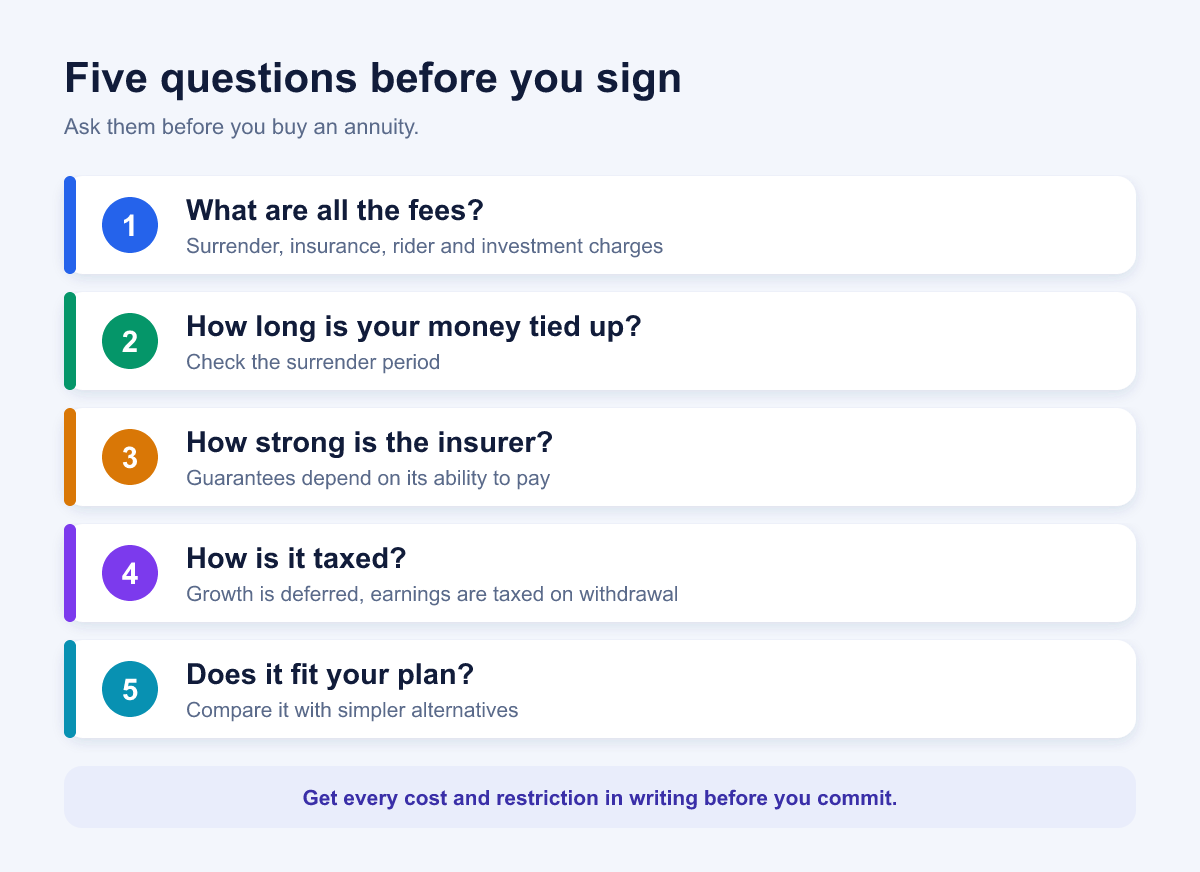
1. What are all the fees?
Ask for every charge in writing: surrender, insurance and administrative, fund expenses, rider fees, and any implicit costs such as caps, participation rates or spreads. For variable and RILA contracts, the prospectus lays out costs. Ask also how the person selling the contract is compensated.
2. How long is your money tied up?
Find the length of the surrender period and the schedule of charges, whether partial penalty-free withdrawals are allowed, and whether any market value or interim value adjustment applies. The SEC suggests asking whether you intend to keep the money in long enough to avoid surrender charges, tax penalties and contract adjustments.
3. How strong is the insurer?
Guarantees depend on its ability to pay. Look at the insurer's financial strength and customer service record, and ask how your state's guaranty association would treat the contract.
4. How is it taxed?
Growth is deferred, and earnings are taxed on withdrawal. Ask how the contract is classified (qualified or non-qualified), how withdrawals and income payments are taxed, and whether the 10 percent additional tax could apply to you. A tax professional can answer for your own situation.
5. Does it fit your plan?
Compare it with simpler alternatives. Consider your goals, risk tolerance, need for cash and other investments, and whether you would still be comfortable if you could not touch this money for the whole surrender period.
Use the free-look period
The SEC says state law gives you a set number of days, usually 10 to 30, to change your mind after you receive the contract; this is often called a free-look period. The contract should state prominently how long it is and how to return it. Read the contract and any prospectus during that window and check that they match what you were told. For variable annuities, the refund may be adjusted up or down to reflect investment performance.
Who annuities may fit, and who they may not
There is no universal verdict. An annuity is a tool that solves certain problems at a certain cost. These criteria can help you think it through.
| May be worth considering if... | May be a poor match if... |
|---|---|
| You want income you cannot outlive and are willing to give up flexibility to get it | You may need the money in the next several years |
| You have a long time horizon and have already used other tax-advantaged accounts | You are buying inside an IRA or 401(k) mainly for the tax deferral you already have |
| You understand every fee, rider and limit and accept them | You cannot explain how the contract credits interest or what it costs |
| You are comfortable with the insurer's financial strength | You are being pushed to decide quickly or to replace an existing annuity |
Three hypothetical profiles
These examples are invented to show how the criteria work. They are not recommendations.
- Profile A: the income seeker. Maria, 66, worries about outliving her savings and has already planned how to cover essential expenses. She could ask how much guaranteed lifetime income an immediate or deferred contract would provide, what happens to payments after her death, and whether inflation adjustments are available and what they cost (FINRA notes that inflation protection generally costs significantly more).
- Profile B: the accumulator. Dan, 48, has maxed out his workplace plan and an IRA, has no need for the money for 15 years and likes the idea of tax deferral. He would want to compare a variable contract's total costs against low-cost funds in a regular account, since FINRA says variable annuity expenses are likely to be much higher than a typical mutual fund's.
- Profile C: the cautious saver. Priya, 58, wants no market risk on part of her savings but may need cash within a few years. Surrender charges and the early-withdrawal tax rules make a long lock-up a potential problem. She might compare fixed contracts with simpler options.
Alternatives worth comparing
Whatever you consider, compare it with plainer options that solve part of the same problem:
- Certificates of deposit and savings accounts. Our guide to CDs vs high-yield savings accounts explains how they work. They are held at banks, a different structure from an insurer's contract.
- Bonds and bond funds, which can provide income with different risks (price changes, credit risk, interest rate risk).
- Low-cost diversified funds. If a variable annuity's subaccounts resemble funds, ask how their costs compare with what you would pay outside the contract; see our overview of index funds, ETFs and mutual funds.
- Delaying Social Security. Claiming later raises the monthly benefit you receive for life, which some people treat as a built-in form of lifetime income. Our guide on how Social Security benefits are calculated and when to claim explains the trade-off.
Each alternative has its own costs and risks, but putting two or three side by side before signing is a good way to see what an annuity's extra features actually cost.
Red flags, license checks and common mistakes
Warning signs
- Pressure to decide on the spot, or to move money from an existing annuity into a new one. The SEC says some professionals may have a financial incentive to offer a new annuity, and an exchange may mean surrender charges on the old contract and a new surrender period on the new one.
- Vague answers about total costs, caps or how the interest is calculated.
- Descriptions such as "no fees" or "market gains with no risk" without a clear explanation of the limits on your gains. The SEC notes that caps, participation rates and spreads reduce your return like a fee would.
- Refusal to give you the contract or prospectus to read before you commit.
How to check who you are dealing with
- Insurance license and complaints: annuities are regulated by state insurance commissioners. The NAIC has a page to find your state insurance department, where you can look into agents and companies and file a complaint.
- Securities registration: for variable annuities and RILAs, FINRA recommends checking your broker on FINRA BrokerCheck for licenses and complaint history. The SEC also points to its Check Out Your Investment Professional tool on Investor.gov.
Common mistakes
- Focusing on the highest advertised rate or index credit and ignoring caps, spreads and conditions.
- Not reading the surrender schedule, and then needing the money in year three.
- Buying an annuity inside an IRA or 401(k) without asking what the annuity adds beyond the tax deferral the account already provides.
- Paying for riders that you will never use, or that lose value if you withdraw at the wrong time.
- Assuming a state guaranty association works like FDIC insurance.
- Putting too large a share of your savings in a contract you cannot easily leave.
In summary
- An annuity is an insurance contract with an accumulation phase and a payout phase; it can be immediate or deferred.
- Fixed: a declared rate set by the insurer. Variable: value follows subaccounts and can fall. Indexed: credited interest linked to an index, with caps and limits; a RILA can lose money.
- Add up every cost: surrender charges, contract and fund fees, rider fees and implicit costs.
- Check the surrender period before you sign, and use the free-look period.
- Growth is tax-deferred, earnings are taxed as ordinary income when withdrawn, and a 10 percent additional tax can apply before 59½.
- Guarantees depend on the insurer's claims-paying ability; state guaranty associations have limits and are not FDIC insurance.
- Compare with simpler alternatives, verify licenses, and be wary of pressure or replacement offers.
This guide is general information, not financial, tax or legal advice. Annuity contracts, tax rules and state protections vary and change; for decisions about your own money, read the contract and prospectus and consult a qualified professional.
Frequently asked questions
Are annuities safe?
It depends on the type and the insurer. Fixed annuities generally do not lose value to market moves, while variable annuities can lose value and RILAs can lose within limits. All of them rely on the insurer's ability to pay, and annuities are not covered by the FDIC or SIPC. State guaranty associations offer limited protection when an insurer fails.
What is the difference between a fixed and an indexed annuity?
A fixed annuity credits interest at a rate the insurer sets. A fixed indexed annuity credits interest based partly on an index, subject to caps, participation rates or spreads, and the SEC says the credited interest is never less than zero. Neither is a direct investment in the index.
Can I lose money in an annuity?
Yes. Variable annuities and RILAs can lose value. Even fixed and fixed indexed contracts can cost you money if you withdraw early, through surrender charges, contract adjustments and taxes, so the amount you receive can be lower than what you paid in.
Are annuity withdrawals taxable?
Growth is tax-deferred, but when you withdraw earnings they are generally taxed as ordinary income. Withdrawals before age 59½ may also carry a 10 percent additional tax unless an exception applies. Your own result depends on how the contract is classified and your situation, so ask a tax professional.
What is a free-look period?
It is a window, usually 10 to 30 days according to the SEC, during which you can cancel a newly issued annuity after receiving the contract. The contract should state its length and how to return it. For a variable annuity, the refund may be adjusted up or down for investment performance.
How do I check the person selling me an annuity?
Annuities are regulated by state insurance commissioners, so start with your state insurance department. If the product is a variable annuity or RILA, also use FINRA BrokerCheck and the SEC's Check Out Your Investment Professional tool to see registration and disciplinary history.
Sources
- Investor.gov (SEC): Annuities
- Investor.gov (SEC): Variable Annuities
- Investor.gov (SEC): Updated Investor Bulletin: Indexed Annuities (July 31, 2020)
- FINRA: Annuities
- NAIC: Annuities
- NAIC: Guaranty Associations and Funds
- IRS: Topic no. 410, Pensions and annuities
- Cornell Legal Information Institute: 26 U.S. Code section 72, Annuities; certain proceeds of endowment and life insurance contracts