You spent decades putting money into a traditional IRA or a workplace plan, and the tax code let that money grow without being taxed each year. At some point, the government wants its share. That is what a required minimum distribution, or RMD, is: the minimum amount you must withdraw from certain retirement accounts each year once you reach the required age. Miss it, and the IRS can charge an excise tax on the amount you should have taken out.
The rules are not complicated once you see the pieces, but there are several of them: which accounts are covered, how old you must be, two possible deadlines in the first year, a division using an IRS table, and different handling for IRAs and for 401(k) plans. This guide walks through each piece in plain language, with two clearly hypothetical worked examples, a table of common mistakes, a checklist and an FAQ. Rules, ages and dollar limits quoted here were checked on the official pages listed at the end in November 2026 and can change, so confirm them on IRS.gov before you act. This guide is general information, not personalized advice.
What an RMD is and why it exists
Contributions to a traditional IRA or a pre-tax 401(k) are generally made before income tax, and the earnings grow tax-deferred. The IRS says plainly that you cannot keep retirement funds in your account indefinitely: you generally have to start taking withdrawals from your IRA, SIMPLE IRA, SEP IRA or retirement plan account once you reach the applicable age. The yearly minimum you must withdraw is your RMD.
Three basic points shape everything else:
- You can always withdraw more than the minimum. The RMD is a floor, not a cap.
- Withdrawals are generally taxable income, except for any part that was already taxed (your basis) or that can be received tax-free, such as qualified distributions from designated Roth accounts.
- You are responsible for taking the right amount on time. The IRS notes that a custodian or plan administrator may calculate the figure, but the account owner is ultimately responsible for taking the correct RMD.
Which accounts have RMDs
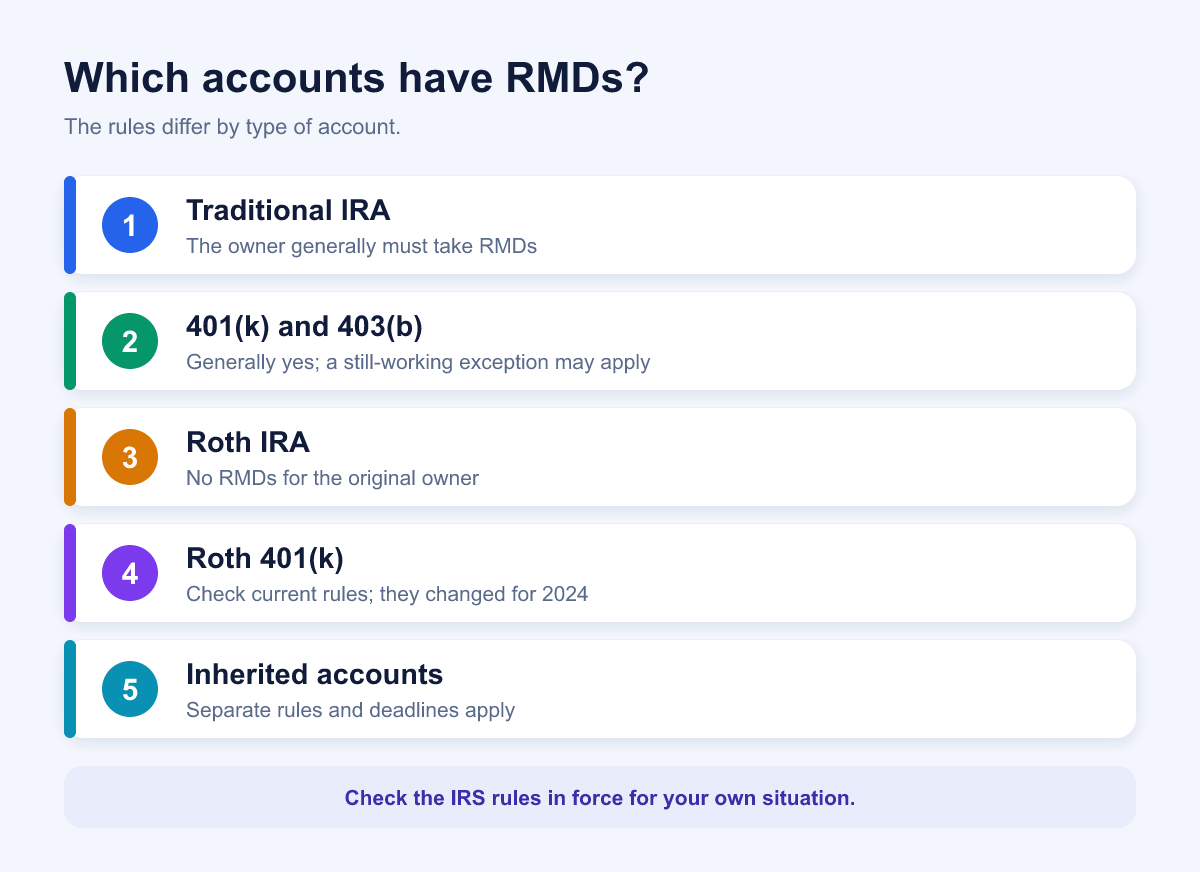
RMD rules apply to traditional IRAs and IRA-based plans (SEP IRAs and SIMPLE IRAs), and to employer-sponsored plans including 401(k), 403(b), 457(b) and profit-sharing plans, according to the IRS. They do not apply to Roth IRAs or designated Roth accounts while the owner is alive. Inherited accounts follow separate rules. The figure below summarizes the five situations most readers ask about, and the sections that follow take them in the same order.
1. Traditional IRA (including SEP and SIMPLE IRAs)
The owner generally must take RMDs, even if still working and even if retired. The IRS states that owners of traditional, SEP and SIMPLE IRAs must begin taking RMDs at the applicable age regardless of employment status. There is no "still working" exception for IRAs.
2. 401(k) and 403(b) plans
RMDs generally apply here too, as they do for 457(b) plans. The difference is a possible still-working exception: under the IRS description, participants in a workplace plan can delay RMDs from that plan until the year they retire, unless they are a 5% owner of the business sponsoring the plan. The IRS adds that the plan document may require distributions to begin at the applicable age even if you are still employed, so the plan's own terms matter. An RMD from an IRA is separate and is not delayed by working.
3. Roth IRA
No RMDs for the original owner. The IRS says Roth IRAs are not subject to RMDs while the owner is alive. Beneficiaries of Roth IRAs, however, are subject to RMD rules.
4. Roth 401(k) and other designated Roth accounts
Check current rules, because they changed. Under the SECURE 2.0 Act, the Internal Revenue Code (section 402A(d)(5)) now provides that the lifetime required-distribution rules do not apply to designated Roth accounts, with an effective date for taxable years beginning after December 31, 2023. Before that change, Roth 401(k) and Roth 403(b) accounts had lifetime RMDs, which is why older articles may still say otherwise. The IRS pages quoted in this guide now say designated Roth accounts in 401(k) and 403(b) plans are not subject to RMDs while the owner is alive. If you hold both pre-tax and Roth money in the same plan, ask the administrator how the RMD is calculated for the pre-tax portion. For the broader choice between the two account types, see our guide to 401(k) vs Roth 401(k).
5. Inherited accounts
Separate rules and deadlines apply. They depend on who inherited the account, when the owner died and whether the owner had already reached the required beginning date. As a summary of what the IRS says: for owners who died after December 31, 2019, the SECURE Act generally requires the entire balance to be distributed within ten years, with exceptions for a surviving spouse, a child who has not reached the age of majority, a disabled or chronically ill person, and a person not more than ten years younger than the owner. This guide does not go deeper than that. If you inherited an account, start with the IRS chart of required minimum distributions for IRA beneficiaries and the Publication 590-B section on beneficiaries.
| Account | RMDs for the original owner? | Key point |
|---|---|---|
| Traditional IRA, SEP IRA, SIMPLE IRA | Yes | No still-working exception |
| 401(k), 403(b), 457(b), profit-sharing | Yes, generally | May be delayed until retirement if the plan allows it and you are not a 5% owner |
| Roth IRA | No | Beneficiaries are subject to RMD rules |
| Designated Roth account in a workplace plan | No, for taxable years beginning after December 31, 2023 | Older sources may still show the former rule |
| Inherited account | Not applicable | Beneficiary rules, often with a ten-year deadline |
Starting age by birth year and deadlines
The starting age depends on your birth year
The age at which RMDs begin has changed several times in recent years. Publication 590-B explains that the required beginning date for an IRA is April 1 of the year after you reach the applicable age, and that the age was 70½ for those who reached it before 2020, then 72 for a short transition, and 73 for tax years 2023 and later. Congress then set a further increase to 75.
The statute (26 U.S.C. 401(a)(9)(C)(v)) says the applicable age is 73 for an individual who attains age 72 after December 31, 2022 and age 73 before January 1, 2033, and 75 for an individual who attains age 74 after December 31, 2032. The Treasury regulation on the topic turns that into birth years. At the time of writing (November 2026), it reads as follows.
| Birth year | Applicable age | Source wording |
|---|---|---|
| Before July 1, 1949 | 70½ | Treas. Reg. 1.401(a)(9)-2(b)(2)(ii) |
| July 1, 1949 through 1950 | 72 | Treas. Reg. 1.401(a)(9)-2(b)(2)(iii) |
| 1951 through 1958 | 73 | Treas. Reg. 1.401(a)(9)-2(b)(2)(iv) |
| 1959 | Check with the IRS or your plan | That paragraph of the regulation is shown as "Reserved" |
| 1960 or later | 75 | Treas. Reg. 1.401(a)(9)-2(b)(2)(vi) |
The row for 1959 is not a typo. The statute's two age definitions overlap for people who attain 73 in 2032 and 74 in 2033, and the regulation leaves that birth year reserved. If you were born in 1959, confirm your applicable age with the IRS, your plan administrator or a qualified professional rather than relying on a general guide. The IRS pages on RMDs that we opened for this guide still describe age 73, which matches the 1951 through 1958 group, so use the birth-year table above and the statute for later groups.
You "reach" the age on your birthday: the IRS comparison chart says you reach age 73 on your 73rd birthday. What counts is the calendar year in which you reach it, not the exact date.
Deadlines: the first RMD and every one after it
For IRAs, the first RMD is for the year you reach the applicable age, but you may delay taking it until April 1 of the following year. That date is called your required beginning date. Every RMD after that is due by December 31 of each year.
Why delaying the first one means two distributions in one year
The delay has a catch that the IRS spells out. If you wait until April 1, you will generally have two required distribution dates in the same calendar year: the first RMD (for the year you reached the age) by April 1, and the second RMD (for the following year) by December 31. Both are taxable in that second year. You can instead take the first RMD by December 31 of the year you reach the age, which keeps the two distributions in separate tax years. Any amount you receive in the year you reach the age counts toward the amount due by April 1.
The IRS gives an example for someone who reaches age 73 on August 20, 2024: the 2024 RMD is due by April 1, 2025, based on the December 31, 2023 balance, and the 2025 RMD is due by December 31, 2025, based on the December 31, 2024 balance.
Workplace plans: the "later of" rule
For a 401(k), 403(b) or other defined contribution plan, the IRS describes the first deadline as generally April 1 following the later of the calendar year in which you reach the applicable age or the calendar year in which you retire, if the plan allows delaying until retirement. The 5% owner exception means a person who is a 5% owner of the company sponsoring the plan cannot use the retirement delay for that plan; the statute uses the definition in section 416 of the Internal Revenue Code. Because an IRA RMD and a plan RMD are separate, your IRA RMD is not affected by a plan's retirement delay.
How to calculate your RMD
For any year, the RMD is the account balance as of the end of the previous calendar year divided by a distribution period from an IRS table. The IRS summarizes it as the prior December 31 balance divided by a life expectancy factor.
- Find the balance on December 31 of the prior year for each account. Publication 590-B notes that the balance is adjusted for outstanding rollovers that are not in any account at year-end, so check the worksheet if you had a rollover in progress.
- Find your age on your birthday this year, and look up the distribution period (also called the applicable denominator) in the right table of Publication 590-B.
- Divide the balance by the distribution period.
Which table applies
| Table in Publication 590-B | Who uses it |
|---|---|
| Table III, Uniform Lifetime | Unmarried owners, married owners whose spouses are not more than 10 years younger, and married owners whose spouses are not the sole beneficiary |
| Table II, Joint Life and Last Survivor Expectancy | Owners whose sole beneficiary is a spouse more than 10 years younger |
| Table I, Single Life Expectancy | Beneficiaries of an inherited account |
For most owners, Table III applies. A few of its published distribution periods, as shown in Publication 590-B (2025): age 72 is 27.4, age 73 is 26.5, age 74 is 25.5, age 75 is 24.6, age 76 is 23.7 and age 77 is 22.9. The IRS also publishes RMD worksheets that walk through the arithmetic. Always use the table in force for the year of the withdrawal, since tables can be revised.
Worked examples
Example 1: one account
The figure below shows the calculation in three steps. This is a hypothetical example with round numbers, and the IRS table in force at the time of your withdrawal should be used for a real calculation.
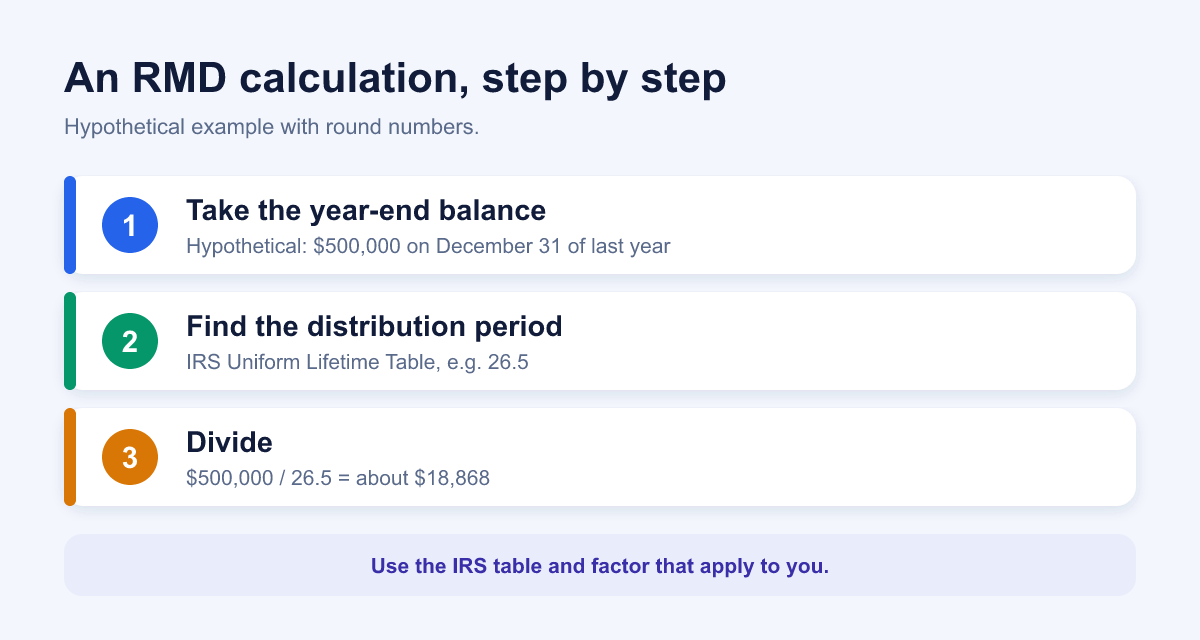
Hypothetical example. Assume an unmarried owner turns 73 during the year, has one traditional IRA, and that IRA was worth $500,000 on December 31 of last year. In Table III, the distribution period for age 73 is 26.5. The RMD is $500,000 / 26.5 = about $18,868.
Now assume the owner waits until the April 1 deadline for that first RMD. Suppose the IRA is worth $520,000 on December 31 of the year the owner turned 73 (a made-up figure). In the next year the owner is 74, and Table III gives 25.5, so that year's RMD is $520,000 / 25.5 = about $20,392. Both RMDs fall in the second year: about $18,868 by April 1 and about $20,392 by December 31, or roughly $39,260 of taxable distributions in a single calendar year. Taking the first one by December 31 of the year the owner turned 73 would have spread the income over two tax years. That is a trade-off to understand, not a recommendation either way.
Example 2: two IRAs and one 401(k)
The aggregation rules are where many people trip. According to the IRS, an IRA owner must calculate the RMD separately for each IRA but can withdraw the total from one or more of the IRAs. The same idea applies to 403(b) contracts. But RMDs from other plans, such as 401(k) and 457(b) plans, must be taken separately from each of those plan accounts. Money cannot be mixed between the groups.
Hypothetical example. Assume an unmarried owner is 74, so the Table III distribution period is 25.5. Balances on December 31 of last year: IRA A, $200,000; IRA B, $100,000; a 401(k) at a former employer, $300,000.
| Account | Balance | Calculation | RMD | Where it can come from |
|---|---|---|---|---|
| IRA A | $200,000 | $200,000 / 25.5 | about $7,843 | Any one or both IRAs (total about $11,765) |
| IRA B | $100,000 | $100,000 / 25.5 | about $3,922 | |
| 401(k) | $300,000 | $300,000 / 25.5 | about $11,765 | Only from the 401(k) |
| Total | $600,000 | about $23,529 |
The owner could take the whole $11,765 IRA amount from IRA A, or split it any way across the two IRAs, but would still need to take $11,765 from the 401(k). Taking the entire $23,529 from IRAs would leave the 401(k) RMD unmet. In this hypothetical case the shortfall of about $11,765 could trigger the excise tax described below, which is why wrong-account withdrawals matter.
QCDs, taxes, withholding and rollovers
Qualified charitable distributions (QCDs)
A qualified charitable distribution is a direct transfer from an IRA to an eligible charity. Publication 590-B says a QCD is generally a nontaxable distribution made directly by the IRA trustee (other than from an ongoing SEP or SIMPLE IRA) to an organization eligible to receive tax-deductible contributions. You must be at least age 70½ when the distribution is made, and you need the same type of acknowledgment from the charity that you would need to claim a deduction.
- It can count toward your RMD. The publication states that a QCD counts toward your required minimum distribution.
- There is an annual cap. For 2025, the maximum annual exclusion is $108,000 per person (a spouse filing jointly can also use up to that amount from their own IRA). The limit is adjusted for inflation each year, and the publication's 2026 worksheet uses $111,000. Check IRS.gov for the current figure.
- No double benefit. You cannot claim a charitable contribution deduction for a QCD that is not included in your income.
- The money must go straight to the charity. A withdrawal paid to you and then donated is not a QCD.
QCD rules include some adjustments, for example when you deducted IRA contributions after age 70½. Read the QCD section of Publication 590-B or ask a tax professional before relying on one.
Taxes
Distributions from traditional IRAs that you include in income are taxed as ordinary income. Publication 590-B adds that the 10-year tax option and capital gain treatment that apply to certain lump-sum distributions from qualified plans cannot be used for them. An RMD from a pre-tax account therefore adds to your taxable income for the year. Higher income can interact with other income-based items on your return, so it is worth reading how those rules work for you, for example how your Social Security benefits fit with other income.
Withholding
Publication 590-B says federal income tax is withheld from traditional IRA distributions unless you choose not to have tax withheld. You use Form W-4R for nonperiodic payments, and the default withholding is generally 10% on those payments. For payments from a workplace plan, ask the plan administrator how withholding is handled. Withholding is only a prepayment: the tax actually owed depends on your whole return.
RMDs cannot be rolled over
Publication 590-B states that amounts that must be distributed as RMDs during a particular year are not eligible for rollover treatment. In practice, if you are moving a plan balance to an IRA in a year when an RMD is due, the RMD portion has to be paid out to you first and cannot be rolled over. Our guide to a 401(k) rollover to an IRA explains the mechanics of a normal rollover.
Extra withdrawals do not carry forward
Taking more than the minimum in one year does not reduce a later year's RMD. Publication 590-B gives an example in which an owner withdrew more than required for 2025 and still had to figure 2026's RMD from the new December 31 balance.
The penalty for missing an RMD
If distributions are less than the required amount, you may owe an excise tax on the amount not distributed. At the time of writing, the IRS says the rate is 25% of the shortfall. A reduced rate of 10% applies if you take the missed distribution and submit a return reflecting the tax within the "correction window," which ends on the earliest of the date a deficiency notice is mailed, the date the tax is assessed, or the last day of the second taxable year beginning after the year the tax is imposed.
In the second hypothetical example above, a shortfall of about $11,765 would mean about $2,941 at 25% or about $1,176 at 10%. Those numbers are for illustration only.
Reporting and asking for a waiver
You report the tax on Form 5329. The instructions explain that the IRS can waive part or all of the tax if the shortfall was due to reasonable error and you are taking reasonable steps to remedy it. To ask, you attach a statement of explanation and complete Form 5329 as the instructions direct (the instructions describe entering "RC" and the amount to be waived). The IRS then decides whether to grant the waiver. Because the process has specific steps, read the current Form 5329 instructions or talk to a tax professional if you think you missed an RMD.
Planning ideas and common mistakes
General planning ideas (informational)
Because RMDs are fixed by formula, many people read about ways to manage the income they create. These are the common topics, described without any suggestion that they fit your situation.
- Roth conversions before RMD age. Moving money from a traditional IRA to a Roth IRA creates taxable income in the year of the conversion, but Roth IRAs have no lifetime RMDs for the original owner. Because an RMD cannot be rolled over, the RMD for the year generally has to be withdrawn first. Our guide to the backdoor Roth and conversion ladder explains the mechanics and tax trade-offs.
- Qualified charitable distributions. For people who give to charity anyway, a QCD can satisfy part or all of an RMD without the withdrawal being included in income, within the annual limit.
- Timing of the first RMD. Taking it in the year you reach the age, or waiting until April 1, changes which tax years the income falls in.
- Consolidating accounts. Fewer IRAs mean fewer separate calculations, though consolidation has its own tax and administrative considerations.
Each of these has costs, rules and exceptions. A tax professional who knows your whole picture is the right person to weigh them.
Common mistakes
| Mistake | Why it happens | How to avoid it |
|---|---|---|
| Missing the first deadline | The April 1 date feels distant, and the second RMD due that same year is easy to overlook | Calendar both dates; know that waiting creates two distributions in one year |
| Using the wrong balance date | Using today's balance instead of the prior December 31 balance | Use the year-end statement and the IRS worksheet |
| Forgetting an inherited account | It sits at a different custodian and has its own schedule | List every account you own or inherited, with its deadline |
| Assuming a Roth IRA needs an RMD | Confusing traditional and Roth rules | Roth IRAs have no RMDs for the original owner; beneficiaries differ |
| Withdrawing from the wrong account | Pooling IRA and 401(k) amounts | IRAs can be aggregated with IRAs; each 401(k) or 457(b) is separate |
| Relying on the custodian entirely | Assuming the institution will always take care of it | The owner is responsible, so double-check the totals |
Three hypothetical profiles
These are made-up situations to show how the rules combine. They are not recommendations.
- Profile A: born in 1953, retired, one traditional IRA. Under the birth-year table, the applicable age is 73, reached in 2026. The first RMD is for 2026, based on the December 31, 2025 balance, and can wait until April 1, 2027 (with the second RMD for 2027 due by December 31, 2027) or be taken in 2026.
- Profile B: still working at 73, with a 401(k) and an IRA. If the employer plan allows it and the person is not a 5% owner, RMDs from that 401(k) may be delayed until the year of retirement. The IRA is different: its RMD is due regardless of work status.
- Profile C: born in 1961, a Roth IRA and a traditional IRA. The applicable age for this birth year is 75, so the first RMD would be for 2036. The Roth IRA never requires an RMD for the original owner; only the traditional IRA does, once the age is reached.
In summary
- An RMD is the yearly minimum you must withdraw from traditional IRAs and workplace plans once you reach the applicable age; you can always take more.
- Applicable age by birth year: 73 for 1951 through 1958, 75 for 1960 or later; confirm 1959 with the IRS or your plan (at the time of writing).
- First RMD: by April 1 of the following year; later RMDs by December 31. Waiting for April 1 means two distributions in one year.
- Formula: prior December 31 balance divided by the Table III distribution period (Table II if your sole beneficiary spouse is more than 10 years younger).
- IRAs can be aggregated with each other; 401(k) and 457(b) plans are calculated and taken per plan.
- Roth IRAs and designated Roth accounts have no lifetime RMDs for the original owner; inherited accounts have their own rules.
- RMDs are not eligible for rollover and are generally taxed as ordinary income.
- A missed RMD can trigger a 25% excise tax (10% if corrected in time); use Form 5329 to report it and to request a waiver for reasonable error.
- Keep a list of accounts, balances, deadlines and withdrawals each year.
This guide is general information, not legal, tax or financial advice. RMD rules are detailed and change, so confirm your situation with the IRS, your plan administrator or a qualified tax professional.
Frequently asked questions
Do I have to take an RMD from a Roth IRA?
No. The IRS says Roth IRAs are not subject to RMDs while the owner is alive. Beneficiaries of a Roth IRA, however, are subject to RMD rules.
What happens if I am still working at the RMD age?
For a workplace plan such as a 401(k), the IRS says participants can generally delay RMDs from that plan until the year they retire, unless they are a 5% owner of the sponsoring business, and the plan's terms can require earlier distributions. The exception does not apply to IRAs, which have RMDs regardless of employment.
Can I take my whole RMD from just one IRA?
If you own several traditional IRAs, you calculate the RMD for each, but you can add the amounts and take the total from one or more of them. This does not extend to 401(k) or 457(b) plans, which must be handled plan by plan.
Can I roll over or convert my RMD to a Roth IRA?
No. Publication 590-B says RMD amounts are not eligible for rollover. The RMD for the year generally must be withdrawn first, and any conversion applies to amounts above it. The withdrawn RMD remains taxable.
What if I forgot to take an RMD?
Take the missed amount as soon as possible and read the Form 5329 instructions. The excise tax is 25% of the shortfall at the time of writing, reduced to 10% if you correct within the correction window, and the IRS can waive it if the shortfall was due to reasonable error and you are taking reasonable steps to fix it. A tax professional can help with the filing.
Why does my plan or custodian show a different RMD than my own calculation?
Differences can come from the balance date, the table used (for example Table II if your spouse is more than 10 years younger and your sole beneficiary), outstanding rollovers, or whether accounts are grouped correctly. The IRS says the custodian may calculate the amount, but you are ultimately responsible, so compare the figure with the IRS worksheet and ask the institution to explain any gap.
Sources
- IRS: Retirement topics, required minimum distributions (RMDs)
- IRS: Retirement plan and IRA required minimum distributions FAQs
- IRS: Publication 590-B, Distributions from Individual Retirement Arrangements (IRAs)
- IRS: RMD comparison chart (IRAs vs. defined contribution plans)
- IRS: Instructions for Form 5329, Additional Taxes on Qualified Plans (Including IRAs) and Other Tax-Favored Accounts
- Cornell Law School Legal Information Institute: 26 U.S. Code section 401, qualified pension, profit-sharing, and stock bonus plans
- Cornell Law School Legal Information Institute: 26 U.S. Code section 402A, optional treatment of elective deferrals as Roth contributions
- Cornell Law School Legal Information Institute: 26 CFR 1.401(a)(9)-2, distributions commencing during an employee's lifetime