You open a renewal notice or an online quote and see a line of terms: bodily injury, property damage, collision, comprehensive, uninsured motorist, medical payments. Somewhere nearby, a salesperson or a friend says you should "just get full coverage" or, to save money, "just carry the minimum." Both pieces of advice skip the useful part: what each coverage actually pays for, what the minimum leaves out, and which pieces make sense for your car, your savings and your risk.
This guide explains the main auto insurance coverages in plain language, what state minimum liability requirements do and do not cover, how to think about liability-only versus broader coverage, how deductibles work, how insurers set premiums and how to compare quotes fairly. It closes with practical ways to lower your premium without stripping out protection you may need. Every dollar figure in the worked examples is hypothetical, with round numbers chosen only to show the arithmetic. Your actual prices and rules depend on your state, your insurer and your situation.
The five coverages, side by side
A personal auto policy is a bundle of separate coverages. Each one pays for a different kind of loss, and each can be added, raised, lowered or sometimes removed. The National Association of Insurance Commissioners (NAIC) describes auto insurance as a legal agreement between you and the insurer: it promises to cover certain risks listed in the policy, as long as they happen while the policy is active and within the coverage limits. The figure below summarizes the five coverages you will see most often.
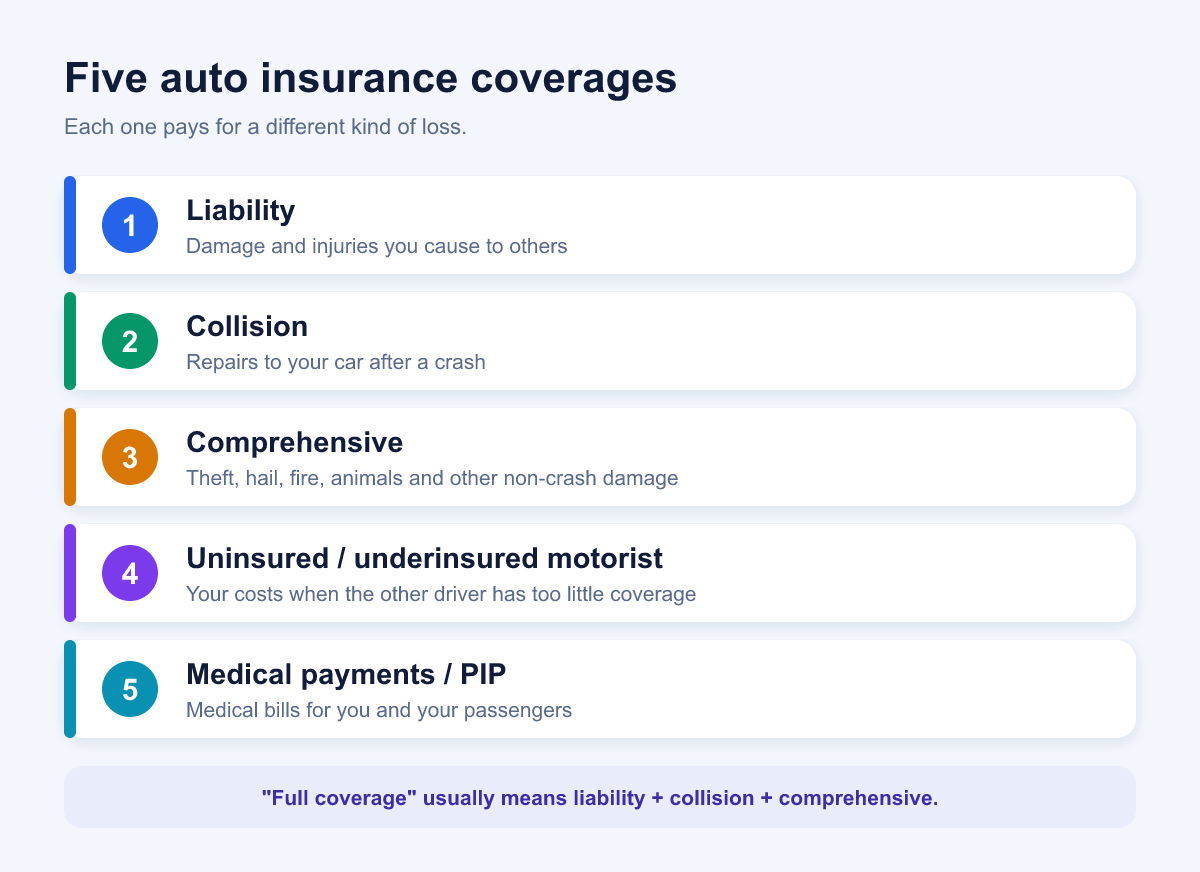
1. Liability: damage and injuries you cause to others
Liability coverage pays when you are at fault and other people suffer a loss. It has two main parts, according to the NAIC:
- Bodily injury liability covers medical expenses for other people injured in an accident caused by the insured driver.
- Property damage liability covers repairs to another person's vehicle or other property when the insured driver is at fault.
Liability does not pay for your own car or your own injuries, and it stops at the limits printed on your policy. Limits are often written as three numbers, such as 30/60/25: the maximum per injured person, the maximum per accident for all injuries, and the maximum for property damage, in thousands of dollars. That example comes from the Texas Department of Insurance's consumer guide, which describes it as that state's required minimum. Other states set different numbers.
2. Collision: repairs to your car after a crash
Collision pays for damage to your own vehicle from hitting another car or an object. It usually comes with a deductible, the amount you pay before the insurer pays the rest. The NAIC notes that collision is not required by state law, although a lender may require it on a financed or leased vehicle.
3. Comprehensive: theft, hail, fire, animals and other non-crash damage
Comprehensive, sometimes called "other than collision," pays for damage to your car from events that are not a collision. The NAIC lists fire, theft and weather as examples; the Texas guide adds flood, vandalism and hitting an animal. Like collision, it usually carries a deductible and is not required by state law.
4. Uninsured and underinsured motorist: your costs when the other driver has too little coverage
If another driver causes a crash and has no insurance, or not enough, this coverage can help pay your costs. The NAIC says most auto policies include it. Rules differ by state: some require insurers to offer it and let you decline in writing, and what it pays for varies. It is one of the few coverages that protects you against someone else's choices.
5. Medical payments and personal injury protection (PIP): medical bills for you and your passengers
Medical payments coverage helps pay treatment costs for you and your passengers. Personal injury protection is similar but can also cover items such as lost wages or funeral expenses, according to the NAIC, which adds that some states require one or the other. The Texas guide notes that medical payments coverage also applies if you are hurt in someone else's car or while walking or biking. How much you need depends partly on your health insurance and on what your state requires.
| Coverage | Pays for | Who it protects | Typical deductible? |
|---|---|---|---|
| Liability (bodily injury and property damage) | Injuries and damage you cause to others, up to your limits | Other people, and your assets if you are at fault | No |
| Collision | Repairs to, or the value of, your car after a crash | Your vehicle | Yes |
| Comprehensive | Theft, fire, weather, animals and similar non-crash losses | Your vehicle | Yes |
| Uninsured / underinsured motorist | Your costs when the at-fault driver has no or too little insurance | You and your passengers (rules vary by state) | Sometimes |
| Medical payments / PIP | Medical bills (and, with PIP, some other costs) for you and passengers | You and your passengers | Varies |
What "full coverage" usually means
"Full coverage" is not a coverage you will find on a policy. Neither the NAIC's description of auto insurance nor the Texas Department of Insurance's guide lists a coverage by that name. In everyday use it is shorthand for a policy that includes liability plus collision plus comprehensive, often with uninsured motorist coverage as well. It does not mean everything is covered. Every coverage has limits, deductibles and exclusions, and the Texas guide gives examples of losses most policies do not cover, such as accidents while driving for a ride-hailing service or delivering items for a fee, equipment that is not permanently installed in the car, and damage you cause intentionally. When anyone says "full coverage," ask for the specific coverages, limits and deductibles behind the phrase.
What state minimum liability covers, and what it does not
According to the NAIC, 49 states and the District of Columbia require drivers to carry auto liability insurance, although the type and amount of coverage vary. The NAIC's page (last updated July 2025) says New Hampshire is the exception, with a financial responsibility law that applies to drivers who have shown a lack of financial responsibility after a past accident. The number you must carry is therefore a state decision. This guide does not list state numbers, because they differ widely and can change; your state insurance department publishes the current requirement.
What a minimum is designed to do
A legal minimum exists so that a driver who causes a crash can pay something toward the other party's losses. It is a floor set by law, not a measure of what a serious crash can cost. The Texas guide says directly that minimum liability limits might be too low if you cause a multi-vehicle accident or the other driver's car is totaled, and that if your liability coverage does not pay for all the damages and injuries you cause, you might have to pay the rest yourself and the other driver could sue you.
What a minimum leaves uncovered
- Your own car. Liability never pays to repair or replace the car you drive.
- Your own injuries. Liability pays other people's costs, not yours. Medical payments, PIP, your health insurance or uninsured motorist coverage may respond instead, depending on the situation and your state.
- Losses above your limits. If a bill or judgment exceeds your limits, the difference can fall on you.
- Non-crash damage. Theft, hail and fire damage to your car are comprehensive losses.
Choosing the minimum is a financial decision, not a neutral default. It is the lowest premium that keeps you legal, and the trade-off is that you accept more of the risk yourself. Some people with few assets and an older car make that trade knowingly. Others find the savings small compared with what they could lose.
Liability-only or full coverage: how to decide
There is no universal answer, but a few questions cover most of the decision.
Do you have a lender or lessor?
The NAIC says collision and comprehensive are not required by state law, but lenders may require them for financed or leased vehicles. The Texas guide is more direct for its state: if you still owe money on your car, the lender will require collision and comprehensive. The reason is simple: the car secures the loan or belongs to the lessor, so they want it protected. Texas adds that if required coverage lapses, the lender may buy coverage that protects only the lender and add the cost to your loan payment, which it describes as expensive. If you are weighing a loan against a lease, insurance requirements and costs belong in the comparison; our guide to car loan vs lease walks through the other costs.
What is the car worth compared with what the coverage costs?
If a car is totaled, insurers generally pay its actual cash value at the time of loss, not what you paid for it. The Texas guide describes actual cash value as the cost to replace your car minus depreciation, and says the insurer pays for repairs or replacement only up to that value. So the most you can get back from collision or comprehensive on an older car shrinks as the car ages, while the premium may not shrink as fast. A simple check is to compare what the coverage costs each year with the most it could pay: the car's value minus your deductible.
Hypothetical example. Two cars, both with a $500 deductible. The prices below are invented to show the method and are not quotes.
| Hypothetical assumption or result | Older car | Newer car |
|---|---|---|
| Assumed actual cash value | $4,000 | $20,000 |
| Assumed added yearly cost of collision and comprehensive | $600 | $1,400 |
| Most the coverage could pay in a total loss (value minus $500 deductible) | $3,500 | $19,500 |
| Yearly cost as a share of that maximum | about 17 percent ($600 / $3,500) | about 7 percent ($1,400 / $19,500) |
No rule says what share is too much; you pick your own line. Some people use a rough rule of thumb, such as reconsidering physical-damage coverage when its yearly cost climbs above a percentage of the car's value that they choose. A second question matters more than the ratio: if the car were totaled tomorrow, could you replace it from savings without borrowing or going without transportation? If yes, dropping collision and comprehensive on an older, paid-off car is a defensible choice. If no, the premium is paying for something you could not easily replace yourself. Building that cushion is covered in our guide to the emergency fund.
Keep the liability decision separate. Dropping collision and comprehensive affects only your own car. It does not mean you should lower liability limits, because the financial harm you can do to other people does not shrink as your car ages.
Deductibles: the trade-off you control
A deductible is the amount of a claim that you pay yourself. The Texas guide gives a simple example: with a $1,500 collision claim and a $500 collision deductible, the insurer subtracts $500 and pays $1,000. Deductibles typically apply to collision and comprehensive, and sometimes to uninsured motorist claims. You generally do not pay a deductible on a claim against another driver's liability insurance.
The NAIC says lower premiums can result from the policyholder accepting more risk, and one of its examples is increasing the deductible. That is the whole trade-off: a higher deductible usually lowers your premium because you take on more of each loss.
Hypothetical example. Suppose raising the collision and comprehensive deductible from $500 to $1,000 lowers the premium by $300 a year.
- Extra amount you would pay out of pocket on a claim: $1,000 - $500 = $500.
- Claim-free years needed to come out ahead: $500 / $300 = about 1.7 years.
- On a $3,000 repair claim, the insurer pays $2,500 with the $500 deductible or $2,000 with the $1,000 deductible.
The savings are real only if you could pay the higher deductible on short notice. A $1,000 deductible you cannot cover may push a repair onto a credit card or lead you to skip a claim. Pick a deductible no higher than the cash you hold, ideally in an emergency fund, and ask the insurer to quote two or three deductible levels side by side so you can see the real price of each step.
How insurers set your premium
The NAIC explains that premiums rest on two steps. Underwriting evaluates the risk of an applicant, using personal details and past claims data to estimate it. Rating assigns a price to the policy based on the expected cost and likelihood of claims. The NAIC lists the main rating factors as location, age, gender, marital status, driving experience, driving record, claims history, credit history, previous insurance coverage, vehicle type, vehicle use, miles driven, and the coverages and deductibles you choose.
Not every insurer uses every factor, and states restrict some of them. The Texas guide, for example, says insurers may not turn you down or charge you more because of race, color, religion or national origin, or only because of your credit score. The rules in your state may be different.
Factors you can influence
- Driving record and claims history. Tickets and at-fault accidents can raise prices. The Texas guide notes that many insurers check claims history through a shared database, and that you can request your own report.
- Coverage choices. Higher limits and lower deductibles cost more; dropping optional coverages costs less.
- Vehicle. The Texas guide notes that collision and comprehensive prices tend to be higher for luxury, high-performance and sports cars and for cars that cost more to repair.
- Use and mileage. Commuting, business use and miles driven can all matter. If your commute changes, tell your insurer.
- Continuous coverage. The NAIC lists previous insurance coverage among the rating factors, which is one reason to avoid a gap between policies.
Age and where the car is garaged are harder to change. The Texas guide notes that rates can vary even between ZIP codes in the same city.
Credit-based insurance scores
Many insurers use information from your credit history in states where it is allowed. The NAIC explains that a credit-based insurance score is based partly or entirely on credit history, and that these scores estimate how likely someone is to file an insurance claim, not how likely they are to repay a loan. State laws limit the use: according to the NAIC, in most states insurers cannot use these scores as the sole reason to raise rates or to deny, cancel or refuse to renew a policy, some states restrict them further, and many require notice when credit information played a role in an adverse decision. Because the score draws on your credit report, errors there can affect an insurance outcome, and you generally have the right to review your report and dispute inaccuracies. Our comparison of FICO Score vs VantageScore explains the traditional scores that credit reports feed.
Discounts many insurers offer
Each company decides which discounts to offer and how large they are, so availability varies by insurer and state. Discounts that many insurers offer include:
- Multi-policy (bundling auto with another policy, such as renters insurance or homeowners insurance) and multi-car.
- Safe driver or claim-free history.
- Vehicle safety and antitheft features, such as airbags, antilock brakes and antitheft devices.
- Completion of a defensive driving or driver education course.
- Paying the premium in full rather than in installments.
- Low mileage or telematics (usage-based) programs.
Usage-based insurance deserves a careful look. The NAIC explains that these programs use a device or smartphone to track things like miles driven, time of day, hard braking and rapid acceleration, and that, depending on the insurer and the state, the data may help set your premium. The NAIC also warns that a program can lead to higher premiums, raises privacy concerns, and that not everyone qualifies for a discount. Read what data is collected and how it is used before you enroll.
How to compare quotes properly
A cheaper quote is only cheaper if it buys the same thing. Two quotes can differ by hundreds of dollars simply because one has lower liability limits, a higher deductible or no uninsured motorist coverage. Build a one-page comparison and hold the following constant across insurers.
| Item to hold constant | What to write down |
|---|---|
| Liability limits | Bodily injury per person and per accident, and property damage |
| Uninsured / underinsured motorist | Included or not, and the limits |
| Medical payments or PIP | Included or not, and the limits |
| Collision and comprehensive | Included or not, and each deductible |
| Drivers and vehicles | Same people, same cars, same estimated annual mileage |
| Policy term and payment | Six or twelve months, and the price if paid in full versus monthly |
| Discounts applied | Which ones are in the quote and what you must do to keep them |
The first page of your current policy, the declarations page, summarizes your coverages, limits and deductibles, which makes it a good template for quote requests. Quote from several companies, since each insurer rates risk its own way. Your state insurance department is the neutral place to start: the NAIC's insurance department directory lets you find your state's department and, if you have a problem with a company or agent, file a complaint. The NAIC also points consumers to a shopping tool for auto insurance, and many state departments publish their own guides and worksheets. Price is one criterion, not the only one: ask how the company handles claims and what the policy excludes.
Ways to lower your premium without losing protection
Lowering the premium and lowering the protection are not the same thing. The five levers below put the price-only moves first and the coverage decisions last.
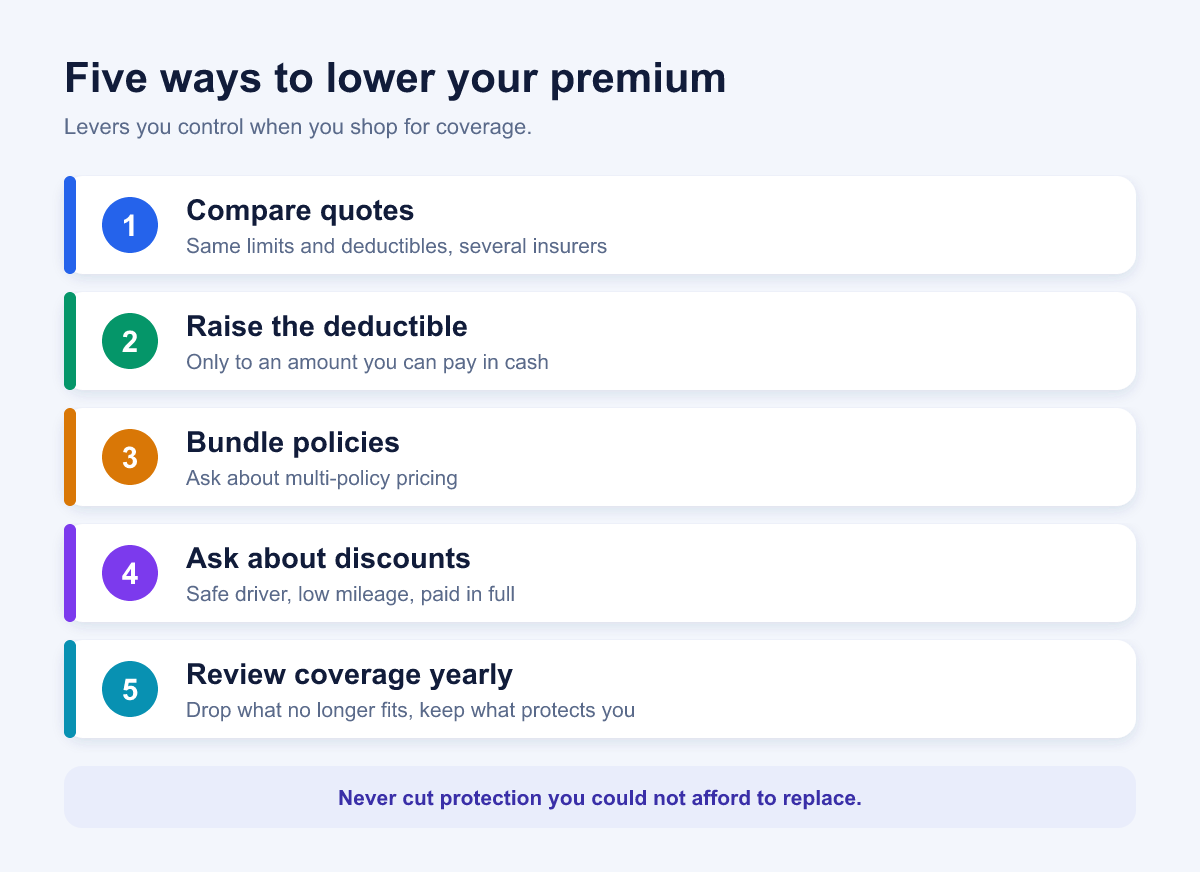
- Compare quotes. Request the same limits and deductibles from several insurers, using the table above. This lever changes the price without changing what you are protected against.
- Raise the deductible, only to an amount you can pay in cash. The saving comes from taking on more of each claim. Run the break-even math from the deductible section and make sure the higher amount fits your savings.
- Bundle policies. Ask whether the insurer prices auto together with renters, homeowners or other policies at a lower combined cost, and compare that with separate quotes, because a bundle is not automatically cheaper.
- Ask about discounts. Many insurers offer safe driver, low mileage, paid-in-full, defensive driving course and vehicle safety discounts, but they are not always applied automatically. Ask what each one requires.
- Review coverage yearly. Drop what no longer fits and keep what protects you. A paid-off, low-value car may not need the collision and comprehensive coverage it once did, while a new driver, a new job or more assets may call for higher liability limits. Also tell your insurer about changes that must be reported, such as a new driver in the household; the Texas guide warns that unreported drivers can lead to extra premium charges or denied claims.
Treat each lever as a decision, not a checkbox. Cutting liability limits or uninsured motorist coverage lowers the price just as raising the deductible does, but it removes protection instead of adjusting how much risk you carry.
A hypothetical premium comparison
The table below shows how coverage choices move a premium for one imaginary driver with a $20,000 car. These numbers are hypothetical, rounded to make the arithmetic easy, and are not real rates. Actual quotes vary widely by state, insurer and driver.
| Setup (same driver, same car) | Hypothetical yearly premium | What it adds |
|---|---|---|
| A. Liability at low limits only | $800 | Pays others' losses up to low limits; nothing for your car |
| B. Liability at higher limits plus uninsured / underinsured motorist | $1,100 | $300 more than A for higher limits and protection if the other driver has too little insurance |
| C. Setup B plus collision and comprehensive, $1,000 deductible | $2,200 | $1,100 more than B to protect your own car |
| D. Setup B plus collision and comprehensive, $500 deductible | $2,500 | $1,400 more than B; $300 more than C for a $500 lower deductible |
Going from A to B costs $300 more per year and raises protection against the large, rare loss. Going from B to C costs $1,100 more and protects the car. Going from C to D costs another $300 for a $500 lower deductible, the same trade-off worked out above. The arithmetic does not tell you which setup is right, but it shows where the money goes.
Three hypothetical drivers
The profiles below are invented to show how the same questions lead to different answers. They illustrate reasoning and are not recommendations.
Maya: financed car, thin savings
Maya's $20,000 car has a loan, so the lender requires collision and comprehensive. She has about $1,500 in savings. She asks for quotes at $500 and $1,000 deductibles. The $1,000 option saves $300 a year, but a single claim would cost her $500 more out of pocket, and she would need about 1.7 claim-free years to come out ahead. Because her cushion is small, she weighs whether she could comfortably pay $1,000 in a bad month, and she compares liability limits across insurers rather than accepting the lowest default.
Daniel: older paid-off car, solid savings
Daniel drives an older car worth about $4,000 with no loan, and he has several months of expenses saved. Collision and comprehensive would cost $600 a year for a maximum payout of $3,500, about 17 percent of that maximum each year. He considers dropping them, because he could replace the car from savings. He decides separately about liability limits and uninsured motorist coverage, since dropping physical-damage coverage on his own car does not change what he could owe someone else.
Priya and Tom: two cars, a teen driver and a home
Priya and Tom are adding a teen driver and own a home. Their main concern is how much they could lose if they caused a serious crash, not the cost of repairing a car. They compare quotes with higher liability limits and ask each insurer about discounts such as a driver education course and about bundling home and auto. The Texas guide says adding a young driver to an existing policy is usually cheaper than buying a separate one. Whether to carry extra protection beyond ordinary liability limits is a question for a licensed agent who can look at their full financial picture.
Common mistakes, and what to do after an accident
Mistakes to avoid
- Carrying only the state minimum without checking what it leaves out. It may be legal and still be too low for a serious crash.
- Dropping uninsured and underinsured motorist coverage to save a little. It protects you from other drivers' choices, which you cannot control. The NAIC notes that the cost of uninsured drivers is passed on to insured drivers through this coverage.
- Letting coverage lapse. Driving uninsured can break your state's law, and the NAIC lists previous insurance coverage as a rating factor. When switching insurers, start the new policy before the old one ends.
- Comparing only the price. Different limits, deductibles and exclusions make quotes impossible to compare fairly.
- Assuming a personal policy covers every use. The NAIC says personal auto insurance usually does not cover vehicles used for work, and the Texas guide lists ride-hailing and paid delivery as activities most policies do not cover. Ask before you start.
- Setting a deductible you cannot afford. Savings on paper do not help if you cannot pay the deductible when you need to.
What to do after an accident, in brief
The Texas Department of Insurance's guide offers a practical checklist that applies broadly, though details differ by state. Stay factual and keep records:
- Get the other driver's name, contact details, license plate and insurance company information, and share the same about you. Photographing the other driver's insurance card is quick.
- Get names and contact details for witnesses, note the time, date, location and conditions, and take photos of the scene.
- Call the police if anyone is injured. For a hit-and-run, the Texas guide says uninsured motorist coverage may not pay if you did not report it to the police.
- Tell your insurer as soon as you can; most companies have deadlines for reporting a claim.
- Keep copies of the police report and any medical records and bills.
If questions arise about fault, injuries or a dispute, your insurer, your state insurance department or a licensed attorney can advise on your specific situation.
In summary
- "Full coverage" is shorthand, not a policy type. Ask for the specific coverages, limits and deductibles behind it.
- Liability pays for harm you cause to others; collision and comprehensive pay for your own car; uninsured/underinsured motorist and medical payments or PIP help with your own costs.
- State minimum liability is a legal floor, not a measure of what a serious crash can cost.
- Lenders and lessors may require collision and comprehensive. Otherwise, compare the yearly cost with the most the coverage could pay, and ask whether you could replace the car from savings.
- A higher deductible lowers the premium only if you can pay it in cash.
- Compare quotes with identical limits, deductibles and coverages, and use your state insurance department's tools.
- Lower the premium by shopping, adjusting the deductible, bundling, asking about discounts and reviewing coverage each year, without dropping protection you could not afford to lose.
- Avoid lapses, and ask your insurer before using your car for work or ride-hailing.
This guide is general information, not insurance, legal, tax or financial advice. Rules and prices vary by state and insurer, and your own situation may differ. For decisions about your policy, consult your state insurance department, a licensed agent or another qualified professional.
Frequently asked questions
Is full coverage required by law?
Generally no. The NAIC says collision and comprehensive are not required by state law, although lenders may require them for financed or leased vehicles. States commonly require liability coverage, and the amount varies; check with your state insurance department.
Does full coverage pay for everything?
No. Every coverage has limits, deductibles and exclusions. For example, the Texas guide notes that most policies do not cover accidents while you drive for a ride-hailing service or deliver items for a fee, or damage you cause intentionally. Read your policy and ask what is excluded.
Can I drop collision and comprehensive on an older car?
If you own the car outright, you can usually choose to, but a lender or lessor may require them on a financed or leased car. One approach is to compare the yearly cost with the most the coverage could pay, which is the car's value minus the deductible, and to ask whether you could replace the car from savings. Dropping them does not change your liability coverage.
Do insurers use my credit to set my premium?
Many insurers use credit-based insurance scores in states where it is allowed. The NAIC says these scores estimate the likelihood of a claim, not loan repayment, and that in most states insurers cannot use them as the sole reason to raise rates or to deny, cancel or refuse to renew a policy. Some states restrict or prohibit certain uses, so the rules depend on where you live.
How much liability coverage should I carry?
That depends on your assets, income and risk tolerance, so there is no single figure. The Texas guide says minimum limits can be too low in a serious crash and that you may have to pay the rest yourself if damages exceed your coverage. A licensed agent can explain how different limits fit your situation, and quotes at several limit levels show what each step costs.
Will a telematics program lower my rate?
It might, but not necessarily. The NAIC explains that telematics programs track driving behavior and that, depending on the insurer and the state, the data may be used to set premiums. It also cautions that a program can lead to higher premiums, raises privacy concerns, and that not everyone qualifies for a discount. Find out what data is collected and how it is used before enrolling.
Sources
- NAIC: Auto Insurance (background, coverage types and rating factors)
- NAIC: Credit-Based Insurance Scores
- NAIC: Uninsured Motorists
- NAIC: Telematics
- NAIC Consumer Insight: Want Your Auto Insurer to Track Your Driving? Understanding Usage-Based Insurance
- NAIC: Insurance Departments (find your state department or file a complaint)
- Texas Department of Insurance: Auto insurance guide