Most people insure their car, their home and their health. Far fewer insure the thing that pays for all of it: their ability to earn a paycheck. If an illness or injury kept you from working for three months, or three years, which bills would keep arriving, and what money would be there to meet them? That question is exactly what disability insurance is built to answer, and it is also why the choice between short-term and long-term coverage matters.
The two products are often bundled in a benefits packet and described in a few lines, yet they differ in waiting period, length of payment, definition of disability, tax treatment and who pays for them. This guide explains what disability insurance does and does not do, how the two types compare, which policy terms decide whether a claim is paid, how benefits are taxed, why Social Security Disability Insurance is a thin safety net, and a simple method to estimate how much coverage you need. There are no prices or insurer names here, only mechanisms and a worked hypothetical. Figures cited were read on the official pages listed in the Sources section at the time of writing (November 2026) and can change.
What disability insurance does (and what it does not)
The North Carolina Department of Insurance describes disability income insurance as coverage that provides benefits to replace lost income when you become unable to work because of illness or injury. Its benefits are generally based on your actual earnings, and the maximum benefit is generally limited to a percentage of your gross salary or wages. In other words, it replaces part of your paycheck, not your whole life's costs and not your medical bills.
It helps to separate it from three things people often confuse with it:
- Health insurance pays for medical care: doctor visits, hospital stays, prescriptions. It does not replace the wages you lose while you recover. If you are comparing medical coverage options, see our guide on marketplace vs employer health plans.
- Workers' compensation covers injuries and illnesses connected to your job. The U.S. Department of Labor explains that people injured at work for private companies or state and local governments should contact their state workers' compensation agency. Disability insurance is typically the answer for conditions that are not work-related, and a typical policy may exclude work-related disabilities or reduce benefits if you receive workers' compensation.
- Social Security Disability Insurance (SSDI) is a federal program with a strict definition of disability, covered in its own section below. It is not a substitute for a private plan.
Disability insurance also does not usually pay 100 percent of your pay. The North Carolina guide notes that benefits are not intended to replace full pre-disability income, because full replacement would remove the financial incentive to return to work. The same guide says the percentage in the benefit formula varies from policy to policy and may range from 50 to 75 percent, often with a maximum dollar amount.
Short-term vs long-term disability: how they differ
Short-term disability (STD) is designed to bridge a limited absence, such as recovery from surgery or a serious but temporary illness. Long-term disability (LTD) is designed for an absence that lasts much longer and can run for years. Many people have, or can get, one without the other, and in a well-built benefits package the two are meant to connect: STD covers the early weeks or months, then LTD takes over after its own waiting period.
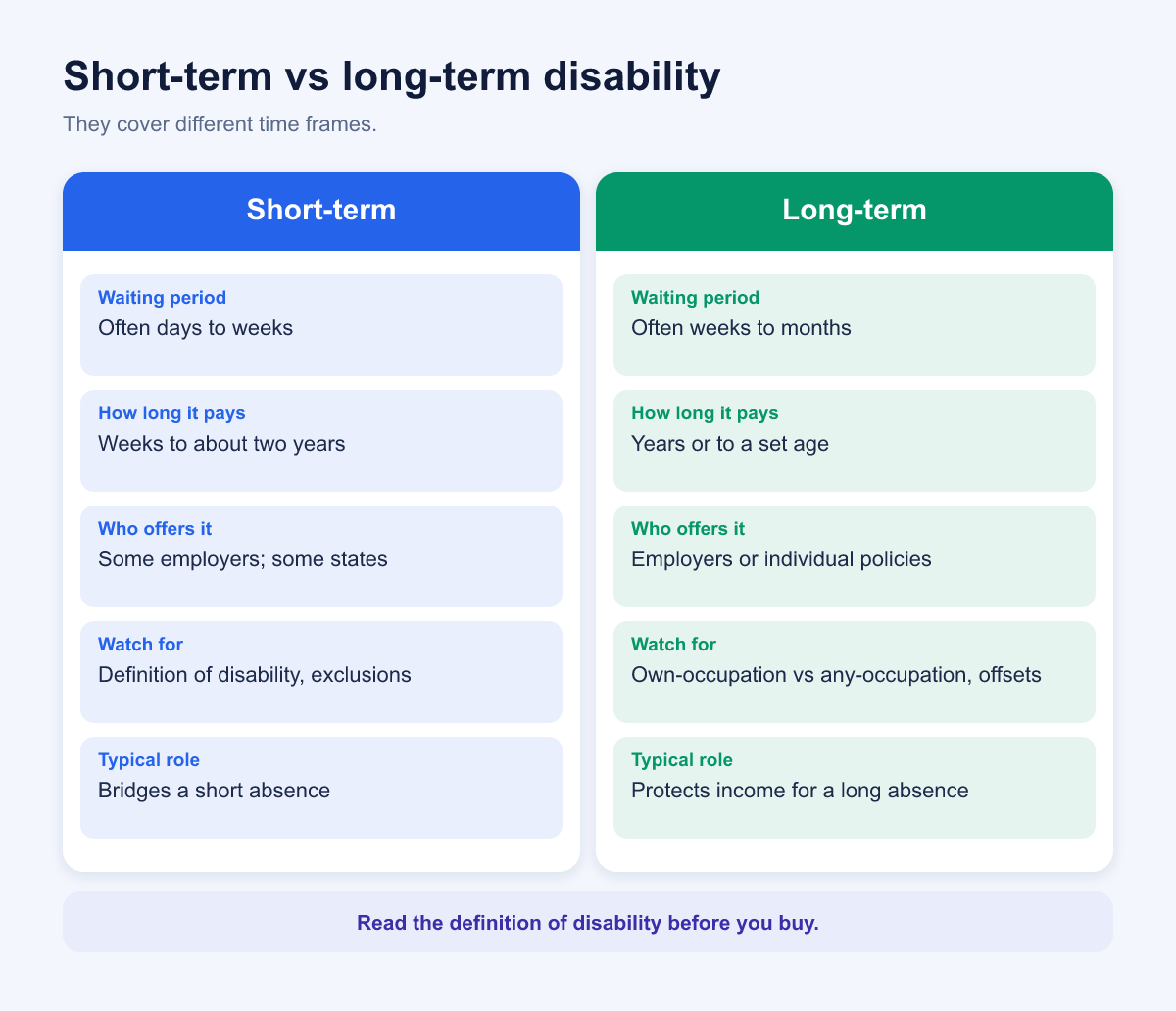
The figure above compares the two across five rows. Here is how each one works.
1. Waiting period
Both types have a gap between the start of your disability and the first payment. The North Carolina guide calls it the elimination period (a period stated in the policy during which benefits are not payable) and says it can range from a few days to a year or longer, with longer periods generally costing less. In practice, short-term plans tend to start after a short wait, usually days to a couple of weeks, while long-term plans tend to wait longer, often weeks to months, so that they begin about when short-term benefits run out. The exact number is in the plan document, so read it rather than assuming.
2. How long it pays
The same guide describes short-term policies as generally paying benefits from six months to two years, and long-term policies as paying for five to 10 years, to age 65 or even for life. A particular employer's short-term plan may be considerably shorter than that range, so the practical picture is weeks to months for short-term and years or to a set age for long-term. The length of payment is called the benefit period.
3. Who offers it
Much of this coverage comes through work. The U.S. Bureau of Labor Statistics reported that, in March 2026, 44 percent of private industry workers had access to short-term disability plans and 37 percent had access to long-term disability plans. Among state and local government workers, the figures were 26 percent and 41 percent. "Access" means the benefit was offered to the worker, not that the worker enrolled. Beyond employers, some states run their own temporary disability programs (California and New Jersey are examples, covered below), and individual policies are sold directly to people who want coverage that does not depend on a job.
4. What to watch for
For short-term coverage, the main things to read are the definition of disability and the exclusions (the North Carolina guide notes that short-term policies usually use an "own occupation" definition). For long-term coverage, the key points are the move from own-occupation to any-occupation after the first year or two, and the offsets that reduce what the policy pays. Both are explained in the policy-terms section below.
5. Typical role
Short-term coverage bridges a short absence, so you are not draining savings for every sick month. Long-term coverage protects your income through a long absence, which is where the largest financial risk sits. The side-by-side table summarizes the contrast.
| Feature | Short-term disability | Long-term disability |
|---|---|---|
| Waiting period | Usually days to weeks | Usually weeks to months |
| How long it pays | Weeks to months (a regulator guide describes six months to two years) | Years, or to a set age (a regulator guide describes five to 10 years, to age 65, or for life) |
| Share of income replaced | Set by the plan; a regulator guide gives 50 to 75 percent as a common range across policies | Same: set by the plan, with a maximum dollar amount |
| Who offers it | Some employers; some states run programs | Employers or individual policies |
| Definition of disability | Usually "own occupation" | Often "own occupation" at first, then "any occupation" |
| Typical role | Bridges a short absence | Protects income for a long absence |
State programs
Some states operate their own short-term programs. The California Employment Development Department describes its Disability Insurance benefits as short-term wage replacement for people who need to take time off work because of illness or injury, pregnancy and childbirth, surgery, or drug and alcohol rehabilitation. New Jersey's Division of Temporary Disability and Family Leave Insurance runs a similar Temporary Disability program, and its page notes that the program has an unpaid week built into it by law. Rules, eligibility and amounts differ by state, so check your own state's agency before assuming you are covered or not covered.
Employer group coverage vs individual policies
The North Carolina guide explains that disability income insurance can be offered through a group policy (employer or association arrangements covering eligible members) and also through individual policies issued directly to the person covered. The difference is more than paperwork.
| Question | Employer group coverage | Individual policy |
|---|---|---|
| Who owns the contract | The employer or association is generally the group policyholder | You |
| Renewal and cancellation rights | Rest with the employer or association, not with you | Set by the policy's terms of renewal |
| Medical underwriting | Eligibility is set by the group's rules | Insurers frequently ask for medical and personal information to determine eligibility |
| What happens if you leave the job | Usually tied to the job; check whether the plan can be converted or continued | Coverage can stay as long as the policy stays in force |
| Customization | Limited to what the plan offers | Riders and options you choose |
The practical consequence is portability. If your only coverage is a group plan, it may disappear the day you change jobs or are laid off, and a new plan may exclude a condition that appeared in the meantime. Ask your benefits team whether the group plan can be converted or continued, and treat any new job's waiting period for disability coverage as a gap to plan around.
How benefits are taxed
Whether benefits are taxable depends on who paid the premiums. The IRS explains, in Publication 525, that you generally must report as income amounts you receive through an accident or health plan paid for by your employer, and if you and your employer both pay for the plan, only the part of the benefit that is due to your employer's payments is reported as income. If you pay the entire cost yourself, you do not include the benefits you receive from the plan as income.
There is a twist for plans bought through a cafeteria plan (a pre-tax benefit arrangement). In most cases, if the premiums were not included in your income, you are not considered to have paid them, and the benefits are included in your income. If the premiums were included in your income, you are treated as having paid them and the benefits are not taxable. Because this changes how much of your benefit you actually keep, ask your employer who pays the premium and whether the cost is paid with after-tax dollars. State income tax treatment can differ, so confirm with a tax professional or your state revenue agency.
Policy terms that decide whether you get paid
Two plans can both be called "disability insurance" and treat the same claim very differently. The vocabulary below follows the North Carolina Department of Insurance's consumer guide; the exact wording is always in the policy or certificate.
| Term | What it means | Why it matters |
|---|---|---|
| Elimination (waiting) period | A stated period after your disability begins during which benefits are not payable. A "waiting period" is similar, but benefits are often paid retroactively to its start. | The longer it is, the more you must cover yourself. Longer periods generally cost less. |
| Benefit period | How long benefits are paid. | A short benefit period can leave a long illness uncovered. |
| Own-occupation | Benefits are paid when you cannot perform the regular and customary duties of your own occupation. | The more lenient test. Short-term plans usually use it, and long-term plans usually use it during the first year or two. |
| Any-occupation | Benefits continue only if you cannot perform the duties of any occupation for which you are qualified by education, training and experience. | For some people it is considerably harder to qualify under this test. Many long-term plans switch to it after the first year or two. |
| Partial and residual disability | A partial rider pays a specified amount, often 50 percent of the full benefit, if you return to work on a limited or part-time basis. A residual rider pays when you return full-time but your income is not fully restored. | Most recoveries are gradual, so these features can matter more than the headline benefit. |
| Cost-of-living adjustment (COLA) rider | Periodically increases the benefit you are being paid, based on a stated percentage or on the Consumer Price Index. | Helps a long claim keep pace with rising prices. |
| Terms of renewal | The contract's rules on the right to renew, cancel or change premiums or benefits. Individual policies are often described with labels such as "guaranteed renewable" or "non-cancellable." | These labels describe how much the insurer can change over time. Ask for the exact wording; under a group plan the renewal rights belong to the employer. |
| Benefit offsets and limits | Benefits can be reduced by other benefits payable, including a Social Security Disability benefit if the policy has an offset provision, or workers' compensation. | The amount you actually receive can be lower than the headline percentage. |
| Pre-existing condition exclusion | The policy may deny claims for a condition you were treated for, or had symptoms of, within a period before coverage began. The period varies. | A new policy or a new employer's plan may not cover what you already have. |
The guide also lists typical exclusions such as war, self-inflicted injuries and, in many policies, work-related disabilities. It warns that some policies cover only accidents, not sickness, so check which of the two is covered. Look as well at supplemental riders: future purchase options (which raise your coverage as earnings rise, and are generally not available once you are disabled), waiver of premium (you keep coverage without paying premiums once disabled for a specified time), and return of premium.
Social Security Disability Insurance: why it is hard to rely on
Social Security Disability Insurance is real protection, but the Social Security Administration (SSA) describes its definition as strict, and it does not match what most private plans promise. According to the SSA, to be eligible for SSDI you must have worked in jobs covered by Social Security and have a medical condition that meets its definition of disability. In general, it pays monthly benefits to people who are unable to work for a year (12 consecutive months) or more. Four points matter for your planning:
- Total disability only. The SSA says it pays only for total disability and that no benefits are payable for partial disability or for short-term disability. Its rules assume working families have other resources, including workers' compensation, insurance, savings and investments, to cover short-term disabilities.
- A five-month waiting period. Generally you must wait five full calendar months from the date the SSA finds your disability began, and the first payment is for the sixth full month. There is an exception for ALS.
- Work credits. Generally you need 40 credits, 20 of them earned in the last 10 years ending with the year your disability begins, though younger workers may need fewer. At the time of writing, in 2026, you earn one credit for each $1,890 in wages or self-employment income per quarter, and $7,560 earns all four credits for the year.
- An earnings limit and the three tests. You must be unable to work at the substantial gainful activity (SGA) level, unable to do your previous work or adjust to other work, and your condition must have lasted or be expected to last at least a year or to result in death. In 2026, if you work and average more than $1,690 a month ($2,830 if blind), you generally cannot be considered to have a disability.
The monthly amount is based on your lifetime average earnings covered by Social Security, so check your own estimate in your Social Security account rather than relying on averages. The SSA adds that it may reduce SSDI if you receive other government benefits such as workers' compensation or public disability benefits. If you are curious how your earnings record feeds into these programs, our guide to Social Security benefits and claiming explains the basics.
The conclusion for planning is straightforward: SSDI will not help during a short illness, will not start for at least five months, and applies only if your impairment is expected to last a year or more and is severe enough to be a total disability. A private plan is designed to fill the first gap and to pay under a different, usually less strict definition.
How much coverage do you need?
There is no universal percentage. The useful approach is to start from what you must pay each month, subtract what keeps coming in, and compare the result with what your coverage would pay. The figure below lists five checks to run before you buy or renew coverage, and this section goes through them in order.
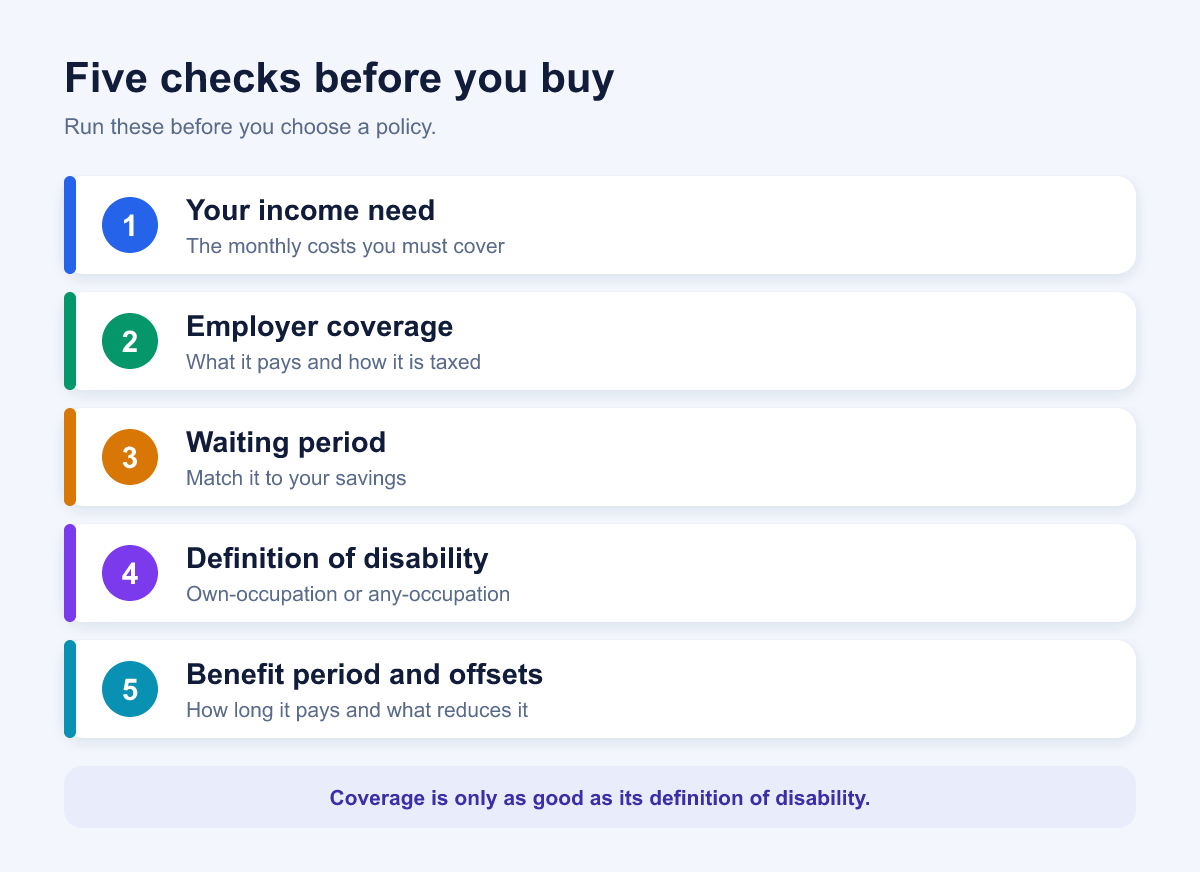
1. Your income need
Add up the monthly costs you must cover if you could not work: housing, utilities, groceries, transportation, insurance premiums, minimum debt payments and any dependents' needs. Leave out the optional spending you could pause. Then subtract income that would continue, such as a partner's earnings, rental income or a pension. The remainder is your monthly gap.
2. Employer coverage
Find out what your employer plan pays: the percentage of pay, any maximum dollar amount, how long it lasts, and who pays the premium. Because the IRS treats employer-paid benefits differently from benefits you pay for with after-tax dollars, compare the benefit after taxes against your gap, not just the headline number. A plan sized as a percentage of salary only works if that percentage, after tax, covers your gap.
3. Waiting period
Match the waiting period to your savings. A longer elimination period lowers the cost of a policy, but it means you must fund the gap yourself in the meantime. This links directly to your emergency fund, and the next subsection works through it.
4. Definition of disability
Check whether the plan uses own-occupation, any-occupation or a switch after a set period. A surgeon who can no longer operate may be disabled under an own-occupation test but not under an any-occupation test if she could work as, say, a consultant. The same logic applies far from medicine, to a roofer with a back injury or a pianist with a hand injury.
5. Benefit period and offsets
Confirm how long benefits last (two years, five years, to age 65) and what reduces them. Offsets for SSDI, workers' compensation or other policies can shrink the check, and long-term benefits that stop after a few years leave you exposed to the longest and costliest claims.
Hypothetical worked example
Hypothetical example (round numbers, for illustration only). Dana earns $6,000 a month in gross pay ($72,000 a year). Her essential monthly costs are:
| Essential cost | Monthly amount |
|---|---|
| Rent | $1,500 |
| Utilities and phone | $250 |
| Groceries | $600 |
| Transportation | $400 |
| Health costs and insurance premiums | $350 |
| Minimum debt payments | $450 |
| Other essentials | $250 |
| Total essential costs | $3,800 |
Assume her partner earns $1,200 a month that would continue, so her monthly gap is $3,800 - $1,200 = $2,600. Now suppose her employer's long-term plan pays 60 percent of salary, or 0.60 x $6,000 = $3,600 a month before any taxes. On paper that clears the gap by $1,000. Three things can erode it:
- Taxes. If the employer paid the premiums, the benefit is taxable income under the IRS rules above, so the amount she keeps is lower than $3,600. She should compare the after-tax figure with $2,600.
- Offsets. Suppose the policy reduces its payment by any Social Security Disability benefit, and Dana is awarded a hypothetical $1,800 a month. The plan then pays $3,600 - $1,800 = $1,800, so her total is still $3,600, not $5,400. SSDI does not add to the plan; it replaces part of it, and only if she is approved.
- The waiting period. If the long-term plan has a 90-day elimination period (about three months) and she has no short-term coverage, she must self-fund 3 x $2,600 = $7,800 of the gap, or 3 x $3,800 = $11,400 if her partner's income also stopped. A six-month wait would double those figures to $15,600 and $22,800.
The lesson is the method, not the numbers: gap, then plan payment after tax and offsets, then waiting period against savings. Dana's own numbers would be different, and yours will be too.
Waiting period and your emergency fund
The elimination period is the most direct link between insurance and savings. If your policy waits 90 days, your emergency fund (or short-term coverage, paid time off and sick leave) has to carry you through those 90 days. A practical rule is to choose a waiting period no longer than the number of months of essential expenses you could cover without strain. Our guide on building an emergency fund explains how to size and keep that cushion. Many people use the two together: a larger emergency fund allows a longer, cheaper waiting period, and a thin fund argues for a shorter one or for short-term coverage.
Who may need disability coverage most
Anyone who depends on earned income has the exposure, but some situations raise the stakes. Here are three hypothetical profiles; they are illustrations, not recommendations.
| Profile (hypothetical) | Why the risk is higher | Questions to ask |
|---|---|---|
| Priya, salaried employee with employer coverage | Group plans are often the only coverage, may not be portable, and the benefit is usually a percentage of base pay only. | Who pays the premium (taxability)? Does the plan cover bonuses and commissions? What happens if I leave? |
| Marcus, freelance designer | No employer plan, no paid sick leave, and income stops when work stops. Income that varies from month to month can make it harder to document what a policy should replace. See our guide to gig-economy taxes for how self-employment income is documented. | Does an individual policy base benefits on tax-return income? Is a state program available to me? How long would my savings last? |
| Elena, single parent and sole earner | No second income to fall back on, and dependents rely on one paycheck. | How many months of essential costs could I cover? Does my plan include partial or residual benefits for a gradual return to work? |
Self-employed workers and independent contractors deserve special attention because they often have neither employer-provided coverage nor workers' compensation by default. Business owners who formalize a side business may also see their coverage options change. Whatever your arrangement, the same five checks apply.
Common mistakes to avoid
- Assuming health insurance or workers' compensation covers lost wages. Health insurance pays for care, and workers' compensation is for work-related injuries and illnesses.
- Counting on SSDI to fill the gap. It has a five-month wait, pays only for total disability and generally needs a condition lasting a year or more.
- Ignoring the definition of disability. A plan that sounds generous but uses a strict any-occupation test after the first year or two may pay much less often than you expect.
- Not reading the offsets. Your check may shrink when other benefits arrive.
- Forgetting taxes. A benefit paid by your employer is generally taxable, so a 60 percent replacement may be much lower in practice.
- Choosing a waiting period longer than your savings. A cheaper premium is not a bargain if you cannot afford the wait.
- Dropping group coverage when changing jobs without a replacement, or missing a window to convert or continue it.
- Overlooking pre-existing condition exclusions when you switch plans or insurers.
How to compare quotes and read a policy
When you hold two quotes, compare them on terms before price. The North Carolina Department of Insurance advises shopping around, asking questions, not feeling pressured into a quick decision, and reviewing the application carefully before signing so that every answer is complete and accurate. It also says to confirm that the agent and the company are licensed in your state and to make payments to the insurance company, not the agent.
- Get the numbers in the same units. Monthly benefit, percentage of pay, maximum, waiting period and benefit period, side by side.
- Read the definition of disability and the date it changes.
- List the offsets and exclusions, including pre-existing conditions and work-related disabilities.
- Check renewal terms and any "guaranteed renewable" or "non-cancellable" wording, in the contract, not the brochure.
- Look for partial and residual benefits and any cost-of-living rider.
- Confirm how the benefit is taxed given who pays the premium.
- Ask about portability for group plans.
- Check the premium behavior over time: whether it can change, and why.
The North Carolina department notes that it does not set premium rates, though insurers must justify them; rules differ by state, so for questions or complaints contact your own state insurance department. Life changes such as a new job, a child or a business can also be a reason to re-run the five checks.
In summary
- Disability insurance replaces part of your income when illness or injury keeps you from working. It is not health insurance, workers' compensation or SSDI.
- Short-term coverage bridges a short absence; long-term coverage protects income for a long one. Check the waiting period, benefit period, who pays and what the plan says about tax.
- The definition of disability (own-occupation vs any-occupation), offsets, exclusions and renewal terms decide whether a claim pays.
- SSDI is hard to rely on: total disability only, a five-month waiting period, work credits and a condition expected to last a year or more.
- Size coverage in three steps: monthly essential costs minus other income, then what the plan pays after taxes and offsets, then waiting period against your emergency fund.
- Group coverage may not follow you. Plan for gaps when changing jobs.
- Compare policies on their terms in the contract, not on a brochure summary.
This guide is general information, not insurance, legal, tax or financial advice. Policy terms, state programs and tax rules vary and change, so confirm details in your plan documents, with your employer's benefits team, your state insurance department or a qualified professional.
Frequently asked questions
Is disability insurance the same as health insurance?
No. Health insurance pays for medical care. Disability insurance replaces part of your income while illness or injury keeps you from working. You can have one without the other, and each addresses a different financial risk.
Is disability insurance the same as workers' compensation?
No. Workers' compensation covers injuries and illnesses connected to your job and is generally handled through your state workers' compensation agency, according to the Department of Labor. A typical disability policy may exclude work-related disabilities, and receiving workers' compensation can reduce or end private benefits.
Do I need both short-term and long-term disability coverage?
It depends on your savings, your employer's benefits and how long you could go without a paycheck. Short-term coverage helps with the first weeks or months; long-term coverage addresses the larger risk of a long absence. If your employer offers both, read how the two connect, since the long-term waiting period is usually timed to follow the short-term benefit.
Are disability insurance benefits taxable?
It depends on who paid the premiums. Under IRS Publication 525, benefits from a plan your employer pays for are generally taxable, benefits from a plan you pay for entirely yourself are not, and when both pay only the part due to your employer's payments is taxable. Premiums paid through a cafeteria plan with pre-tax money generally make the benefits taxable. Confirm your situation with a tax professional.
Can Social Security Disability Insurance replace a private policy?
Usually not. SSDI pays only for total disability, has a five-month waiting period in general, and requires enough work credits and a condition that has lasted or is expected to last at least a year. A private plan may pay sooner, for shorter absences and under a different definition, though it can also offset against SSDI.
What happens to my group disability coverage if I change jobs?
Under an employer group plan, the employer is generally the policyholder and holds the renewal rights, so coverage typically ends with the job unless the plan lets you convert or continue it. Ask your benefits team before leaving, check the new employer's waiting period for coverage, and consider an individual policy if you will have a gap.
Sources
- North Carolina Department of Insurance: A Consumer's Guide to Disability Income Insurance
- Social Security Administration: How Does Someone Become Eligible? (Disability Benefits)
- Social Security Administration: Approval Process (Disability Benefits)
- IRS: Publication 525, Taxable and Nontaxable Income (Sickness and Injury Benefits)
- U.S. Bureau of Labor Statistics: Employee Benefits in the United States, March 2026
- U.S. Department of Labor: Workers' Compensation
- California Employment Development Department: Disability Insurance Benefits
- New Jersey Division of Temporary Disability and Family Leave Insurance: Temporary Disability Insurance