Turning 65, or helping a parent who is about to, usually means running into a pile of similar-sounding terms at once: Medicare, Medicare Advantage, Medigap, Part D. They are not interchangeable, and some of them cannot be combined. Picking the wrong combination, or missing a deadline, can mean higher costs for years, sometimes for life.
The good news is that the structure is simpler than the marketing suggests. There are two main paths: Original Medicare (Parts A and B), usually paired with an optional Medigap policy and a separate drug plan, or a Medicare Advantage plan (Part C) sold by a private insurer that bundles your coverage. This guide explains the building blocks, how costs work in each path, the enrollment windows that matter, and a question-based method to compare options. It names no plans or insurers and does not tell you which path to choose, because the right answer depends on your doctors, your medications, your budget and where you live.
All figures marked "2026" come from Medicare.gov pages read in November 2026. Amounts change every year, so always confirm them on the official site before you decide.
The building blocks: Parts A, B, C, D and Medigap
Medicare.gov describes the pieces this way:
- Part A (Hospital Insurance) helps cover inpatient care in hospitals, skilled nursing facility care, hospice care and home health care.
- Part B (Medical Insurance) helps cover services from doctors and other health care providers, outpatient care, home health care, durable medical equipment (like walkers and hospital beds) and many preventive services, such as screenings, shots and yearly "Wellness" visits.
- Part C (Medicare Advantage) is not extra coverage on top of A and B. It is an alternative way to receive your Part A and Part B benefits, through a private health plan that Medicare has approved. These bundled plans include Part A, Part B and usually Part D.
- Part D (drug coverage) helps cover the cost of prescription drugs. You either join a Medicare drug plan in addition to Original Medicare, or you get it by joining a Medicare Advantage plan with drug coverage. Drug plans are run by private insurance companies that follow rules set by Medicare.
- Medicare Supplement Insurance (Medigap) is extra insurance you can buy from a private company to help pay your share of costs in Original Medicare. It is not a part of Medicare itself.
Parts A and B together are called Original Medicare. The two main ways to get your coverage are Original Medicare, or a Medicare Advantage plan. Everything else in this guide is a consequence of that first choice.
A note on who this applies to: Medicare is health insurance for people 65 or older who meet citizenship or residency requirements, and some people under 65 with disabilities, End-Stage Renal Disease (ESRD) or ALS may qualify earlier. Some people are enrolled automatically, others must sign up, depending on whether they already receive Social Security benefits. If you are still deciding when to claim retirement benefits, our guide to how Social Security benefits are calculated and when to claim covers the retirement side of that timeline.
Original Medicare vs Medicare Advantage: the two paths side by side
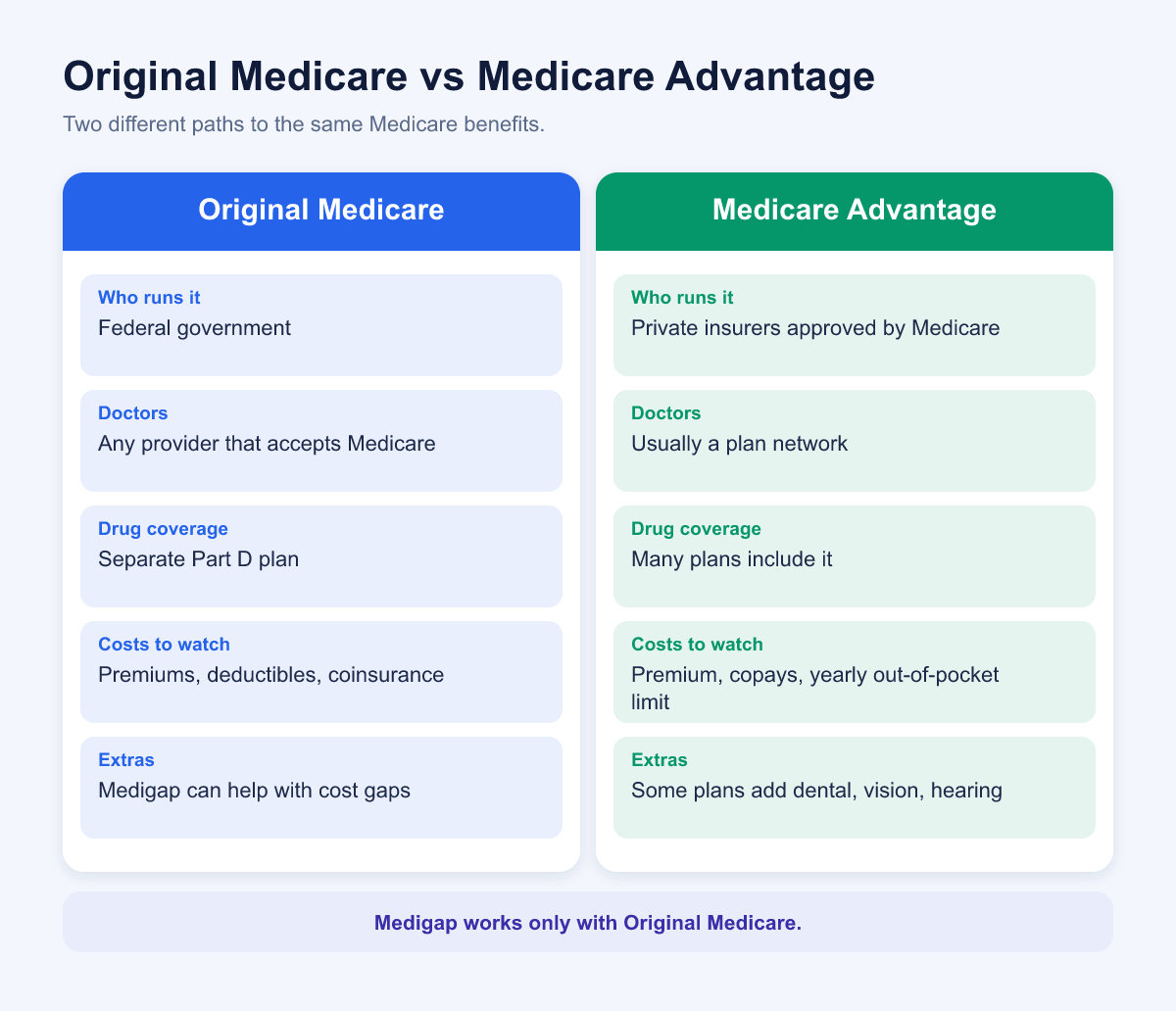
Once you have Part A and Part B, you choose how to receive your coverage. The comparison below follows five points in the same order as the figure: who runs it, doctors, drug coverage, costs to watch and extras.
1. Who runs it
Original Medicare is run by the federal government: you pay for services as you get them, Medicare pays its part of the cost and you pay your share. A Medicare Advantage plan is run by a private company approved by Medicare that must follow Medicare's rules. To join one, you must have both Part A and Part B, live in the plan's service area, and meet the citizenship or lawful-presence requirements Medicare lists. Insurance companies decide whether a plan is offered statewide or only in certain counties, and each year they can decide to join or leave Medicare, so the plans available to you can change from one year to the next.
2. Doctors and hospitals
With Original Medicare, you can use any doctor or hospital that takes Medicare, anywhere in the U.S. (the 50 states, the District of Columbia and the U.S. territories). Medicare.gov adds that you may pay more if your doctor does not accept assignment. In most cases you do not need a referral to see a specialist.
With Medicare Advantage, you may need to use doctors and providers in the plan's network and service area for non-emergency care. Some plans cover non-emergency care out of network, but it may cost more. You may also need a referral to see a specialist.
3. Drug coverage
Original Medicare does not include drug coverage in the package; you can join a separate Part D plan. Most Medicare Advantage plans include Part D, so you usually do not need a separate drug plan, and in most types of Advantage plans you are not allowed to add one. More on this in the Part D section below.
4. Costs to watch
In Original Medicare you pay a monthly Part B premium, a yearly Part B deductible, and usually 20% of the Medicare-approved amount for covered services after the deductible. There is no yearly limit on what you pay out of pocket unless you add supplemental coverage such as Medigap, or have other coverage like Medicaid or retiree coverage. The next section puts 2026 numbers on this.
In a Medicare Advantage plan, you keep paying your Part B premium and may also pay a plan premium (some plans have a $0 premium and may help pay all or part of your Part B premium). Deductibles, copays and coinsurance vary by plan, and the plan must set a yearly limit on what you pay for covered Medicare services. Once you reach it, you pay nothing for covered services for the rest of the year. That limit is a real protection, but it is also the worst case, not your expected cost, so look at it next to the copays you would actually pay for the care you use.
5. Extras
Plans must cover everything Original Medicare covers that is medically necessary, and many add benefits that Original Medicare does not, such as some dental, vision and hearing services. Medicare.gov says most plans offer some extras. Look at how generous each extra is: an annual dental allowance, for example, is not the same as full dental coverage. With Original Medicare, those extras are generally not covered (Medicare.gov lists routine physical exams, eye exams and most dental care as examples), though a Medigap policy can help with cost gaps in the services Medicare does cover.
Prior authorization
In most cases, Original Medicare does not require approval (prior authorization) before it covers your services or supplies. Medicare Advantage plans may require approval from the plan before covering certain services or supplies, and in some cases certain drugs. It is worth asking how a plan handles prior authorization for the kinds of care you are likely to need.
Travel and living in more than one place
Original Medicare works anywhere in the U.S., which suits people who spend part of the year in another state. A Medicare Advantage plan is tied to a service area and often to a network. If you live in another state for part of the year, check whether the plan will cover you there, and what counts as emergency or urgent care away from home.
Outside the U.S., the picture is the same for both: Original Medicare generally does not cover medical care outside the U.S., and Medicare Advantage plans generally do not either, although some plans offer an extra benefit for emergency and urgently needed services while traveling abroad. Some Medigap policies cover emergency care outside the U.S.
What Original Medicare costs in 2026
Medicare.gov publishes the 2026 amounts below. They are the basis for the Original Medicare path, and they explain why many people look at supplemental coverage.
| Item (2026) | What Medicare.gov says |
|---|---|
| Part A premium | $0 for most people who paid Medicare taxes long enough (generally at least 10 years). Otherwise $311 or $565 a month, depending on how long you or your spouse worked and paid Medicare taxes. |
| Part A deductible | $1,736 each time you are admitted to the hospital per benefit period, before Original Medicare starts to pay. |
| Hospital stay copayments | Days 1-60: $0 after the deductible. Days 61-90: $434 a day. Days 91-150: $868 a day using lifetime reserve days. After day 150: you pay all costs. |
| Part B premium | $202.90 a month, or higher depending on income. |
| Part B deductible | $283 once a year. |
| Part B coinsurance | Usually 20% of the cost of each covered service or item after the deductible. |
The key point: Medicare.gov states there is no yearly limit on what you pay out of pocket in Original Medicare unless you have supplemental coverage or join a Medicare Advantage plan.
Hypothetical example (not a forecast): assume that in one year you use Part B services with a total Medicare-approved amount of $5,000, and you have no Medigap, Medicaid or retiree coverage. You pay the $283 deductible first. The remaining $4,717 is subject to 20% coinsurance, which is $943.40. Your out-of-pocket cost for those services is about $1,226.40, in addition to the monthly Part B premium. With a Medigap policy, some or all of that $1,226.40 could be covered, depending on the plan letter, but you would also pay the Medigap premium. With a Medicare Advantage plan, you would instead pay the plan's copays or coinsurance, up to its yearly limit.
If you have limited income and resources, your state may help with premiums, deductibles, coinsurance and copays, and the Extra Help program can reduce drug costs. These are worth checking before deciding anything.
What Medigap is, and what it is not
Medigap is extra insurance sold by private companies that helps pay your share of out-of-pocket costs in Original Medicare, such as copayments, coinsurance and deductibles. Medicare.gov highlights several rules that surprise people:
- It only works with Original Medicare. Generally you need both Part A and Part B to buy a policy. When you start Medicare you can either buy Medigap or enroll in a Medicare Advantage plan, but you cannot have both. You cannot use Medigap to pay Advantage copays, deductibles or premiums.
- Policies are standardized. In most states there are 10 types of plans, named by letters: A through D, F, G, and K through N. Policies with the same letter offer the same basic benefits no matter which company sells them, so price is the only difference between them. Massachusetts, Minnesota and Wisconsin standardize their policies differently. Not every plan is offered in every state.
- It covers one person. A spouse who wants Medigap needs a separate policy.
- It does not cover everything. Medigap generally does not cover long-term care, vision or dental care, hearing aids, glasses or private-duty nursing. Policies sold after 2005 do not include prescription drug coverage, so you would join a separate Part D plan for that.
- You still pay Part B. You must keep paying your Part B premium to keep your supplement, and Medicare does not pay Medigap premiums.
- Renewal is automatic. Standardized policies are renewed every year even if you have health problems. The company can only drop you if you stop paying premiums, were not truthful on the application, or the company goes bankrupt or out of business.
Premiums vary widely by company, plan letter and location, and premiums typically rise every year. How companies set prices differs, and may affect how much you pay now and in the future. When you compare, compare the same letter from different companies, and ask how each company prices its policies over time.
The Medigap window
Under federal law you get a 6-month Medigap Open Enrollment Period that starts the first month you have Part B and are 65 or older. During it, a company cannot refuse to sell you any policy it offers and cannot use medical underwriting or charge more because of pre-existing health problems. It is a one-time period and, unlike the yearly Medicare Open Enrollment, it does not repeat. Outside it, you may pay more, have fewer options, and the company may be allowed to deny you based on its medical underwriting rules. Some situations create "guaranteed issue rights" (for example, certain cases when your coverage ends); the usual deadlines are to apply no more than 63 days after the coverage ends. Your state may give you additional rights, and if you are under 65 with Medicare because of a disability or ESRD, federal law generally does not require companies to sell you a policy until 65.
Switching between Medigap and Advantage
This is where many people get caught. If you drop a Medigap policy to join a Medicare Advantage plan for the first time, you get a single 12-month trial right period to get a Medigap policy back if the same company still sells it. If you leave Advantage later, you may not be able to get the same policy back, or in some cases any Medigap policy, unless you leave the Advantage plan during your trial right period. Most Medigap policies do not cancel automatically when you join an Advantage plan; you must contact your insurer yourself.
Part D: prescription drug coverage
Part D is optional and available to everyone with Medicare, but ignoring it can be costly. Medicare.gov recommends considering drug coverage even if you take few drugs now, to avoid a late enrollment penalty later.
Formularies and tiers
Each plan has its own list of covered drugs, called a formulary. Plans must cover a wide range of drugs people with Medicare take, but they differ on which specific drugs they include and what they cost. Drugs on the formulary are divided into tiers by cost: a drug in a lower tier costs less than one in a higher tier. Your actual cost depends on the medicines you take, whether they are on the plan's list, and which pharmacy you use.
How the costs work
You may pay a monthly premium (on top of your Part B premium), a deductible, and copayments or coinsurance. Medicare.gov describes three stages: an optional deductible stage, then an initial coverage stage where you pay 25% coinsurance until your out-of-pocket spending on covered drugs reaches $2,100 in 2026 ($2,400 in 2027), and then catastrophic coverage, where you pay nothing for covered drugs for the rest of the calendar year. No drug plan may have a deductible higher than $615 in 2026 ($700 in 2027).
The late enrollment penalty
You may owe a Part D late enrollment penalty if, after your Initial Enrollment Period, you go 63 or more days in a row without Part D or other creditable drug coverage (coverage similar in value to Part D). The penalty is 1% of the "national base beneficiary premium" ($38.99 in 2026) for each full uncovered month, rounded to the nearest $0.10 and added to your premium. In most cases you pay it for as long as you have Part D, even if you switch plans. If you get Extra Help, you do not pay it.
Hypothetical example: you wait 14 months without creditable coverage. The penalty is 14% of $38.99, or about $5.46, rounded to $5.50 a month, added to the plan premium. That is small today, but it is permanent, and the base premium can go up each year.
Drug coverage in each path
If you choose Original Medicare, you can add a stand-alone Part D plan. If you choose Medicare Advantage, check that the plan includes drug coverage. Medicare.gov warns that moving to an Advantage plan that does not include drug coverage may mean losing your prescription drug coverage until your next enrollment opportunity, and possibly paying a Part D late enrollment penalty. Medigap policies sold after 2005 do not cover drugs, so the drug plan and the Medigap policy are separate purchases, and may involve two separate premium payments even if one company sells both.
When you can enroll, and what happens if you miss it
You can only join, switch or drop a Medicare Advantage plan or a drug plan at certain times. Medigap and Part A/B have their own rules. The main windows, as described on Medicare.gov, are below.
| Window | When | What you can do |
|---|---|---|
| Initial Enrollment Period (Parts A and B) | 7 months: 3 months before the month you turn 65, the birthday month, and 3 months after | Sign up for Part A and Part B; avoid the Part B penalty and a coverage gap |
| Initial Enrollment Period (plans) | Same 7 months, once you have the Parts you need | Join any plan; you need A and B for Advantage, and A or B for a drug plan |
| Open Enrollment Period (often called the Annual Enrollment Period) | October 15 to December 7 each year; coverage starts January 1 | Join, drop or switch Advantage plans; switch between Original Medicare and Advantage; join, drop or switch a drug plan if you are in Original Medicare |
| Medicare Advantage Open Enrollment Period | January 1 to March 31, only if you are already in an Advantage plan | Switch to another Advantage plan, or drop it and return to Original Medicare (and join a separate drug plan) |
| Special Enrollment Period | Varies by situation | Changes after events such as moving, losing coverage or qualifying for Medicaid or Extra Help |
| Medigap Open Enrollment Period | 6 months starting the first month you have Part B and are 65 or older; one time only | Buy any Medigap policy without medical underwriting |
Part B timing and working past 65
Medicare.gov says that if you do not sign up for Part B when first eligible, you may pay an extra 10% for each year you could have signed up but did not, for as long as you have Part B. You generally avoid the penalty with a Special Enrollment Period if you or your spouse are still working and have health coverage based on that job: you then have 8 months after the work or coverage ends to sign up for Part B. The rules differ if your coverage comes from a family member's job, the employer's size, retiree coverage or the Marketplace, so use Medicare.gov's questions for your situation and talk to your benefits administrator first. Our guide on Marketplace vs employer plans explains how job-based coverage and open enrollment work before you reach Medicare. If you have a Health Savings Account, Medicare.gov has a dedicated note on it; our HSA vs FSA guide covers how those accounts work in general.
Starting dates
If you request to join a plan before your Part A or Part B starts, plan coverage starts the same day as your Part A or B. If you request it after, coverage generally starts the first of the month after the plan gets your request. If you join an Advantage plan during your Initial Enrollment Period, you can change to another plan or go back to Original Medicare within the first 3 months you have both Part A and Part B.
The lesson in every row: the dates are deadlines, not suggestions. A missed Medigap window can lock you out of guaranteed approval. A missed Part D window can add a permanent premium. A missed Part B window can add a permanent surcharge.
How to compare plans: five checks before you choose
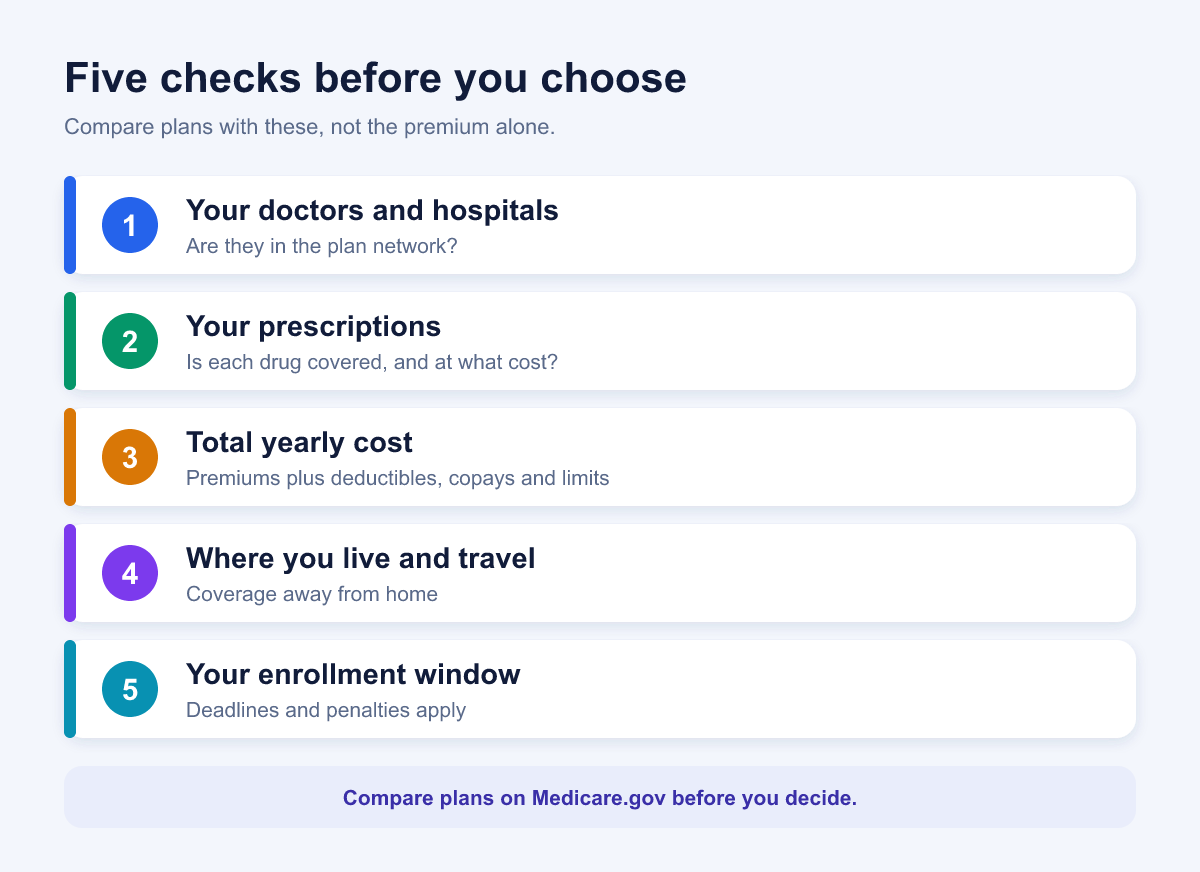
Medicare.gov's Plan Finder lets you compare plans available in your area, including estimated monthly and yearly costs once you enter your drugs. You can also use the "Medicare & You" handbook, talk to a trusted agent or broker, or contact your State Health Insurance Assistance Program (SHIP) for free, personalized counseling. SHIPs are not connected to any insurance company or health plan. You can also call 1-800-MEDICARE (1-800-633-4227). The five checks below follow the figure.
1. Your doctors and hospitals
List your primary doctor, specialists and the hospital you would use. For an Advantage plan, ask each provider and pharmacy directly whether they are in the plan's network, and check the plan's directory too. Do not rely on a provider "taking Medicare": that only guarantees access under Original Medicare. Networks and plan offerings can change each year.
2. Your prescriptions
Enter every medication you take regularly into the Plan Finder and check whether each is on the formulary, its tier, any restrictions, and which pharmacies are in network. Check again every year, because plan costs and details can change.
3. Total yearly cost
Do not stop at the premium. Add the premium, the Part B premium you pay in every path, deductibles, copays and coinsurance for the care you expect, and the yearly limit that applies in each path. A low-premium plan with high copays can cost more than a higher-premium plan if you use a lot of care, and the reverse can be true for a person who rarely sees a doctor. Remember that Original Medicare has no yearly cap unless you add Medigap or other coverage, whereas Advantage plans have one.
4. Where you live and travel
Confirm the plan's service area, what happens if you spend months in another state, and how emergencies and urgent care away from home are covered. If you plan to move, ask what a move out of the service area would trigger (Medicare.gov describes a Special Enrollment Period after a move, with a window that lasts two full months after you move).
5. Your enrollment window
Identify which window you are in today and what happens if you wait. Check the Part B, Part D and Medigap windows separately: each has its own clock and penalties. Count carefully if you are working past 65.
Three hypothetical profiles
These are illustrations of how the questions play out, not recommendations. They use no real plans or prices.
| Hypothetical profile | Questions that matter most | What the comparison may hinge on |
|---|---|---|
| Person A takes several brand-name medications and sees specialists at a hospital 90 miles away. | Are the specialists and the hospital in a network? Are all drugs on the formulary and in which tier? How do prior authorization and referrals work? | Provider access and drug costs may matter more than premium. Original Medicare offers wide access; some Advantage plans may also cover the providers, which is worth confirming. |
| Person B is healthy, rarely sees a doctor and wants low fixed costs. | What is the total yearly cost if I stay healthy, and what if I do not? What is the yearly out-of-pocket limit? Do the extras (dental, vision, hearing) have value to me? | Premiums and the worst-case limit. A person who buys Medigap later may face underwriting, so it is worth understanding the one-time window before skipping it. |
| Person C spends winters in another state and travels abroad. | Does the plan cover care in both places? Is a Medigap plan with foreign-travel emergency coverage worth the premium? Which window am I in? | Original Medicare works anywhere in the U.S.; Advantage plans depend on service area and network, so coverage away from home needs to be confirmed in writing. |
Common mistakes to avoid
- Missing the window. Part B, Part D and Medigap each have deadlines. Some penalties are permanent.
- Ignoring the drug list. A plan that looks cheap can leave your key drug uncovered or on a high tier. Check every drug and the pharmacy.
- Assuming a network covers your doctor. Confirm with the provider and the plan, not only with a directory.
- Choosing on premium alone. Add deductibles, copays and the yearly limit to the premium before comparing.
- Forgetting Medigap rules. Medigap works only with Original Medicare, policies sold after 2005 do not cover drugs, and the best time to buy is your one-time open enrollment period. Dropping it for Advantage can be hard to undo.
- Dropping employer or union coverage without checking. Medicare.gov warns that joining an Advantage plan might cause you to lose employer or union coverage, and possibly coverage for a spouse and dependents.
- Not reviewing each year. Premiums can change each year, and insurers can leave Medicare or change which areas they serve. If you have a plan, review its yearly changes before the October 15 window opens.
- Ignoring what is left uncovered. Original Medicare does not cover some services (Medicare.gov lists routine physical exams, eye exams and most dental care), and Medigap generally excludes long-term care, vision, dental and hearing aids. Our guide on negotiating medical bills helps if a balance gets out of hand.
In summary
- Original Medicare (Parts A and B) plus optional Medigap and a separate Part D plan is one path; a Medicare Advantage plan (Part C) is the other. Medigap cannot be combined with Advantage.
- Original Medicare has no yearly out-of-pocket limit unless you add supplemental coverage; Advantage plans have a yearly limit but may use networks and prior authorization.
- In 2026, Medicare.gov lists the Part B premium at $202.90 a month, the Part B deductible at $283 and typical Part B coinsurance at 20%.
- Medigap policies are standardized by letter; compare the same letter across companies. The 6-month Medigap Open Enrollment Period is one-time.
- Part D late enrollment penalties are 1% of the national base beneficiary premium per full uncovered month and generally last as long as you have Part D.
- The Open Enrollment Period runs October 15 to December 7; the Medicare Advantage Open Enrollment Period runs January 1 to March 31 for people already in an Advantage plan.
- Run the five checks: doctors, prescriptions, total yearly cost, where you live and travel, and your enrollment window.
- Get free, unbiased help from a SHIP or at 1-800-MEDICARE before you sign.
- Keep an emergency cushion for the costs Medicare does not cover; our emergency fund guide explains how to size one.
This guide is general information, not legal, tax, insurance or financial advice. Rules, amounts and plan availability change and depend on your situation and state. Confirm details on Medicare.gov, with your SHIP or with your state insurance department before making a decision.
Frequently asked questions
Can I have Medigap and Medicare Advantage at the same time?
No. Medicare.gov says you can either buy Medigap or enroll in a Medicare Advantage plan, but not both. You cannot buy Medigap while in an Advantage plan unless you are switching back to Original Medicare, and Medigap cannot pay Advantage copays, deductibles or premiums.
Does Medicare Advantage cost less than Original Medicare?
It depends. Advantage plans may have lower or $0 plan premiums, but you still pay your Part B premium, plus the plan's copays or coinsurance, up to its yearly limit. Original Medicare has no yearly limit unless you add supplemental coverage, and a Medigap policy adds its own premium. The cheaper path depends on your health care use, so estimate total yearly cost for each.
When is the best time to buy Medigap?
Medicare.gov calls the 6-month Medigap Open Enrollment Period, which starts the first month you have Part B and are 65 or older, the best time. In it, companies cannot deny you or charge more because of pre-existing health problems. After it, you may pay more, have fewer options or be denied unless a guaranteed issue right applies.
Do I need Part D if I do not take any medications?
Drug coverage is optional, but Medicare.gov suggests considering it even if you take no drugs now, because going 63 or more days without creditable drug coverage after your Initial Enrollment Period can trigger a permanent late enrollment penalty. If you have creditable coverage from another source, you may not owe a penalty; confirm with that insurer.
Can I switch from Medicare Advantage back to Original Medicare?
Yes, at certain times: during the Open Enrollment Period from October 15 to December 7, during the Medicare Advantage Open Enrollment Period from January 1 to March 31, within the first 3 months you have Medicare if you joined during your Initial Enrollment Period, or during a Special Enrollment Period. If you want a Medigap policy afterward, check first whether you would be approved, since a guaranteed right may not apply.
Who can help me compare options for free?
Your State Health Insurance Assistance Program (SHIP) offers free, personalized health insurance counseling and is not connected to any insurance company or health plan. You can also call 1-800-MEDICARE (1-800-633-4227), use the Plan Finder on Medicare.gov, or contact your state insurance department.
Sources
- Medicare.gov: Parts of Medicare
- Medicare.gov: Compare Original Medicare & Medicare Advantage
- Medicare.gov: What does Medicare cost?
- Medicare.gov: Joining a plan
- Medicare.gov: Learn how Medigap works
- Medicare.gov: Get ready to buy a Medigap policy
- Medicare.gov: How much does Medicare drug coverage cost?
- Medicare.gov: When can I sign up for Medicare?