You open your health plan's summary and find five different ways to say "you pay something": premium, deductible, copayment, coinsurance and out-of-pocket maximum. They sound similar, they are easy to mix up, and they apply at different moments of the year. Yet together they decide how much a plan really costs you, far more than the monthly premium alone.
The good news is that the logic is simple once you see the order in which these costs show up. You pay a premium to keep the coverage. You pay a deductible before the plan starts sharing costs. After that, you pay either a flat copay or a percentage (coinsurance) depending on the service. And at some point, a cap stops the bleeding for the rest of the plan year.
This guide walks through each term using the wording of official US sources, shows what does and does not count toward your yearly cap, explains in-network and out-of-network pricing and the federal protections against surprise bills, and works through a hypothetical $10,000 hospital bill step by step. It ends with a checklist for comparing plans during open enrollment. It contains no insurer names or plan prices: your own plan documents are what matter.
The five terms that decide what you pay
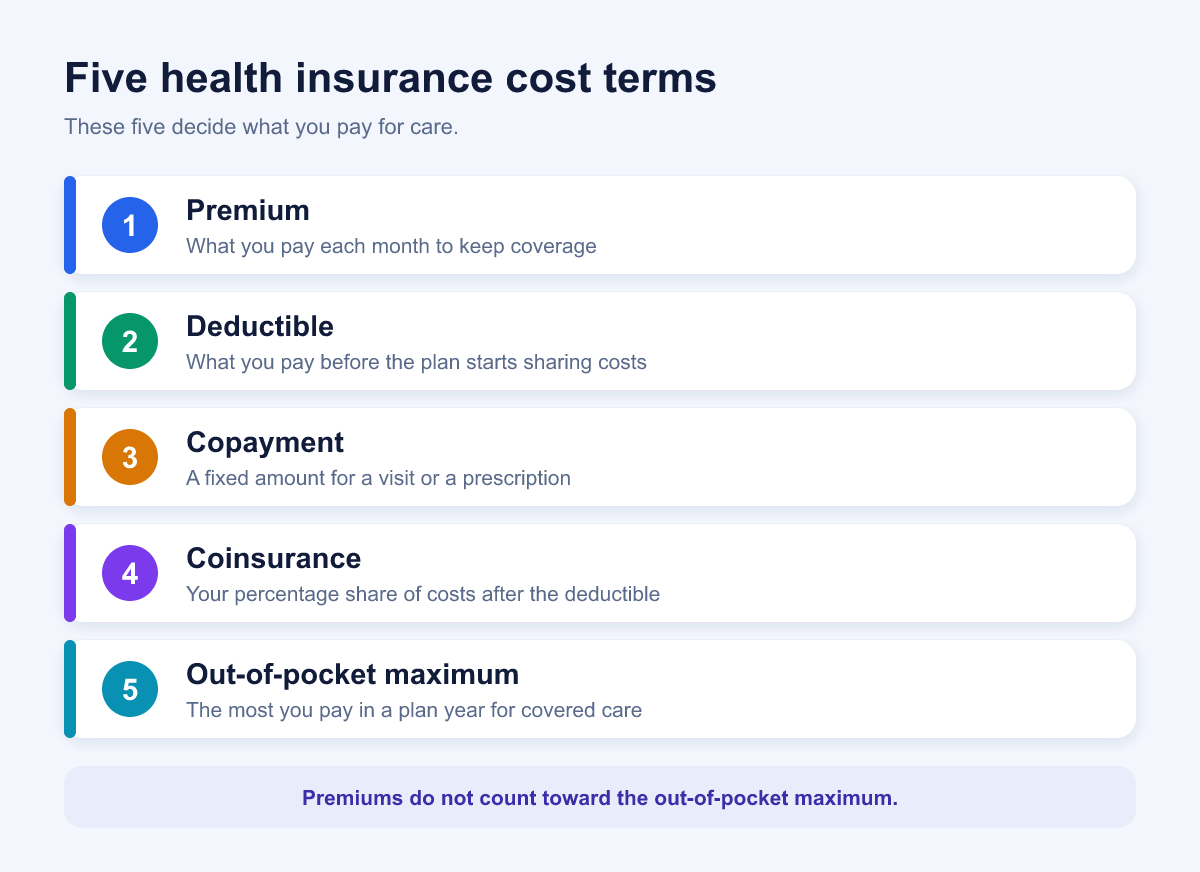
Here are the five core terms, in the order they usually hit your wallet. The definitions follow the glossary on HealthCare.gov, the federal Marketplace website.
1. Premium: what you pay each month to keep coverage
The premium is the amount you pay for your health insurance every month. You owe it whether you see a doctor or not. HealthCare.gov points out that the plan with the lowest monthly premium may not be the best match for you: if you use a lot of care, a slightly higher premium with a lower deductible can save you money. With a Marketplace plan, you may be able to lower the premium with a premium tax credit; with employer coverage, your share is usually taken from your paycheck.
2. Deductible: what you pay before the plan starts sharing costs
The deductible is the amount you pay for covered health care services before your plan starts to pay. HealthCare.gov's example: with a $2,000 deductible, you pay the first $2,000 of covered services yourself. After you meet it, you usually pay only a copayment or coinsurance and the insurer pays the rest. The deductible starts over with each new plan year.
3. Copayment: a fixed amount for a visit or a prescription
A copayment, or copay, is a fixed amount (for example $20) you pay for a covered service. It can vary by service within the same plan: a primary care visit, a specialist visit, a lab test and a prescription may each have a different copay.
4. Coinsurance: your percentage share of costs after the deductible
Coinsurance is the percentage of the cost of a covered service you pay after you have met your deductible, for example 20%. The plan pays the remaining 80%.
5. Out-of-pocket maximum: the most you pay in a plan year for covered care
The out-of-pocket maximum (also called the out-of-pocket limit) is the most you have to pay for covered services in a plan year. Once your deductible, copayments and coinsurance for in-network care add up to that amount, your plan pays 100% of the cost of covered benefits for the rest of the plan year.
A quick way to remember the sequence: the premium keeps you covered, the deductible comes first, copays and coinsurance come next, and the out-of-pocket maximum is the ceiling. Not every plan uses every feature in the same way: some plans charge copays before the deductible for certain services, so always check your plan's own summary.
Copay vs coinsurance: the difference that trips people up
Both are ways of sharing the cost of care after the plan has started paying, but they behave differently. A copay is a flat dollar amount. Coinsurance is a percentage, so what you pay grows with the price of the service.
HealthCare.gov gives a simple illustration. Say the plan's allowed amount for an office visit is $100:
- With a $20 copay and the deductible met: you pay $20, usually at the time of the visit.
- With 20% coinsurance and the deductible met: you pay 20% of $100, or $20, and the insurer pays the rest.
- If you have not met your deductible: in both cases you pay the full allowed amount, $100.
The result looks identical on a $100 visit, but the difference appears on expensive care. A $20 copay stays $20. A 20% coinsurance on a $10,000 service is $2,000, until you reach your out-of-pocket maximum.
| Feature | Copay | Coinsurance |
|---|---|---|
| Form | Fixed dollar amount | Percentage of the allowed amount |
| Typical use | Office visits, prescriptions, some urgent care | Hospital stays, surgery, imaging, many specialist services |
| Predictability | High: you know the amount in advance | Lower: it depends on the price of the service |
| Before the deductible | You usually pay the full allowed amount, unless your plan charges a copay for that service first | You pay the full allowed amount |
| Counts toward the out-of-pocket maximum | Yes, for covered in-network care | Yes, for covered in-network care |
Note the last row: both feed the same ceiling, which is the subject of the next section. Also remember that "typical use" is only a pattern. Your plan documents show exactly which service carries which cost.
The out-of-pocket maximum: what counts and what does not
The out-of-pocket maximum is your protection against a catastrophic year. HealthCare.gov explains that after you spend this amount on deductibles, copayments and coinsurance for in-network care and services, your plan pays 100% of the costs of covered benefits.
But the limit does not include:
- Your monthly premium.
- Anything you spend on services your plan does not cover.
- Out-of-network care and services.
- Costs above the allowed amount for a service that a provider may charge.
In other words, a plan year can cost you more than the maximum: twelve premiums, plus the cap, plus anything excluded from it.
Federal ceiling for Marketplace plans
For Marketplace plans, HealthCare.gov lists these legal ceilings on the out-of-pocket limit (the plan year is shown in each case): for plan year 2026, no more than $10,600 for an individual or $21,200 for a family; for plan year 2027, no more than $12,000 for an individual or $24,000 for a family. These are ceilings, not what every plan charges: many plans set a lower maximum, and the number printed in your plan's Summary of Benefits and Coverage is the one that applies to you. These figures were read on HealthCare.gov at the time of writing (November 2026) and change over time.
Individual and family deductibles
On family plans, HealthCare.gov notes that you often see both an individual deductible, which applies to each person, and a family deductible, which applies to all family members together. Plans differ on how the two interact: in some, one person's costs can trigger coverage once they reach the individual amount; in others, the family amount must be reached first. Ask the insurer or your employer how your plan works before you count on it. This matters most when one family member expects heavy care.
In-network, out-of-network and the allowed amount
A network is made up of the facilities, providers and suppliers your insurer has contracted with to provide care. This contract matters because it sets the price.
The allowed amount
The allowed amount is the maximum a plan will pay for a covered service; it may also be called the "negotiated rate." Your deductible, copay and coinsurance are calculated on this amount, not on the "sticker price" the provider first charges. This is why the number on a hospital bill can be much higher than the number the plan counts.
Out-of-network and balance billing
A provider who is not in your network has not agreed to the allowed amount. HealthCare.gov defines balance billing as a provider billing you for the difference between the provider's charge and the allowed amount. Example from the glossary: the provider's charge is $100, the allowed amount is $70, so the provider may bill you the remaining $30. A preferred (in-network) provider may not balance bill you for covered services. Out-of-network coinsurance, for its part, usually costs more than in-network coinsurance.
How much freedom you have to go out of network depends on your plan type (HMO, EPO, PPO or POS). Some plan types do not cover out-of-network care except in an emergency, while others cover it at a higher cost to you. Your plan documents say which rules apply.
Surprise bills and the No Surprises Act
The No Surprises Act, a federal law in effect since January 1, 2022, protects you from certain unexpected out-of-network bills. According to the Centers for Medicare & Medicaid Services (CMS), it covers:
- Emergency room visits, where you generally cannot be charged more than the in-network cost-sharing rate for emergency services if your insurance covers emergency care.
- Non-emergency care related to a visit to an in-network hospital, hospital outpatient department or ambulatory surgical center, for example when an attending physician there is out of network.
- Air ambulance services.
The protections apply to people with health insurance through an employer, the federal or a state Marketplace, or other individual market coverage. CMS lists exceptions: they do not apply at an out-of-network facility or in settings such as a doctor's office that is not a hospital outpatient department, and they generally do not apply to vision-only or dental-only plans, short-term limited duration plans, health care sharing ministry plans or fixed indemnity plans. You can also lose these protections by signing a notice and consent form, so read what you sign. If you think a bill breaks the rules, CMS runs a No Surprises Help Desk where you can ask questions or file a complaint. If a large bill arrives anyway, our guide on how to negotiate medical bills and avoid collections covers the practical steps.
A worked example: how a $10,000 hospital bill is shared
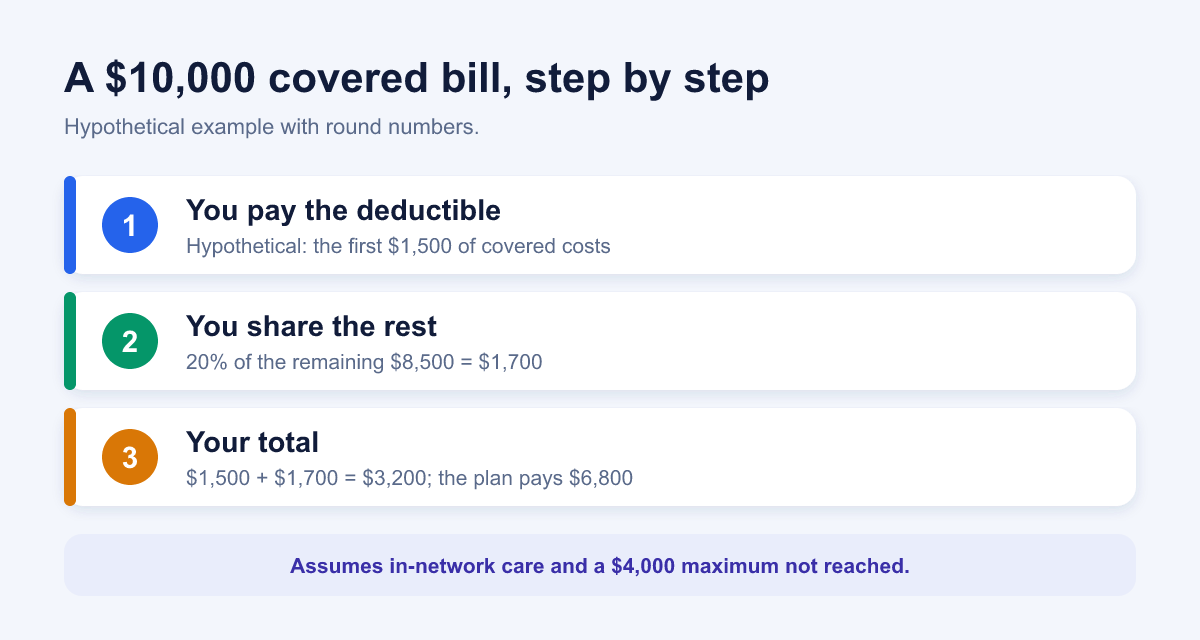
Hypothetical example. The numbers below are invented to show the mechanics. They are not a real plan or a prediction of what any care costs. Assumptions: the care is covered and in-network; the amount shown is the allowed amount; your plan has a $1,500 deductible, 20% coinsurance and a $4,000 out-of-pocket maximum; and you have paid nothing toward the deductible yet this plan year.
Scenario A: a $10,000 covered bill
- You pay the deductible: the first $1,500 of covered costs.
- You share the rest: $10,000 - $1,500 = $8,500 remains, and 20% x $8,500 = $1,700.
- Your total: $1,500 + $1,700 = $3,200. The plan pays $10,000 - $3,200 = $6,800.
Your $3,200 is below the $4,000 maximum, so the cap does not come into play.
Scenario B: a $30,000 covered bill that hits the cap
Same plan, same assumptions, but a much larger bill.
- Deductible: $1,500.
- Coinsurance: 20% x ($30,000 - $1,500) = 20% x $28,500 = $5,700.
- Calculated total: $1,500 + $5,700 = $7,200. That exceeds the $4,000 maximum, so you pay $4,000 and the plan pays $30,000 - $4,000 = $26,000.
This is the whole point of the out-of-pocket maximum: your cost stops growing once you reach it, and for the rest of the plan year the plan pays 100% of covered in-network care.
Side by side
| Hypothetical covered in-network bill | Deductible portion | Coinsurance (20%) | Calculated total | You pay | Plan pays |
|---|---|---|---|---|---|
| $2,000 | $1,500 | $100 | $1,600 | $1,600 | $400 |
| $10,000 | $1,500 | $1,700 | $3,200 | $3,200 | $6,800 |
| $30,000 | $1,500 | $5,700 | $7,200 | $4,000 (cap) | $26,000 |
HealthCare.gov's own coinsurance page walks through a similar case: allowable costs of $12,000, a $3,000 deductible, 20% coinsurance and a $6,850 out-of-pocket maximum gives a patient cost of $3,000 + 20% of $9,000 = $4,800. The structure is identical to the example above, just with different numbers. And remember that these examples count only what you pay for care: premiums come on top.
Reading an Explanation of Benefits (EOB) vs the bill
After a visit, you may get a document from your health plan called an Explanation of Benefits. CMS is clear on the point: an EOB isn't a bill. It shows the total charges for your visit and helps you understand how much your plan covers and what you will owe when the provider's bill arrives. The bill itself comes from the provider, and it may arrive before or after the EOB.
CMS describes the main lines of an EOB:
- Provider Charges: the amount your provider billed for the visit.
- Allowed Charges: the amount your provider will be paid, which may differ from the provider charges.
- Paid by Insurer: the amount your plan will pay the provider.
- What You Owe or Patient Balance: what you owe after the insurer has paid everything else. The EOB shows what you owe, not whether you have already paid it.
- Remark code: a note from the plan, usually 2 or 3 letters and numbers, explaining the costs, charges or payments. A legend at the bottom of the EOB describes each code.
CMS adds that your bill should not be higher than the Patient Balance, and that if it is, you should talk to your provider.
A simple EOB check
- Match the date of service and the provider to a visit you actually had.
- Compare the Patient Balance with the provider's bill.
- Look at which part went to the deductible, which to a copay and which to coinsurance. Does it fit your plan summary?
- If something looks wrong, call the number on the EOB first, then the provider's billing office. If you disagree with a coverage decision, your plan documents explain whether and how you can appeal.
Keep your EOBs for the year. They are also a running record of how much you have already paid toward the deductible and the out-of-pocket maximum.
Other details that change your costs
Preventive care
All Marketplace health plans pay the full cost of certain preventive benefits even before you meet your deductible, according to HealthCare.gov. Coverage can vary by plan, so check yours. If a visit includes both a preventive service and other care, the other care can still be charged normally. Many plans also pay for certain services, such as a checkup or a disease management program, before you have met the deductible.
Prescription drugs
Plans usually cover prescriptions through a formulary, a list of covered drugs also called a drug list. HealthCare.gov notes that drugs on your plan's formulary are usually less expensive for you than drugs that are not, and that some plans have a separate deductible for prescription drugs. Plans often charge a different copay or coinsurance depending on the drug, with higher costs for non-preferred brand drugs. Check that your regular pharmacy is in the plan's network, and look up each of your medications before you choose a plan.
Metal tiers: Bronze, Silver, Gold and Platinum
Marketplace plans fall into four categories, or "metal levels," plus catastrophic plans for certain people. HealthCare.gov stresses that the categories have nothing to do with the quality of care; they differ in how costs are shared between the plan and you. The percentages below are the estimates published there, and actual costs vary by plan:
| Category | Plan pays (estimate) | You pay (estimate) | Deductible is generally |
|---|---|---|---|
| Bronze | 60% | 40% | High |
| Silver | 70% | 30% | Moderate |
| Gold | 80% | 20% | Low |
| Platinum | 90% | 10% | Low |
The pattern is the general rule on the HealthCare.gov glossary pages: plans with lower monthly premiums tend to have higher deductibles, copays and coinsurance, and plans with higher premiums tend to have lower ones. If you qualify for extra savings based on income, those apply only if you enroll in a Silver plan. Our guide to Marketplace vs employer plans at open enrollment explains where to shop.
High-deductible plans and HSAs
All Bronze and catastrophic Marketplace plans work with Health Savings Accounts, as do some plans in other categories. A Health Savings Account lets you set aside pre-tax money to pay deductibles, copays and coinsurance (but not premiums). The trade-off is a lower premium in exchange for a higher deductible that you pay in full for most non-preventive care until it is met. If you are weighing it, read our comparison of HSA vs FSA accounts, and check eligibility rules with the IRS and your plan before assuming a plan qualifies.
How to compare plans at open enrollment
HealthCare.gov recommends comparing the estimated total yearly cost of each plan rather than the premium alone. Total yearly cost means 12 monthly premiums plus the deductible, copays and coinsurance you are likely to pay, up to the out-of-pocket maximum. The more care you use, the more the costs rise, up to that maximum. At a minimum, you pay your premiums.
Hypothetical comparison of two plans
Hypothetical example. Assumptions: all care is covered and in-network, copays are ignored to keep the arithmetic simple, and the amounts are the plan's allowed amounts. Plan A has a lower premium ($300 a month, $3,600 a year), a $5,000 deductible, 30% coinsurance and an $8,000 out-of-pocket maximum. Plan B has a higher premium ($500 a month, $6,000 a year), a $1,000 deductible, 20% coinsurance and a $5,000 out-of-pocket maximum.
| Year | Covered care that year | Plan A: care + premiums | Plan A total | Plan B: care + premiums | Plan B total |
|---|---|---|---|---|---|
| Light use | $600 | $600 + $3,600 | $4,200 | $600 + $6,000 | $6,600 |
| Moderate use | $10,000 | $6,500 + $3,600 | $10,100 | $2,800 + $6,000 | $8,800 |
| Heavy use | $40,000 | $8,000 (cap) + $3,600 | $11,600 | $5,000 (cap) + $6,000 | $11,000 |
Check the arithmetic for the moderate year. Plan A: $5,000 deductible, plus 30% x ($10,000 - $5,000) = $1,500, for $6,500. Plan B: $1,000 deductible, plus 20% x ($10,000 - $1,000) = $1,800, for $2,800. In the heavy year, both plans reach their caps: Plan A would otherwise cost $5,000 + 30% x $35,000 = $15,500, and Plan B $1,000 + 20% x $39,000 = $8,800, so the caps limit what you pay for care to $8,000 and $5,000.
The lesson is not that one plan is better. The cheaper plan wins in a light year, the pricier plan wins in a moderate or heavy year, and the gap in the heavy year is smaller than the premium difference might suggest because both plans have a ceiling. What you cannot know in advance is which year you will have. That is where your budget comes in: can you absorb the higher maximum if the year goes badly? A solid emergency fund is what makes a high-deductible plan manageable.
A checklist for open enrollment
- Expected care: list the visits, tests, procedures, therapy or pregnancy you can foresee for each person covered.
- Prescriptions: check each medication against the formulary and note the cost for each; confirm the pharmacy is in the network.
- Doctors and hospitals: confirm that each is in the network of the exact plan you are considering, not just the same insurer.
- Total annual cost: premiums x 12 plus your expected deductible, copays and coinsurance, then recalculate with a heavy year, up to the out-of-pocket maximum.
- Savings buffer: can you pay the out-of-pocket maximum, or the deductible, from savings if you have to?
- Plan rules: referrals, prior authorization, separate deductibles for drugs, and how the family deductible works.
Three hypothetical profiles
These profiles are illustrations of how the same plans can look different to different people. They are not recommendations.
- Healthy and rarely sick. A person who expects a checkup and perhaps one urgent care visit may find that a lower-premium, higher-deductible plan costs less in most years, as in the "light use" row above. The risk is a rare bad year, so the question is whether savings can cover the deductible and, in the worst case, the maximum.
- Parent with a regular prescription. A household with predictable monthly costs, such as a child with a standing prescription and routine specialist visits, may be better served by a plan whose copays and drug tiers they can see in advance. Because the use is steady, the higher-premium plan can come out ahead of the lower-premium one in the "moderate use" row.
- Managing a chronic condition. Someone who knows they will reach the out-of-pocket maximum each year may focus on the plan with the lowest maximum plus premiums, and on making sure the specialists and hospital they use are in the network. For this profile, the heavy-use row matters most.
Common mistakes to avoid
- Choosing on the premium alone. A low premium can come with a deductible you cannot afford, and HealthCare.gov warns that the cheapest premium may not match your needs.
- Ignoring the network. A plan with a low price and a network that excludes your doctor can cost more than a pricier plan that includes them, because out-of-network care is excluded from the out-of-pocket maximum.
- Forgetting that the deductible resets. Your deductible and out-of-pocket maximum start over each plan year. Care scheduled just before or after the reset can change what you pay. Check when your plan year starts, since it may not be the calendar year.
- Confusing copay with coinsurance. "$30" and "30%" are not the same thing, and the difference grows with the price of the service.
- Assuming everything counts toward the maximum. Premiums, non-covered services, out-of-network care and amounts above the allowed amount do not.
- Skipping EOB review. Billing errors happen, and an EOB is your first tool for catching a bill that does not match what the plan says you owe.
- Assuming an emergency is free of cost sharing. The No Surprises Act limits out-of-network charges for emergency services, but you may still owe your normal in-network cost sharing.
In summary
- Premium: the monthly price of keeping coverage. It is not counted toward the out-of-pocket maximum.
- Deductible: what you pay first, each plan year, before the plan starts sharing costs for most services.
- Copay: a flat amount for a service. Coinsurance: a percentage of the allowed amount after the deductible.
- Out-of-pocket maximum: the ceiling on what you pay for covered in-network care in a plan year. It excludes premiums, non-covered services, out-of-network care and amounts above the allowed amount.
- In-network care is priced on the allowed amount; out-of-network care can cost more, and balance billing may apply outside the protections of the No Surprises Act.
- An EOB is not a bill: compare it with the provider's bill and check the Patient Balance.
- Compare plans on total yearly cost for a light, moderate and heavy year, and make sure your doctors and drugs are covered.
- Keep a savings buffer sized to the deductible or maximum you choose.
This guide is general information, not insurance, legal or financial advice. Plan details vary by insurer and by state, so confirm the figures that apply to you in your plan documents or with your insurer, your employer's benefits team, or your state insurance department.
Frequently asked questions
Do copays count toward my deductible?
It depends on the plan. HealthCare.gov describes a copay as a fixed amount you pay for a covered service after you have paid your deductible, but some plans charge a copay for certain services before the deductible is met. Whether a given copay is credited toward the deductible is spelled out in your plan documents, so ask your insurer if the Summary of Benefits and Coverage does not say.
What happens when I reach my out-of-pocket maximum?
For the rest of the plan year, your plan pays 100% of the cost of covered in-network services. You still pay your monthly premium, and you may still owe costs that never count toward the maximum, such as non-covered services and out-of-network care.
Is the deductible the same as the out-of-pocket maximum?
No. The deductible is only the first layer of what you pay. The out-of-pocket maximum includes the deductible plus copayments and coinsurance, so it is always at least as large as the deductible. In the hypothetical example above, the deductible is $1,500 and the maximum is $4,000.
Do I pay the deductible for preventive care?
Usually not. HealthCare.gov states that all Marketplace health plans pay the full cost of certain preventive benefits even before you meet your deductible, for the benefits it lists. Coverage may vary by plan, so check yours and ask which services count as preventive.
Why is my bill higher than what the EOB says I owe?
CMS says your bill should not be higher than the Patient Balance on your EOB, and that you should talk to your provider if it is. Possible reasons include a bill that has not yet been matched to the insurer's decision, an error, or a claim that was processed differently. Start with the provider's billing office and your plan's customer service number. If the care was out of network, the situation can be different, which is why you should check the network status and the No Surprises Act protections that may apply.
Does the deductible reset every year?
Yes. The deductible and the out-of-pocket maximum apply to a plan year, which for employer plans may not match the calendar year; for individual policies it is called a policy year. At the start of a new plan year, the amounts you paid before no longer count and you start again.
Sources
- HealthCare.gov: Out-of-pocket maximum/limit
- HealthCare.gov: Deductible
- HealthCare.gov: Copayment
- HealthCare.gov: Coinsurance
- HealthCare.gov: Balance billing
- HealthCare.gov: Health plan categories: Bronze, Silver, Gold and Platinum
- CMS: Medical bill rights, the No Surprises Act and your health insurance
- CMS: How to read a health insurance explanation of benefits