
For many older homeowners, the house is the largest asset they own, while monthly income feels tight. A reverse mortgage promises a way to turn part of that home equity into cash without selling and without a required monthly mortgage payment. That promise is real, but it comes with trade-offs that are easy to miss in a sales brochure: the loan balance grows instead of shrinking, upfront costs are significant, and you must keep paying certain bills on the house for as long as the loan lasts.
This guide covers the most common kind of reverse mortgage, the Home Equity Conversion Mortgage (HECM), which is insured by the Federal Housing Administration (FHA). You will see who qualifies, what the required counseling involves, how the money can be paid out, what the loan costs, what your obligations are, what happens to spouses and heirs, and how to spot scams. A hypothetical example shows how the balance can grow over time. The facts and figures here come from official pages of the Consumer Financial Protection Bureau (CFPB) and the U.S. Department of Housing and Urban Development (HUD), listed at the end. Rules and amounts change, so confirm current figures with a HUD-approved counselor before you decide.
What a reverse mortgage is, and the three types
A reverse mortgage lets a homeowner borrow money using the home as security. As with a traditional mortgage, the title stays in your name. The difference, according to the CFPB, is that borrowers do not make monthly mortgage payments. The loan is repaid when you no longer live in the home. Meanwhile, interest and fees are added to the loan balance every month, so the amount you owe goes up, not down, and your home equity shrinks as it does. The CFPB is blunt about it: a reverse mortgage is not free money.
The CFPB describes three kinds of reverse mortgages:
- HECMs, insured by the FHA (part of HUD). Most reverse mortgages today are HECMs, and HUD says the HECM is the only reverse mortgage insured by the federal government. It is available only through an FHA-approved lender.
- Proprietary reverse mortgages, offered by private lenders and not federally insured. The CFPB says they are typically designed for borrowers with higher home values.
- Single-purpose reverse mortgages, offered by some state and local governments and nonprofits. They can be used only for the purpose the lender specifies, such as home repairs or property taxes, may be available only in some areas, and may be limited to low- or moderate-income homeowners. They are not federally insured either.
The rest of this guide is about HECMs. If you are offered a proprietary loan, the rules on counseling, fees and protections can differ, so ask for every term in writing and compare offers from several lenders, as the CFPB recommends.
How a HECM works and who qualifies
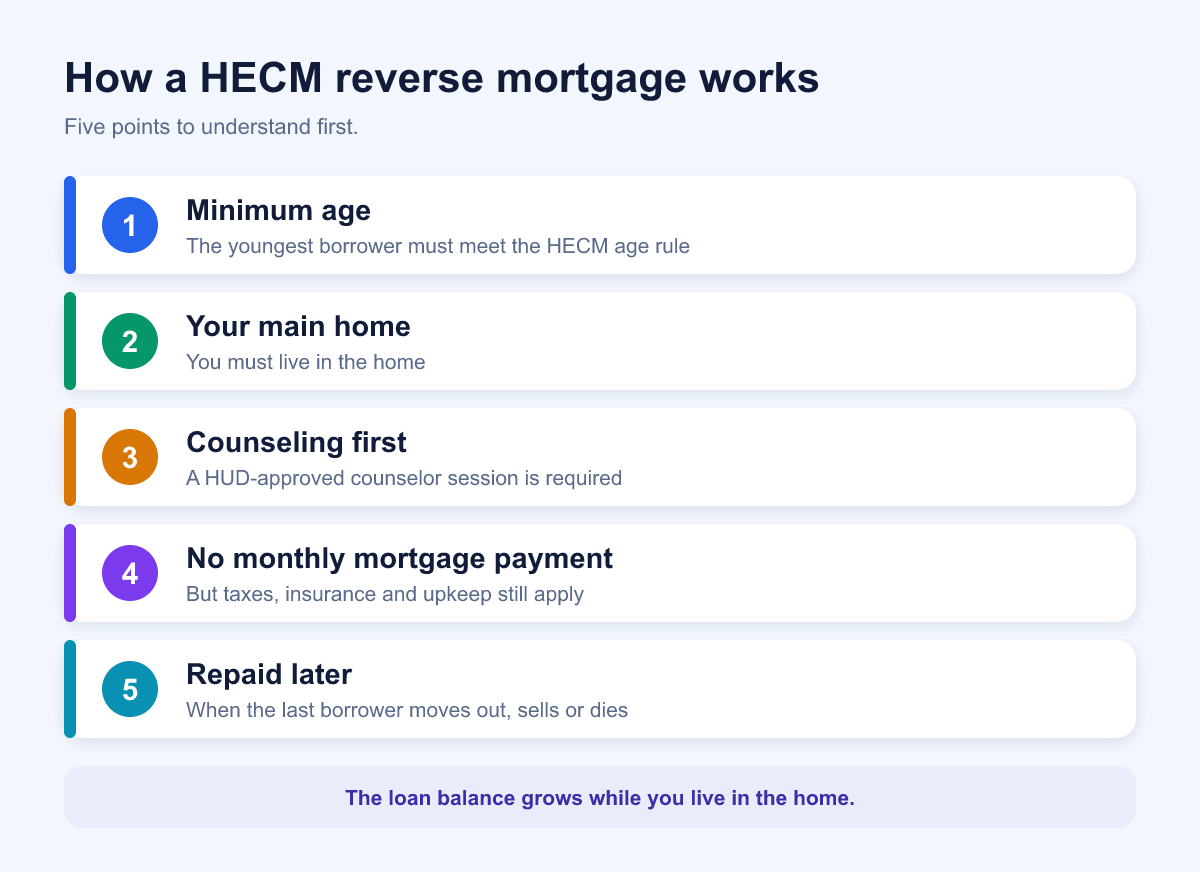
The five points in the figure follow the order in which you will meet them.
1. Minimum age
The CFPB says a HECM is available only to homeowners who are 62 and older. When there is more than one borrower, HUD says the amount you can borrow is based on the age of the youngest borrower, or of an eligible non-borrowing spouse, which we cover below.
2. Your main home
The home must be your principal residence, meaning you live there the majority of the year. A second home or a rental property does not qualify. You must also either own the home outright or have a low mortgage balance that you can pay off at closing, using your own funds or money from the reverse mortgage. Per the CFPB, you cannot owe any federal debt, such as federal income taxes or federal student loans, although you may use loan money to pay it off. The home must meet property standards, and the lender will tell you which repairs are needed before the loan can proceed.
HUD also notes that a HECM can be used to purchase a primary residence if you can pay the difference between the loan proceeds and the sales price plus closing costs with cash on hand.
3. Counseling first
Before you receive a HECM, you must get counseling from a HUD-approved reverse mortgage counseling agency. The session covers whether you qualify, the financial implications and the alternatives. The CFPB adds that agencies may charge a reasonable fee, depending on the agency and your income and debts, but they cannot charge you if you cannot afford it, and they must explain all charges before counseling. You can speak with a counselor even before you choose a lender. HUD's counselor referral line is (800) 569-4287. If you spoke to a lender first, tell the counselor what the lender recommended.
4. No required monthly mortgage payment, but other costs remain
You do not make monthly mortgage payments, but you still must pay property taxes and homeowners insurance (plus flood insurance, condo or homeowners' association fees and similar charges where they apply), and keep the home in good condition. The CFPB says you must have enough of your own money, or agree to set aside part of the loan funds at closing, to cover ongoing property charges and upkeep.
5. Repaid later
A HECM must be paid off when the last surviving borrower or eligible non-borrowing spouse dies, sells the home, or no longer lives there as a principal residence. Usually the home is sold to repay it.
How much you can borrow and how you receive the money
Your borrowing limit is called the principal limit. According to HUD, the amount available depends on three things: the age of the youngest borrower or eligible non-borrowing spouse, the current interest rate, and the lesser of the appraised value, the HECM FHA mortgage limit or the sales price (the last for purchase loans). In general, the CFPB says, older borrowers, higher-priced homes and lower interest rates produce higher principal limits than younger borrowers, lower-priced homes and higher rates.
The FHA limit matters if your home is worth a lot. For FHA case numbers assigned from January 1, 2026, through December 31, 2026, HUD set the HECM maximum claim amount at $1,249,125 for all areas. If your home is worth more than that, the loan is still calculated on $1,249,125 at most. HUD updates the figure each calendar year, so check the current one.
The CFPB lists three main ways to receive the money:
| Option | How it works | Cost and risk notes (CFPB) |
|---|---|---|
| Line of credit (adjustable rate) | Borrow when you need it. Unused credit can keep growing, up to a maximum stated in the mortgage. Can be combined with monthly payouts. | Lower cost than a lump sum because interest and fees apply only to the money you use. |
| Monthly payout (adjustable rate) | Fixed monthly amounts, either for a set number of years (term) or for as long as you keep the loan, within the limit stated in the mortgage (tenure). Can be combined with a line of credit. | Lower cost than a lump sum because interest and fees apply only to the money drawn so far. |
| Lump sum (fixed rate) | Withdraw all available funds at once at closing. | Amount available may be lower, no credit line growth, higher cost since interest and fees apply to the whole amount, and higher risk for younger borrowers who may outlive the funds. |
The CFPB's key-terms page adds that the principal limit generally increases each month, which may make more funds available over time for adjustable-rate HECMs but not for fixed-rate ones.
What a HECM costs
The CFPB says a reverse mortgage is typically more expensive than other home loans. Costs fall into two groups. You can pay the upfront ones in cash or finance them from the loan proceeds, but financing them leaves you less money to spend and adds to the balance that grows.
| Cost | Paid to | When | What to know |
|---|---|---|---|
| Counseling | HUD-approved agency | Before the loan | Reasonable fee allowed; cannot be charged if you cannot afford it. |
| Origination fee | Lender | Upfront | The CFPB says $6,000 or less; compare lenders. |
| Closing costs | Third parties | Upfront | Can include appraisal, title search, surveys, inspections, recording fees, mortgage taxes and credit checks. |
| Initial mortgage insurance premium | FHA | Upfront | HUD set it at 2.00% of the maximum claim amount for case numbers assigned from October 2, 2017 (Mortgagee Letter 2017-12). Confirm the current rate. |
| Interest | Lender | Monthly, added to balance | Interest is charged on interest and fees already added. |
| Servicing fees | Lender/servicer | Monthly, added to balance | Cover statements, disbursements and checking that you meet the loan requirements. |
| Annual mortgage insurance premium | FHA | Monthly, added to balance | The CFPB lists it as 0.5% of the outstanding mortgage balance per year. |
The mortgage insurance, the CFPB explains, guarantees that you receive your expected loan advances. It is in addition to your homeowners insurance. The larger your balance and the longer you keep the loan, the more you pay in ongoing costs, and the CFPB says the best way to keep them low is to borrow only as much as you need.
Five costs and risks to weigh
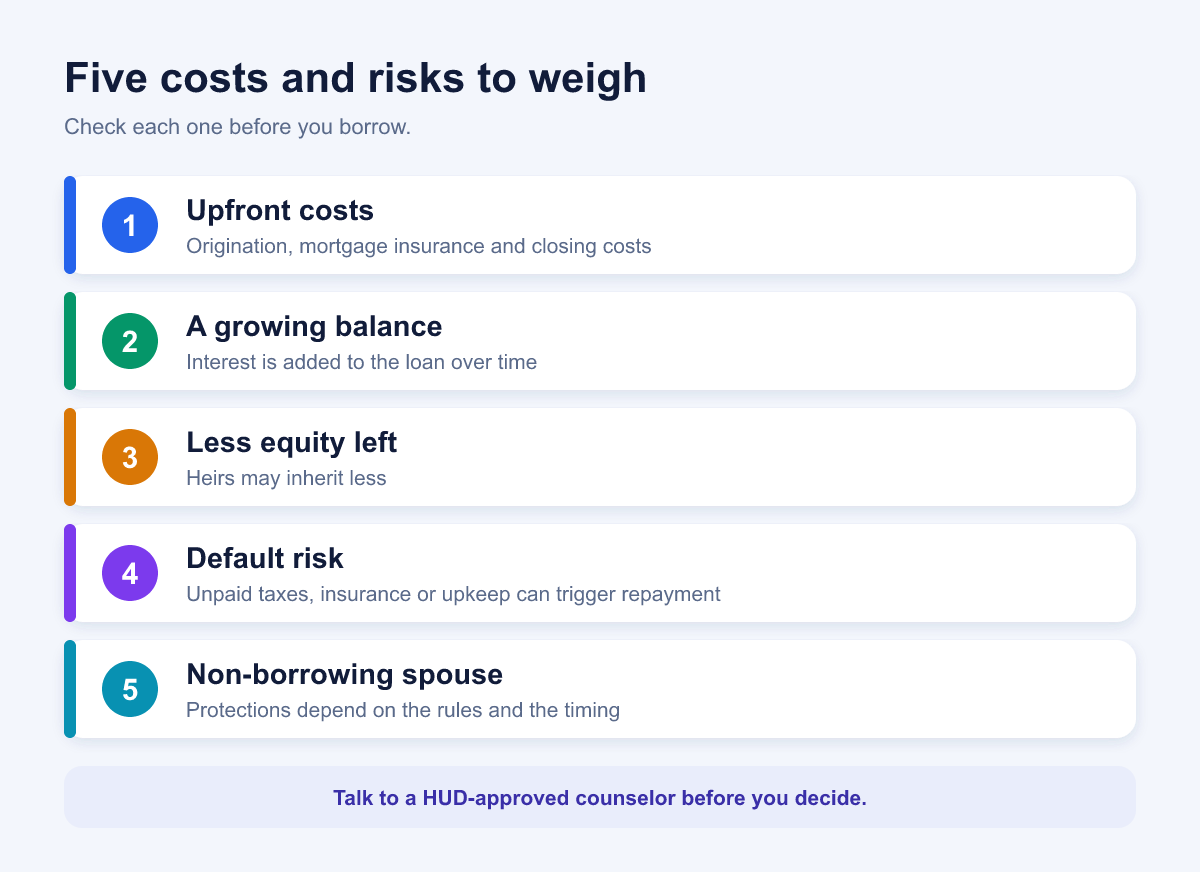
- Upfront costs. Origination, mortgage insurance and closing costs add up at the start, whether you pay them in cash or from the loan.
- A growing balance. Interest and fees are added to the loan each month, so the balance rises over time. The hypothetical example further down shows how quickly.
- Less equity left. As the balance grows, home equity falls, and heirs may inherit less. If you want to leave the house to someone, discuss it with them now.
- Default risk. Unpaid property taxes or insurance, or a home that is not kept in good repair, can make the loan due and lead to foreclosure.
- Non-borrowing spouse. A spouse who is not on the loan may or may not be able to stay in the home after you die or move out. Protections depend on HUD's rules and on when the loan was made.
Another trade-off, noted by the CFPB, is timing. Taking a reverse mortgage when you are too young can leave you short of money later, when income is lower and health care costs may be higher.
Your obligations and what happens in default
With a HECM, you must pay property taxes and homeowners insurance, use the home as your principal residence, and keep it in good repair. The CFPB defines the full set of property charges to include property taxes, hazard and flood insurance, ground rents, condominium fees, planned unit development fees, homeowners' association fees and special assessments. Paying them on time is a loan requirement. Our guides on how property taxes are calculated and appealed and on what homeowners insurance covers can help you estimate those yearly bills before you borrow.
Failing any of these obligations puts the loan in default, and the lender can start foreclosure. The CFPB's advice if you cannot afford taxes or insurance is to act right away:
- If you receive a default or foreclosure notice, get advice right away from a reverse mortgage housing counseling agency or an attorney. Ignoring it can cost you the home.
- Ask your local Area Agency on Aging about state and local programs that help with property charges or home repairs (the CFPB lists (800) 677-1116 and the Eldercare Locator website).
- Each year, borrowers must certify that the home is their principal residence and that their contact information is current. If you did not get the form, contact your servicer.
Absences matter too. The CFPB says that if you are away for more than 12 consecutive months in a healthcare facility such as a hospital, rehabilitation center, nursing home or assisted living facility, and no co-borrower lives in the home, the loan becomes due.
Repayment, heirs, spouses and other people in the home
Selling or moving
If you sell, you repay the balance and keep any difference. If the balance is higher than the sale price and you sell for the appraised value, the CFPB says the shortfall is covered by mortgage insurance. In general, for a HECM, you or your estate will never owe more than the value of the house, which is the non-recourse protection that the FHA insurance provides.
When the last borrower dies
The loan becomes due and payable after the death of the last borrower, co-borrower or eligible non-borrowing spouse. Once heirs receive the due and payable notice, they have 30 days to buy, sell or turn the home over to the lender, although the timeline may be extended up to six months. Heirs who want to keep the home must repay the full balance, or 95 percent of the appraised value if that is less. If they sell, the CFPB says they can keep any amount left over after repaying the loan. HUD also publishes a fact sheet on inheriting a home with a HECM, linked in the sources.
Spouses and co-borrowers
A co-borrower can stay in the home and keep receiving loan payments after the other borrower dies, as long as the loan obligations are met. A spouse who is not a co-borrower may be an "Eligible Non-Borrowing Spouse." For HECMs with FHA case numbers assigned on or after August 4, 2014, the CFPB lists these conditions: the spouse was married to you when the loan documents were signed and stays married until your death; was identified in the loan documents as a non-borrowing spouse; lived in the home at closing and continues to live there as a principal residence; and keeps meeting the loan requirements. An eligible non-borrowing spouse receives no money from the loan. Earlier loans follow a different process, which the CFPB describes. The practical lesson is that who is on the loan, and when it was signed, can decide whether a partner can stay.
Children, relatives and other residents
A reverse mortgage does not change who can live with you while you live there. But children, relatives or other residents who are not co-borrowers or eligible spouses can stay after you die or move out only if the loan is paid off from another source.
Hypothetical example: how the balance can grow
Hypothetical example, not a real offer. Assume a $400,000 home and a total of $100,000 drawn at closing, including financed costs. Assume interest, mortgage insurance and servicing together add up to a simplified 6.5% a year, compounded annually, with no other draws or payments. These are round numbers chosen for illustration; real rates and fees vary by loan and by time.
| Years | Loan balance | Equity if the home stays at $400,000 | Equity if the home grows 3% a year |
|---|---|---|---|
| 0 | $100,000 | $300,000 | $300,000 |
| 5 | $137,009 | $262,991 | $326,701 |
| 10 | $187,714 | $212,286 | $349,853 |
| 15 | $257,184 | $142,816 | $366,003 |
| 20 | $352,365 | $47,635 | $370,079 |
In this example, the balance more than triples in 20 years even though nothing more was borrowed. Whether equity falls or holds up depends on how fast the home value changes, which no one can predict. Two other effects are worth noting. First, financing the upfront costs raises the starting balance. Hypothetically, a 2.00% initial premium on a $400,000 maximum claim amount would be $8,000 on its own, in addition to the origination fee and closing costs. Second, the annual 0.5% premium applies to the outstanding balance, so it grows as the balance does. For instance, 0.5% of $100,000 is $500 in a year, and 0.5% of $187,714 is about $939.
Three hypothetical profiles
These simplified situations are only meant to illustrate the questions to ask. They are not recommendations.
Profile A: a single homeowner who wants a safety net
A 70-year-old owns a home outright and has stable but modest income. She is interested in a HECM line of credit she would use only for large expenses. Questions: Can I keep paying taxes, insurance and repairs for 15 to 20 years? What will the upfront costs be compared with the amount I might actually use? Would a smaller, cheaper option or downsizing meet the same need?
Profile B: a couple with a younger spouse
A 75-year-old homeowner is married to a 60-year-old. The spouse is under 62, so she cannot be a borrower, and HUD says the amount available is based on the age of the youngest borrower or eligible non-borrowing spouse. Questions: Will she qualify as an eligible non-borrowing spouse under the rules for this loan? What happens if the borrower moves into care for more than 12 consecutive months? What does she need to keep doing to stay protected?
Profile C: a homeowner with a mortgage and tight cash flow
A 66-year-old has a remaining mortgage and struggles with the monthly payment. A HECM could pay off the existing mortgage at closing, which the CFPB says is allowed. Questions: How much of the loan would go to the old mortgage? How long might he stay in the home? Would downsizing, refinancing or a property-tax program reduce expenses without a growing balance?
Alternatives and effects on benefits
Before borrowing, the CFPB suggests comparing other ways to use your home and budget:
- Waiting. A HECM taken too early may run out when you need it most.
- A home equity loan or line of credit. The CFPB says this may be a cheaper way to borrow against equity, although such loans usually require monthly payments and depend on your income and credit. Our guide on cash-out refinancing versus a HELOC compares the two.
- Refinancing. A new traditional mortgage could lower payments, but watch the term, since a new 30-year loan near retirement can become a hardship.
- Downsizing. Moving to a more affordable home may reduce overall expenses.
- Lowering expenses. State and local programs may help with utilities, fuel, home repairs and property taxes, and benefitscheckup.org, cited by the CFPB, lists benefit programs.
Also think about income planning. If you are deciding when to start Social Security, you may want to read our guide on how Social Security benefits are calculated and claimed before using home equity to fill a gap.
As for public benefits, we did not find an official page that sets out rules for each program, so treat this as a general caution. Programs that depend on your income or assets, such as Medicaid or Supplemental Security Income (SSI), may treat money you receive and keep differently from money you spend. Ask your counselor, the benefits agency and, if needed, an attorney how a reverse mortgage would apply to you before you sign.
Scams, cancellation rights and common mistakes
Red flags
The CFPB warns about contractors who approach you with the idea of paying for repairs through a reverse mortgage and pressure you to sign. It also warns about ads aimed at veterans that falsely imply VA approval, since the VA does not offer reverse mortgage loans, or that promise a "no-payment" loan. HUD cautions that scam artists charge thousands of dollars for information that is free from HUD. Be wary of anyone who pushes you to skip counseling, hides the costs, or sells you an unrelated product to get the loan.
Your right to cancel
With most reverse mortgages, the CFPB says you have three business days after closing to cancel for any reason, without penalty. You must notify the lender in writing, and the CFPB suggests certified mail with a return receipt. The lender then has 20 days to return money you paid for financing.
Common mistakes
- Borrowing a lump sum when a line of credit would do.
- Underestimating taxes, insurance and repairs over many years.
- Forgetting to list a spouse in the loan documents or to understand their status.
- Not telling the family, so heirs are surprised by a 30-day clock.
- Comparing only one lender instead of fees and rates from several.
- Skipping questions the counselor could answer, such as what happens in a nursing home stay.
In summary
- A HECM is an FHA-insured loan for homeowners aged 62 and older, on a main residence, after counseling with a HUD-approved agency.
- There is no required monthly mortgage payment, but you still pay property taxes, insurance and upkeep.
- Money can come as a line of credit, monthly payments, a lump sum, or a combination.
- Costs include origination, closing costs, FHA insurance premiums, interest and servicing, and the balance grows over time.
- The loan is repaid when the last borrower or eligible non-borrowing spouse dies, sells or leaves; heirs generally repay the lesser of the balance or 95% of the appraised value.
- Check spouse protections, alternatives and scam warnings, and use the three-business-day right to cancel if needed.
This guide is general information, not legal, tax or financial advice. A reverse mortgage is a major decision, so talk to a HUD-approved housing counselor and, where relevant, an attorney or tax professional.
Frequently asked questions
Does the lender own my home with a reverse mortgage?
No. The CFPB says the title stays with you. The lender holds a security interest, and you can lose the home to foreclosure if you do not meet the loan obligations.
Can I owe more than my home is worth?
With a HECM, the CFPB says that if the balance exceeds the home's value, you or your heirs may not have to pay the difference. Mortgage insurance covers the remaining balance when the home is sold for the appraised value, and heirs do not have to pay more than 95 percent of the appraised value.
Do I have to pay anything every month?
Not a mortgage payment. But you must pay property taxes, homeowners insurance and other property charges and keep the home in good repair. Some borrowers set aside part of the loan funds at closing for those costs.
What if I move into a nursing home?
If you are away from the home for more than 12 consecutive months in a healthcare facility and no co-borrower lives there, the loan becomes due. A qualifying eligible non-borrowing spouse may stay, depending on HUD's rules.
Can my children keep the house?
Yes, if they repay the loan. According to the CFPB, they must pay the full balance or, if less, 95 percent of the appraised value, and they might need their own loan to do so. They generally have 30 days after the notice, with extensions possible up to six months.
Is counseling really required, and what does it cost?
Yes, for a HECM you must receive counseling from a HUD-approved agency before getting the loan. Agencies may charge a reasonable fee based on your income and debts, but cannot charge you if you cannot afford it.
Sources
- HUD: FHA Reverse Mortgage for Seniors (HECM)
- HUD: Mortgagee Letter 2025-22 (HECM maximum claim amount for 2026)
- HUD: Mortgagee Letter 2017-12 (HECM mortgage insurance premium rates)
- CFPB: Reverse mortgages (hub with answers on eligibility, payment options, costs, repayment, default, heirs, spouses and selling)
- CFPB: What is a reverse mortgage?
- CFPB: Can anyone take out a reverse mortgage loan?
- CFPB: How much does a reverse mortgage loan cost?
- CFPB: Reverse mortgages key terms