If you freelance or run a small business, you have probably heard the advice: "Form an LLC, then elect S corp status and cut your self-employment tax." It sounds simple, and sometimes the numbers do work out. But the advice mixes up two different things, skips the paperwork that comes with it, and ignores the fact that the savings depend on how much profit you really make and what a fair salary for your work would be.
This guide explains, in plain English, what an LLC is, what an S corp is, how a default LLC is taxed, what changes when you elect S-corp tax treatment, and what the election adds in payroll, filings and state-level rules. It includes a hypothetical example with round numbers, five checks to run before you file, common mistakes and questions to bring to a CPA or enrolled agent. Rules and figures cited were read on the official IRS pages listed at the end at the time of writing (October 2026) and can change. This is general information, not tax advice.
LLC and S corp: a state entity and a tax election
The first thing to untangle is vocabulary. According to the IRS, a limited liability company (LLC) is an entity created by state statute. It is a legal form you create by filing with your state. An S corporation, by contrast, is a federal tax classification: the IRS describes S corporations as corporations that elect to pass corporate income, losses, deductions and credits through to their shareholders for federal tax purposes. In other words, "LLC" says how your business is organized under state law, and "S corp" says how the IRS taxes it.
That is why the question "LLC or S corp?" is slightly misleading. Many freelancers end up with an LLC that is taxed as an S corp. The two can coexist, and the real decision is whether to leave your LLC with its default tax treatment or to elect S-corp treatment. If you are still deciding whether to form an LLC at all, our guide on turning a side hustle into an LLC covers the formation side. The liability protection an LLC may offer is a state-law matter and is the same whichever tax route you pick, so this guide focuses on tax.
How a default single-member LLC is taxed
Per the IRS, an LLC with only one member is, for income tax purposes, treated as an entity disregarded as separate from its owner, unless it files Form 8832 and elects to be treated as a corporation. For an individual owner running a business, that usually means you report the business on Schedule C of your personal Form 1040. The IRS also says the owner of a single-member LLC is subject to the tax on net earnings from self-employment in the same manner as a sole proprietor.
An LLC with two or more members is classified as a partnership by default, which brings its own return and schedules. The rest of this guide focuses on the single-owner case, because that is where the S-corp question comes up most often for freelancers.
What self-employment tax is
Self-employment (SE) tax is the Social Security and Medicare tax you pay on your own business earnings, because no employer is withholding it for you. The IRS lists the rate as 15.3%, made up of 12.4% for Social Security and 2.9% for Medicare. It is not applied to your full profit: the IRS explains that generally the amount subject to SE tax is 92.35% of your net earnings from self-employment, and net earnings are your business income minus ordinary and necessary business expenses.
A few related points from the same IRS pages:
- The Social Security part applies only up to an annual maximum that changes every year; all net earnings are subject to the Medicare part, and an additional 0.9% Medicare tax applies above income thresholds that depend on filing status.
- You can deduct the employer-equivalent portion of SE tax when figuring your adjusted gross income. That deduction affects income tax, not SE tax itself.
- This tax is separate from income tax. Both apply to the same profit, which is why the S-corp idea, which targets the SE tax part, attracts so much attention.
If you are also making estimated payments during the year, see our guide to gig economy taxes and quarterly payments.
What the S-corp election changes: salary plus distributions
When an LLC is taxed as an S corporation, you are no longer a sole proprietor in the eyes of the IRS. The business becomes a corporation for tax purposes, and you, as an owner who also works in the business, become a shareholder-employee. The money you take out falls into two buckets:
- Wages. You pay yourself a salary through payroll. Social Security and Medicare taxes apply to that salary. The IRS lists the rates as 6.2% for the employer and 6.2% for the employee for Social Security, and 1.45% each for Medicare, which adds up to the same 15.3% total, split between "employer" and "employee" (both of which are you).
- Distributions. Remaining profit can be paid out as distributions. The IRS refers to these as non-wage distributions, which are not subject to employment taxes. They are still part of your income and are taxed at your individual income tax rates, because profit flows through to your personal return.
The potential saving, then, comes from one place only: a slice of your profit is no longer subject to the 15.3% payroll or self-employment tax. Income tax on that profit is unchanged. Note also that an S corp is not a way to avoid tax on profit, and it does not reduce the profit itself.
Reasonable compensation is the rule that limits the idea
You cannot set your salary at $1 and take everything as distributions. The IRS says S corporations must pay reasonable compensation to a shareholder-employee for services provided before non-wage distributions may be made, and that it has authority to reclassify distributions as wages. The IRS page does not give a percentage or a formula. It lists factors that can be considered, including:
- training and experience;
- duties and responsibilities;
- time and effort devoted to the business;
- payments to non-shareholder employees;
- what comparable businesses pay for similar services.
It also notes that to the extent income comes from the owner's personal services, payments to the owner should be treated as wages. For a freelancer whose income is almost entirely their own work, that can put a meaningful share of profit into salary, which narrows the savings.
Default LLC vs LLC taxed as an S corp, side by side
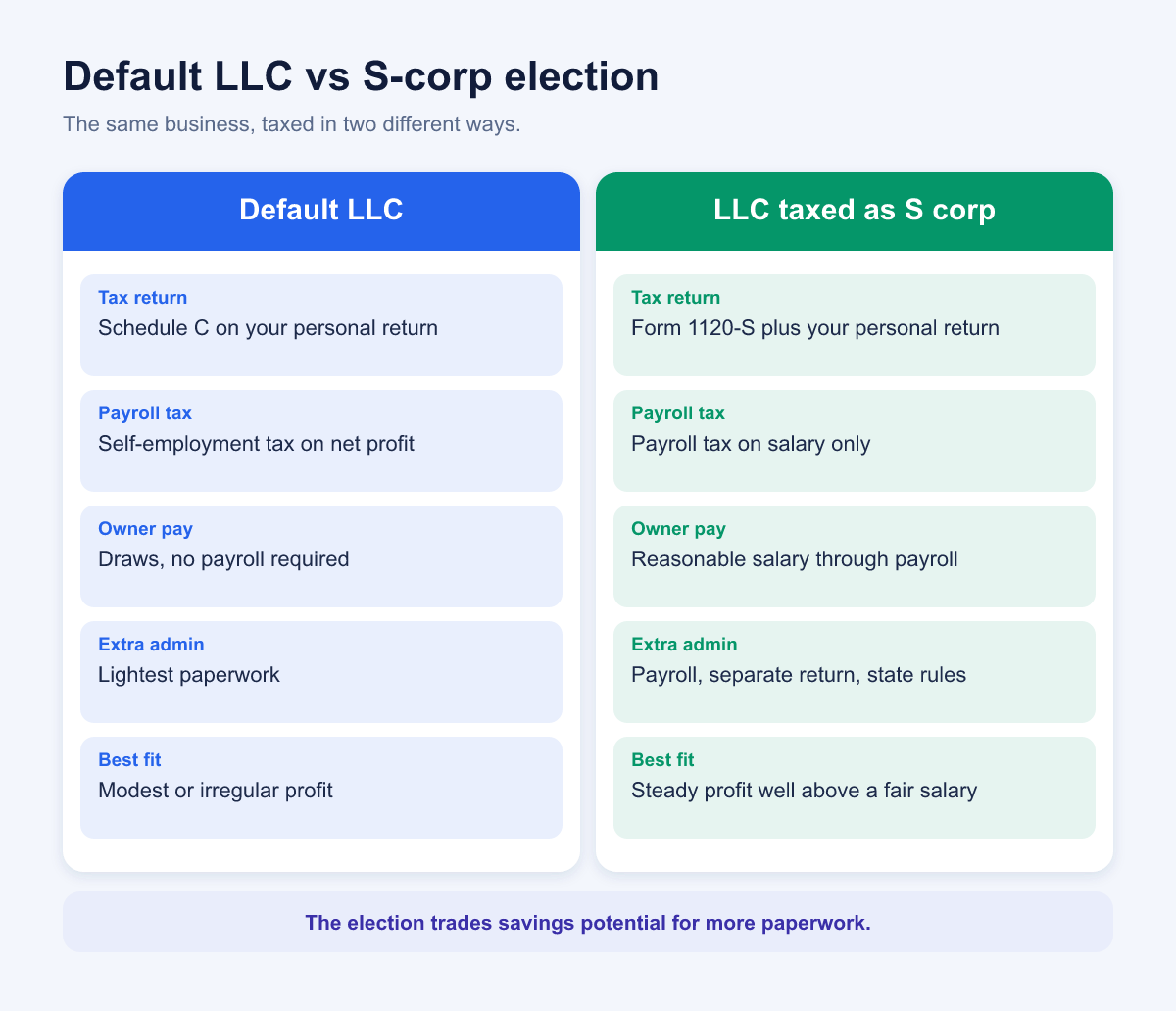
The comparison above covers five rows. Here they are in the same order, with the nuance the graphic cannot show.
- Tax return. A default single-member LLC reports on Schedule C of your personal return. With the S election, the business files Form 1120-S, the U.S. income tax return for an S corporation, and you receive a Schedule K-1 showing your share of income, which you report on your personal return alongside your W-2 wages from the business. You file both.
- Payroll tax. The default LLC owner pays self-employment tax on net profit (92.35% of it, at 15.3%). With the election, Social Security and Medicare taxes apply to the salary you pay yourself; distributions are not subject to those taxes.
- Owner pay. The default LLC owner simply takes draws; no payroll is required. The S-corp owner who works in the business must run a reasonable salary through payroll first.
- Extra admin. The default setup is the lightest in paperwork. The S corp adds payroll, a separate federal return and whatever your state requires, covered in the next section.
- Best fit. A default LLC usually suits modest or irregular profit. The S election is generally considered when profit is steady and well above what a fair salary for your work would be.
What the election adds: payroll, filings and fees
The extra work is the part that is easiest to underestimate. The IRS charts for S corporations list the filings that can apply. The table below summarizes them in general terms; your situation may involve more or fewer.
| Item | Default single-member LLC | LLC taxed as an S corp |
|---|---|---|
| Business income reported on | Schedule C (Form 1040) | Form 1120-S, with a Schedule K-1 to you; K-1 income goes on your Form 1040 (Schedule E) |
| Payroll filings | None for yourself | Employment tax returns (Form 941 or 943) and federal unemployment tax (Form 940), plus Form W-2 for your wages |
| Estimated tax | Form 1040-ES covers income tax and SE tax | Shareholders may still need Form 1040-ES for income tax on K-1 income not covered by withholding |
| Bookkeeping | Business income and expenses | Payroll records, shareholder distributions, a clear line between business and personal money |
| State level | Depends on your state | Depends on your state; some states add entity-level taxes or fees, covered below |
In practice, that means choosing a payroll provider or a bookkeeper who can run payroll, depositing payroll taxes on schedule, issuing a W-2 and preparing a corporate return each year. It also means a dedicated business bank account and disciplined bookkeeping, because distributions and salary need a clear paper trail. We are not quoting prices here, since they vary by provider and by state; the useful exercise is to get quotes for your own situation and subtract them from any estimated savings.
Good records matter well before payroll starts, so if your bookkeeping is loose today, tighten it up first. Also keep in mind that once you pay yourself wages, employer-side costs beyond Social Security and Medicare, such as unemployment taxes, can apply, and the simple example below ignores them.
Who can elect, and when to file Form 2553
Eligibility
Per the IRS, to qualify as an S corporation the corporation must meet the following requirements: be a domestic corporation; have only allowable shareholders (individuals, certain trusts and estates, but not partnerships, corporations or nonresident alien shareholders); have no more than 100 shareholders; have only one class of stock; and not be an ineligible corporation, such as certain financial institutions and insurance companies. For most freelancers who are the only owner, the shareholder and stock rules are easy to meet, but keep them in mind if you add partners or investors later.
How an LLC makes the election
The election is made on Form 2553, Election by a Small Business Corporation, signed by all shareholders. According to the Form 2553 instructions, a domestic entity eligible to elect to be treated as a corporation, which includes an LLC, can use Form 2553 to make the election, and if it meets the tests and files on time it is treated as a corporation as of the effective date and does not need to file Form 8832 separately.
Timing
The instructions say Form 2553 should be filed no more than 2 months and 15 days after the beginning of the tax year the election is to take effect, or at any time during the tax year before the year it is to take effect. The instructions also describe relief for late elections in certain circumstances. Because a missed deadline may require a relief request, timing is worth confirming with a tax professional before you file, particularly if your business started recently or you use a non-calendar tax year.
A hypothetical worked example
Hypothetical example, for illustration only. Three freelancers run single-member LLCs. We compare only the self-employment tax of a default LLC with the Social Security and Medicare tax on an assumed S-corp salary, using the IRS rates described above. The assumed salaries are round numbers chosen for the example; they are not guidance on what a reasonable salary is for any business.
Assumptions: all figures are annual; "net profit" means profit before any pay to the owner; default LLC tax = 15.3% × 92.35% × net profit; S-corp payroll tax = 15.3% × salary (employer and employee shares combined); amounts are rounded to the nearest dollar.
| Hypothetical net profit | Assumed salary | SE tax as default LLC | Payroll tax on salary (S corp) | Difference before extra costs |
|---|---|---|---|---|
| $60,000 | $42,000 (70%) | $8,478 | $6,426 | $2,052 |
| $100,000 | $60,000 (60%) | $14,130 | $9,180 | $4,950 |
| $150,000 | $75,000 (50%) | $21,194 | $11,475 | $9,719 |
What the table shows is the pattern, not a promise. The gap widens as profit rises above a fair salary, and it is small when profit is modest. All amounts above are below the Social Security wage base the IRS page lists (for 2024; it changes annually), so the cap does not come into play here.
What this simplification leaves out
- Extra costs. Payroll service, corporate return preparation, state fees and your own time are not subtracted. A $2,052 gap can disappear entirely once real costs are counted.
- Income tax. Distributions are still taxed as income. The deduction for half of SE tax in the default case, and the employer-side payroll tax deduction in the S-corp case, both slightly change income tax; we ignore both.
- Unemployment taxes. The IRS lists federal unemployment tax (Form 940) as a possible S-corp filing; your state may add its own unemployment tax and employer requirements.
- State effects. Some states tax S corporations and LLCs differently, as described below.
- Reasonable salary. The share of profit that counts as reasonable compensation is a fact-based question. A higher salary shrinks the saving.
Side effects: health insurance, retirement, QBI and state rules
The S election touches more than payroll tax. Here are the main side effects, in general terms.
| Area | What can change | Where to check |
|---|---|---|
| Health insurance | For an owner of more than 2% of the stock, premiums paid by the S corp are generally reported as wages on Form W-2 (not subject to Social Security or Medicare tax if paid under a qualifying plan), and a deduction may be available if conditions are met. | IRS page on S corporation compensation and medical insurance issues |
| Retirement plans | Some plan types set contribution limits as a percentage of compensation, so a lower salary can mean lower allowed contributions. Rules differ by plan type. | IRS page on retirement plans for self-employed people; your plan provider |
| Qualified Business Income (QBI) deduction | The IRS describes QBI as including income from S corporations and sole proprietorships, but amounts received as reasonable compensation from an S corporation are not QBI. Limits depend on taxable income and other factors. | IRS QBI deduction page; your tax professional |
| Social Security record | Wages subject to Social Security tax are what is credited to your earnings record. Lower wages may mean a different record than higher self-employment earnings would. | ssa.gov |
| State rules | Entity-level taxes, annual fees and the treatment of an S-corp election differ by state, so the federal picture may not match what you owe locally. | Your state tax and secretary of state websites |
The QBI deduction deserves a special mention because it interacts with the salary decision. The IRS page says the QBI component equals 20 percent of qualified business income and is subject to limitations. Because reasonable compensation from an S corporation is excluded from QBI, the interaction between your salary level, your payroll-tax savings and the deduction depends on your taxable income and the rules for your type of business. It is a question for a tax professional rather than a rule of thumb.
For health coverage questions around self-employment more generally, our guide on marketplace vs employer health plans may help frame the options.
Before you elect: five checks
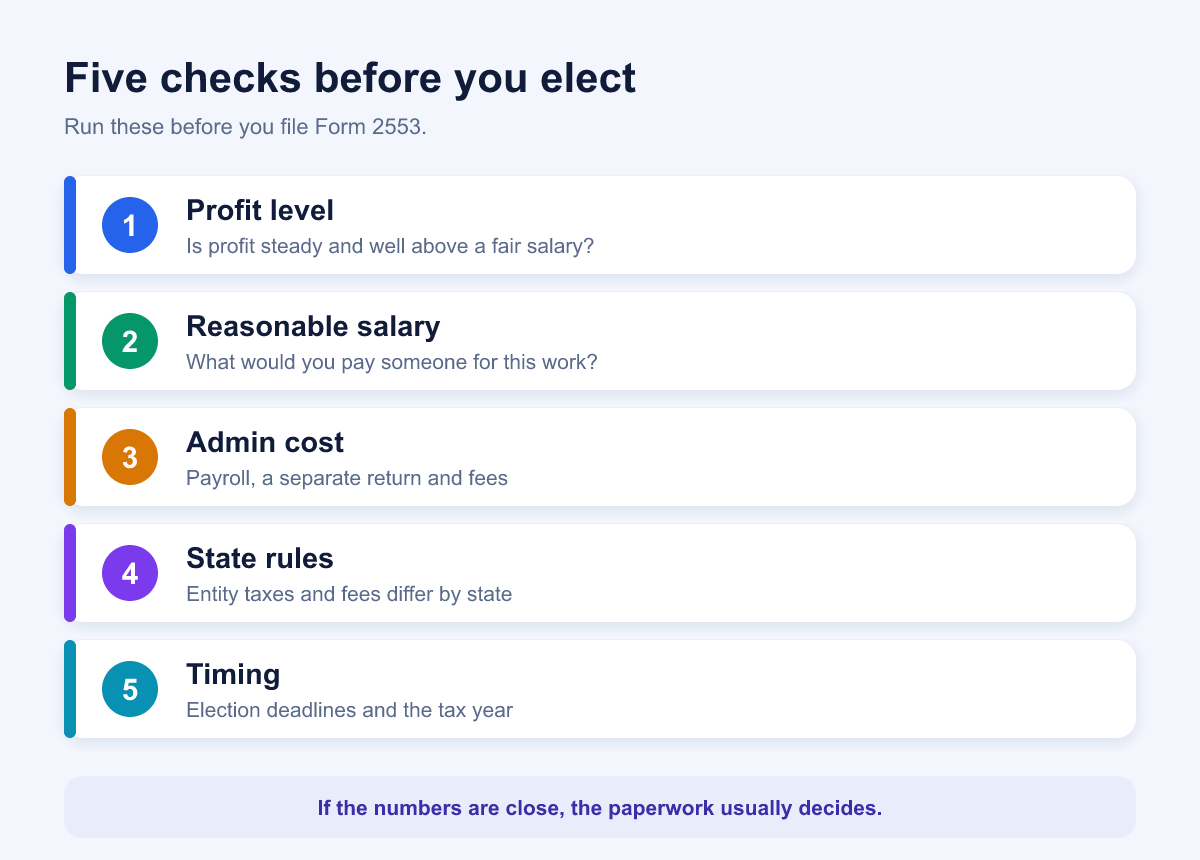
These checks follow the order in the graphic above. If any one of them is shaky, pause before filing.
- Profit level. Is profit steady and well above a fair salary for your work? If profit swings from year to year, or barely exceeds what you would pay someone to do the job, the savings may not exist in a lean year while the fixed costs still do. Look at at least a couple of years of real numbers, not your best month.
- Reasonable salary. What would you pay someone for this work? Use the IRS factors listed earlier: your duties, experience, time spent and what comparable businesses pay. Write down how you reached the figure. If the number you want is far below that comparison, that is a warning sign, not a plan.
- Admin cost. Add up payroll, a separate return and fees, then compare them with the estimated payroll-tax difference. The election makes sense only if the savings clearly exceed the cost and effort.
- State rules. Entity taxes and fees differ by state. Check your state's tax agency and business-registration office for the rules that apply to an LLC taxed as an S corp where you operate.
- Timing. The election has deadlines tied to the tax year, as described earlier. Make sure the date you want the election to take effect and the date you file line up, and that your payroll can start when the election does.
Common mistakes and questions for your CPA
Common mistakes
- Paying yourself no salary or a token salary. The IRS can reclassify distributions as wages. If that happens, payroll taxes that should have been paid on that pay can come due.
- Electing too early. A business that has just started, or that earns modest profit, can pay more in administration than it saves. Starting with the default LLC and revisiting the question once profit is steady is a common approach.
- Mixing personal and business funds. Paying personal bills from the business account makes it hard to tell salary from distributions, and it can weaken the separation an LLC is meant to provide.
- Ignoring state rules. Some states charge entity-level taxes or fees that can offset the federal saving, or treat the election differently.
- Skipping payroll deposits and filings. Once you are an employer, deposit and filing deadlines apply to you personally.
- Treating the election as a quick toggle. Filing the form is easy, but changing course later can bring its own rules and tax consequences. Confirm your plan with a tax professional before you file, not after.
Questions to ask a CPA or enrolled agent
- Based on my last two years of profit, what would my payroll-tax difference look like, after costs?
- What salary range is defensible for the work I do, and how should I document it?
- What does my state add for an LLC taxed as an S corp?
- How would the election affect my health insurance, retirement contributions and QBI deduction?
- What effective date should I choose, and by when must Form 2553 be filed?
- Who runs payroll, and who files the corporate return and K-1?
If you are an LLC owner whose business holds rental property, the entity question is different again; see our comparison of an LLC vs a land trust for rental property.
In summary
- An LLC is a state-law entity; an S corp is a federal tax election. An LLC can elect S-corp treatment on Form 2553.
- A default single-member LLC reports on Schedule C and pays self-employment tax: 15.3% on 92.35% of net earnings, per the IRS.
- With the election, you pay yourself a reasonable salary through payroll; distributions are not subject to employment taxes but remain subject to income tax.
- The saving comes from profit above a fair salary. It shrinks or disappears when profit is modest or costs are high.
- The election adds payroll, Form 1120-S, a Schedule K-1, a separate account and often state-level rules.
- Eligibility: domestic, one class of stock, allowable shareholders, no more than 100.
- Timing: Form 2553 is generally due within 2 months and 15 days after the start of the tax year the election takes effect, or during the preceding year.
- Check profit level, reasonable salary, admin cost, state rules and timing before you file.
This guide is general information, not tax, legal or financial advice. Rules, forms and amounts change, and your state may add its own requirements. Confirm details on the official pages below and with a qualified tax professional who knows your situation before making an election.
Frequently asked questions
Is an LLC the same thing as an S corp?
No. An LLC is an entity created under state law. An S corp is a federal tax classification for a corporation that elects pass-through treatment. An LLC can be taxed as an S corp if it meets the requirements and files the election, but the two terms describe different things.
Can an LLC be taxed as an S corp?
Yes. The Form 2553 instructions say an entity eligible to elect to be treated as a corporation, including a domestic LLC, may elect S status by timely filing Form 2553 if it meets the other tests. Under those instructions, it is treated as a corporation from the effective date and does not need to file Form 8832 separately.
Do I have to pay myself a salary if I elect S-corp status?
If you work in the business, yes. The IRS says S corporations must pay reasonable compensation to a shareholder-employee for services provided before non-wage distributions may be made, and the IRS can reclassify distributions as wages. The IRS lists factors rather than a fixed percentage.
Are S-corp distributions tax-free?
No. The IRS refers to non-wage distributions as not being subject to employment taxes, but profit still flows through to your personal return and is taxed at your individual income tax rates. The election mainly changes the payroll-tax side, not the income-tax side.
When do I have to file Form 2553?
Per the instructions, no more than 2 months and 15 days after the beginning of the tax year the election is to take effect, or at any time during the preceding tax year. Relief for late elections exists in some situations, so talk to a tax professional if you have missed a date.
Will an S corp always save me money?
No. The potential saving depends on how much profit exceeds a reasonable salary, and it has to cover payroll, filing and state costs. With modest or irregular profit, a default LLC is often simpler and may cost less overall. Use your own numbers, ideally reviewed by a tax professional, rather than a general rule.
Sources
- IRS: S corporations
- IRS: Single member limited liability companies
- IRS: Topic no. 554, Self-employment tax
- IRS: Topic no. 751, Social Security and Medicare withholding rates
- IRS: S corporation compensation and medical insurance issues
- IRS: Instructions for Form 2553, Election by a Small Business Corporation
- IRS: Qualified Business Income Deduction
- IRS: Retirement plans for self-employed people