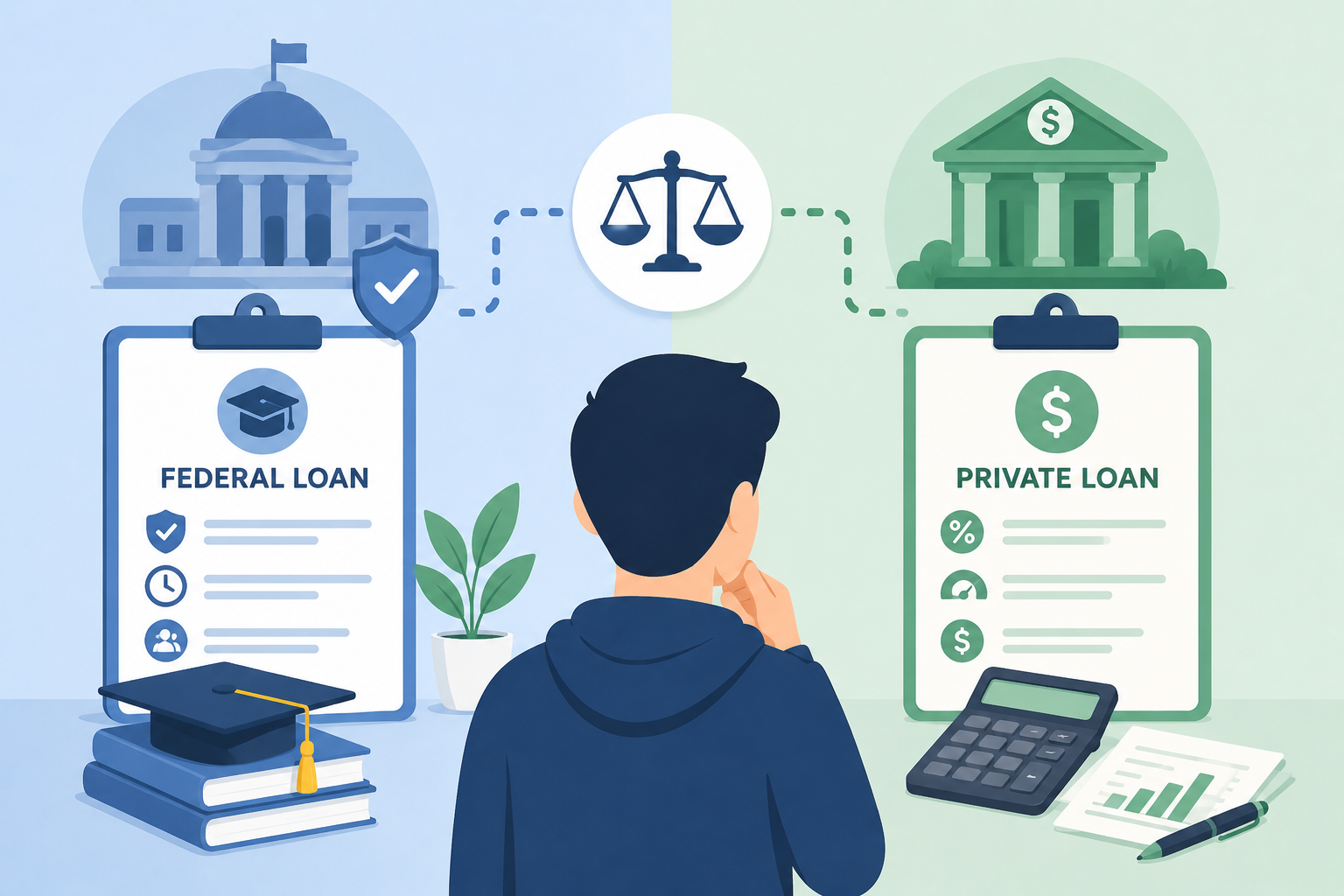
Student loan debt affects a huge share of American households, and the decisions made about which loans to take out, how to structure repayment, and whether to pursue forgiveness or refinancing options can affect a borrower's finances for a decade or more after graduation. Yet the distinction between federal, meaning public, student loans and private student loans, and the very different rules that govern each, remains poorly understood by many borrowers until they are already deep into repayment and discover their options are more limited than they assumed. This guide breaks down exactly how each type of loan works, what protections and forgiveness programs are actually available, and how to make an informed decision at every stage, from borrowing through repayment.
Related reading: If you are already repaying loans and considering your options, compare student loan refinancing between federal and private lenders, and if you are juggling other debts too, see whether a debt snowball or debt avalanche method saves you more.
How federal student loans work
Federal student loans are issued directly by the U.S. Department of Education and come in several forms, most commonly Direct Subsidized Loans, available to undergraduate students with demonstrated financial need, where the government pays the interest while the borrower is in school at least half time, and Direct Unsubsidized Loans, available to both undergraduate and graduate students regardless of financial need, where interest accrues from the moment the loan is disbursed. Graduate and professional students, along with parents of undergraduate students, may also access Direct PLUS Loans, which require a credit check but not the extensive underwriting typical of private lending.
Federal loan interest rates are set annually by Congress and are fixed for the life of the loan, meaning every borrower who takes out a federal loan in a given academic year receives the identical interest rate regardless of their individual credit history or income. This is fundamentally different from private lending, where rates are determined by an individual credit assessment.
How private student loans work
Private student loans are issued by banks, credit unions, and specialized private lenders, and unlike federal loans, they are underwritten based on the borrower's, or a cosigner's, credit history, income, and overall creditworthiness. This means interest rates on private loans can vary significantly from one borrower to the next, and can be either fixed or variable, with variable rates fluctuating based on an underlying benchmark rate over the life of the loan. Most undergraduate students, having limited credit history and income, need a creditworthy cosigner, frequently a parent, to qualify for a private loan at a reasonable rate, and that cosigner remains legally responsible for the debt if the student borrower fails to make payments.
The critical differences in repayment flexibility
This is where the gap between federal and private loans becomes most significant for real world financial planning. Federal loans offer several income driven repayment plans, which calculate a monthly payment based on the borrower's income and family size rather than the loan balance, with any remaining balance forgiven after a set number of years of qualifying payments, typically 20 to 25 years depending on the specific plan and loan type. These plans can reduce monthly payments dramatically for borrowers with lower income relative to their debt, sometimes to as little as zero dollars per month for borrowers below a certain income threshold, while still counting as a qualifying payment that moves the borrower closer to eventual forgiveness.
Private student loans almost never offer income driven repayment in the way federal loans do. Most private lenders offer only a standard fixed repayment schedule, though some offer limited hardship forbearance options for borrowers experiencing temporary financial difficulty, typically allowing a short pause or reduction in payments for a matter of months, not the multi decade income based structure available on the federal side.
Public Service Loan Forgiveness and other federal forgiveness programs
One of the most valuable federal only benefits is Public Service Loan Forgiveness, available to borrowers with Direct Loans who work full time for a qualifying government or nonprofit employer and make 120 qualifying monthly payments, typically under an income driven repayment plan, after which the remaining loan balance is forgiven entirely, tax free under current federal law. Teachers may also qualify for Teacher Loan Forgiveness, offering a smaller forgiveness amount after five consecutive years of qualifying teaching service in a low income school, though borrowers generally cannot receive benefits from both programs for the same period of service. None of these forgiveness programs are available to private student loan borrowers under any circumstances, since they are federal programs tied specifically to the federal loan system.
A side by side comparison of key features
| Feature | Federal student loans | Private student loans |
|---|---|---|
| Interest rate determination | Fixed annually by Congress, same for all borrowers in a given year | Based on individual or cosigner credit, can be fixed or variable |
| Income driven repayment | Available, with forgiveness after 20 to 25 years | Generally not available |
| Public Service Loan Forgiveness eligibility | Eligible if Direct Loans | Not eligible |
| Deferment and forbearance options | Extensive, including economic hardship and unemployment deferment | Limited, varies significantly by lender |
| Credit check required | Not required for most loans (except PLUS loans) | Required, often needs a cosigner for undergraduates |
| Discharge in death or total disability | Automatically discharged | Varies by lender, not guaranteed |
When refinancing private or federal loans might make sense
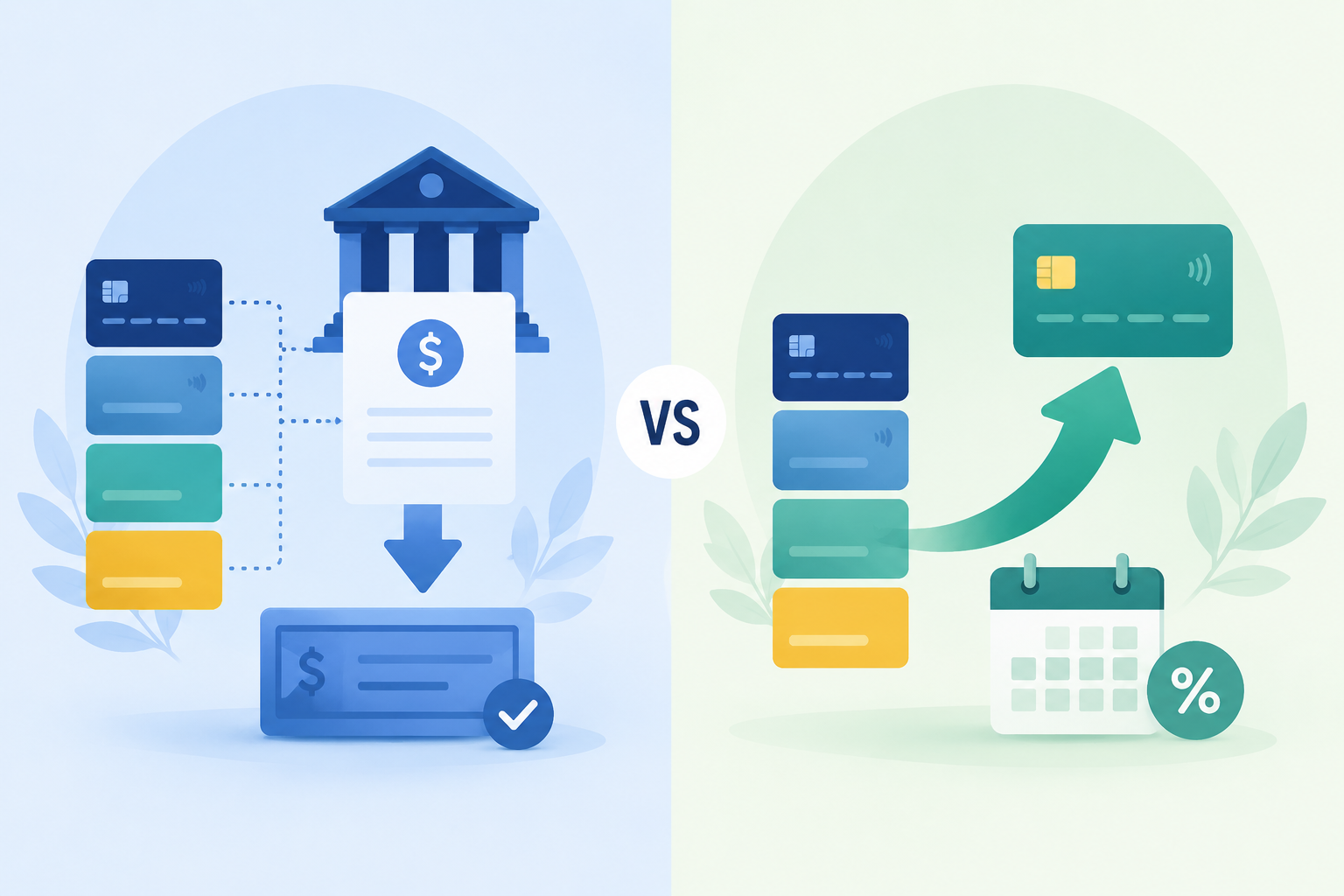
Refinancing involves taking out a new private loan to pay off one or more existing loans, potentially at a lower interest rate if the borrower's credit and income have improved since originally borrowing. Refinancing federal loans into a private loan can make sense purely from an interest rate perspective for borrowers with strong, stable income and excellent credit who are confident they will never need income driven repayment or Public Service Loan Forgiveness, since refinancing federal loans into a private loan permanently forfeits access to every federal protection and forgiveness program described above, a decision that cannot be reversed once completed. This makes refinancing federal loans a decision that deserves considerable caution, particularly for borrowers in public service careers, borrowers with unstable income, or borrowers who want to preserve the safety net that federal repayment plans provide during unexpected financial hardship.
Refinancing existing private loans into a new private loan, by contrast, carries none of this trade off, since no federal protections are being forfeited, and can be a straightforward way to secure a lower interest rate if the borrower's credit has improved since originally borrowing, without giving up anything of comparable value.
A worked example comparing standard repayment to an income driven plan
Consider a borrower with 60,000 dollars in federal loans at a 6 percent interest rate, earning 45,000 dollars annually as a single person. Under the standard 10 year repayment plan, the monthly payment would be approximately 666 dollars, with total payments of roughly 79,900 dollars over the full term. Under an income driven repayment plan calculating payments based on a percentage of discretionary income, the same borrower might pay closer to 200 to 250 dollars per month initially, rising gradually as income grows over the repayment period, with any remaining balance forgiven after the plan's specified forgiveness period, commonly 20 to 25 years, though the borrower may ultimately pay more in total interest over that longer period if the balance is not fully repaid before forgiveness, and any forgiven amount under most income driven plans, outside Public Service Loan Forgiveness, may currently be treated as taxable income in the year of forgiveness under existing law, a detail worth confirming with a tax professional given how frequently this specific rule has changed in recent years.
How cosigner release works on private loans
Many private loans allow the primary borrower to apply for cosigner release after making a specified number of consecutive, on time payments, commonly 24 to 36 payments, along with demonstrating sufficient independent income and credit to qualify for the loan without the cosigner. This process is not automatic and must be actively requested and approved by the lender, and a borrower who misses even a single payment during the qualifying period typically must restart the entire consecutive payment count from zero. Cosigners should understand before agreeing to cosign that they remain fully legally liable for the debt until a formal release is granted or the loan is paid off entirely, and that the debt, along with any missed payments, appears on the cosigner's own credit report throughout that period.
How loan servicers can complicate the repayment experience
Regardless of whether a loan is federal or private, borrowers interact directly with a loan servicer, a company responsible for billing, processing payments, and administering benefits like income driven repayment or forbearance, and servicers are periodically reassigned or sold to a different company, sometimes with little advance notice to the borrower. This transition can occasionally result in lost paperwork, incorrect payment counts toward forgiveness programs, or temporary confusion about which repayment plan is currently active, which is why maintaining personal, independent records of every payment made and every recertification submitted, rather than relying solely on the servicer's own records, has proven valuable for borrowers who later needed to dispute an inaccurate payment count, particularly for those pursuing Public Service Loan Forgiveness over a period as long as ten years, during which a servicer change is common.
How to decide between federal and private loans when a funding gap remains
Even after maximizing federal loan eligibility, many students face a remaining funding gap between financial aid and the actual cost of attendance, and choosing how to fill that gap deserves the same careful comparison shopping applied to any major financial decision. Comparing interest rates, repayment flexibility, and cosigner release provisions across several private lenders, rather than simply accepting the first offer from a lender recommended by the school's financial aid office, can meaningfully reduce the total cost of the remaining gap. Parent PLUS loans, a federal option available to parents of undergraduate students, are also worth comparing directly against private parent loans, since Parent PLUS loans, despite typically carrying a higher interest rate than federal student loans, still retain federal protections like deferment options and eventual eligibility for federal consolidation, which most private lenders do not match.
How loan consolidation differs from refinancing
Federal loan consolidation, offered directly through the Department of Education, combines multiple federal loans into a single Direct Consolidation Loan with a new interest rate calculated as the weighted average of the original loans, rounded up to the nearest one eighth of one percent. Unlike refinancing through a private lender, consolidation does not lower the interest rate and does not require a credit check, but it can simplify repayment by combining multiple loans into a single monthly payment, and it can also make loans that were previously ineligible for certain income driven plans or Public Service Loan Forgiveness, such as older Federal Family Education Loan Program loans, eligible after consolidation into a Direct Consolidation Loan. Borrowers should understand this distinction clearly before assuming that consolidating and refinancing are interchangeable terms, since confusing the two has led some borrowers to unintentionally forfeit federal protections by refinancing with a private lender when their actual goal was simply to combine several federal loans into one convenient payment.
Common mistakes borrowers make with student loans
- Refinancing federal loans into a private loan without fully appreciating the permanent loss of income driven repayment and forgiveness eligibility.
- Choosing a longer standard repayment term or forbearance to reduce monthly payments without understanding how much additional interest accrues over the extended period.
- Not recertifying income annually for an income driven repayment plan, which can result in being switched to a standard payment calculated on the full balance if recertification is missed.
- Assuming any employer, not just qualifying government and nonprofit employers, counts toward Public Service Loan Forgiveness eligibility.
- Cosigning a private loan without understanding the full extent of personal liability involved, or without confirming a cosigner release option exists and its specific requirements.
- Ignoring loan servicer communications during the grace period after graduation, missing the opportunity to select the most appropriate repayment plan before the first payment comes due.
Frequently asked questions
Can private student loans be discharged in bankruptcy?
Both federal and private student loans are generally difficult to discharge in bankruptcy, requiring the borrower to prove undue hardship through a specific and demanding legal standard, though recent years have seen somewhat more successful discharge outcomes for some borrowers as courts have applied this standard somewhat more flexibly than in the past. This remains one of the most difficult forms of debt to eliminate through bankruptcy regardless of loan type.
Does taking out private loans affect my eligibility for federal loans or aid?
No, having private loans does not affect your eligibility for federal student aid, though most financial aid counselors recommend exhausting federal loan eligibility first, given the superior repayment protections and forgiveness options, before turning to private loans to cover any remaining funding gap.
What happens to my student loans if I become permanently disabled?
Federal student loans offer a Total and Permanent Disability discharge program that can eliminate the remaining balance entirely upon proper documentation and application. Private loan treatment of disability varies significantly by lender, with some offering similar discharge provisions and others offering no such protection at all, making it worth reviewing a private lender's specific disability provisions before borrowing.
Is it better to pay off student loans early or invest the extra money instead?
This depends heavily on the loan's interest rate relative to expected investment returns, the borrower's other financial priorities such as an emergency fund and retirement contributions, and whether the loan offers valuable protections, like income driven repayment or forgiveness eligibility, that the borrower would want to preserve rather than aggressively pay down.
Can I switch between different federal repayment plans over time?
Yes, federal loan borrowers can generally switch repayment plans at any time by contacting their loan servicer, which can be useful if income changes significantly, though switching plans can sometimes affect progress toward loan forgiveness under a specific plan, so it is worth confirming how a switch affects your specific forgiveness timeline before making a change.
Does making extra payments toward federal loans affect progress toward forgiveness?
Under most income driven repayment plans working toward forgiveness, making only the required monthly payment, rather than paying extra, is generally the better strategy if forgiveness is genuinely the goal, since any balance forgiven at the end of the qualifying period is simply eliminated regardless of its size, meaning extra payments in that scenario reduce the eventual forgiveness benefit rather than saving money overall.
Final takeaway
Federal and private student loans may look similar on a monthly statement, but the protections, flexibility, and forgiveness possibilities attached to each are dramatically different, and understanding these differences before borrowing, and again before refinancing, is one of the most consequential financial decisions many young adults make. Federal loans generally offer superior borrower protections and should typically be exhausted before turning to private lending, and any decision to refinance federal loans into a private loan deserves careful, deliberate consideration given how permanent and irreversible that trade off actually is. Reviewing your specific loan types, current repayment plan, and long term career path at least once a year, rather than leaving repayment on autopilot for a decade, is the simplest habit that keeps a borrower's options open and their total cost as low as possible.